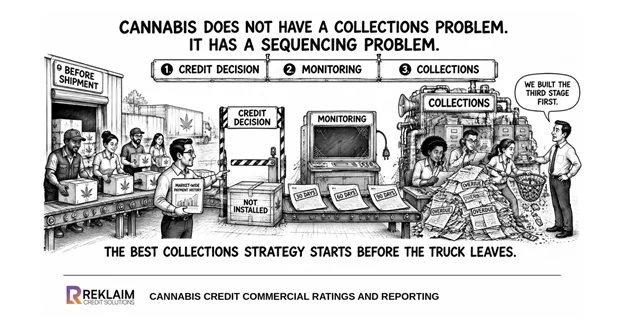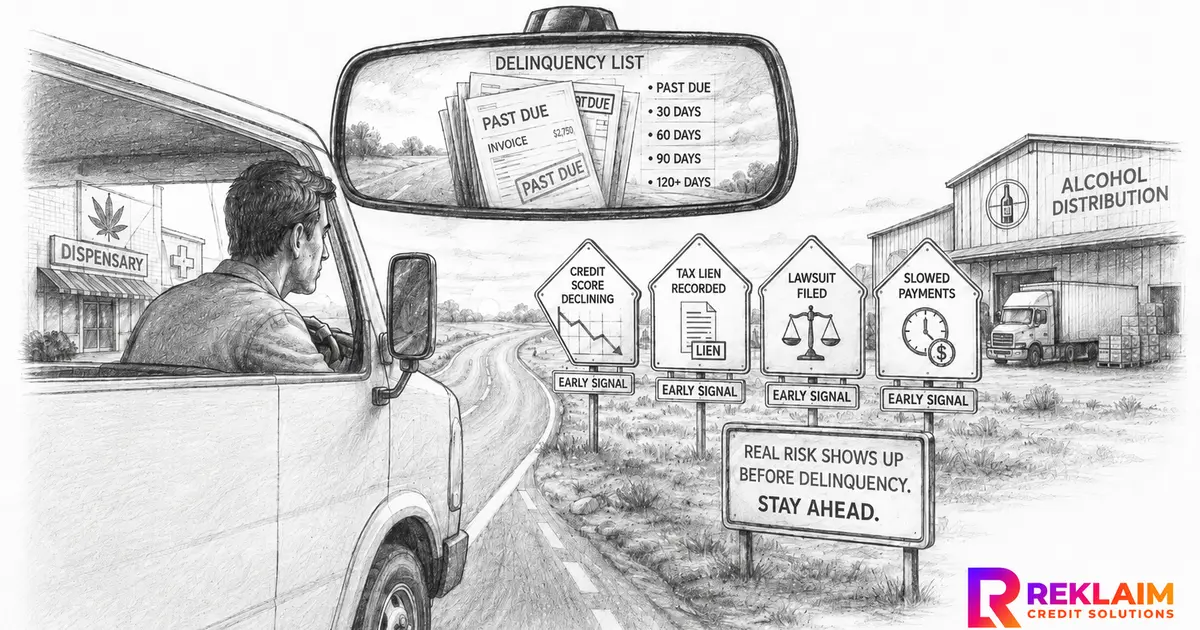


A rearview mirror is a great tool. It just can’t tell you what’s coming. That’s the problem with scoring built on collection data.
Collection data is a record of AR that already went bad. By the time a receivable lands in collections, the relationship has failed.
The terms broke.
The $$ are late or gone.
That information is real, and it matters. But it is a record of the past.
Now stack a “credit score” on top of it.
A collection file only contains counterparties who defaulted. Everyone who paid on time, every clean relationship that worked as intended, is missing from the dataset. You are building a prediction engine from a sample that excludes the outcome you actually care about: who pays on time.
You can’t learn what good looks like from a file that only keeps the bad.
Aggregating more collection data does not fix this. It raises the resolution of the rearview mirror.
You still cannot see the road in front.
Predicting future payment behavior is a different discipline entirely. It requires data on the full population, performing accounts and failing ones. It requires modeling the patterns that separate them before the failure shows up. It requires treating credit as a forward-looking question, not a backward-looking ledger.
This is the line we keep drawing at Reklaim Credit Solutions.
We are building a commercial credit rating and reporting agency for the cannabis industry.
The foundation is a contributory network where operators share DE-IDENTIFIED accounts receivable aging data.
The full picture, on-time and late, performing and stressed. That data feeds the Reklaim Credit Solutions proprietary computational engine, which compounds the value of each contributor.
The whole is worth more than the sum of the parts.
We use an ensemble model with best-of-breed neural networks and machine learning, refreshed each reporting cycle against prior history, to return credit score and credit limit guidance as operational intelligence to our accountholders and subscribers.
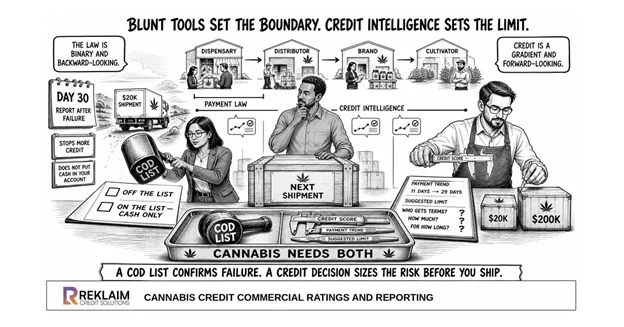
In plain English, Reklaim Credit Solutions provides how much credit is reasonable to extend to a counterparty. You benefit from your own AR history combined with other operators doing business with the same counterparties.
Coverage gets wider as more operators contribute.
The view of each counterparty gets deeper.
The signal sharpens.
Collection data has a place. When a relationship has already broken, recovery is the job, and the firms who do it well earn their keep. That work is necessary.
It is just not the same thing as credit intelligence.
One looks backward at the accounts that failed. The other looks forward at the accounts you are about to extend terms to.
Confusing the two is how an operator ends up trusting a clean-looking counterparty that no model ever flagged, because the data was never built to flag it.
In a market this young, with terms this tight, that distinction is not academic. It is the difference between getting paid and chasing it.