
Cannabis Does Not Have a Collections Problem. It Has a Sequencing Problem.
The industry has built infrastructure for what happens after an invoice goes bad, and almost nothing for what happens before the truck leaves the dock. That sequence is backwards, and it explains most of what operators describe as a cash flow crisis.
Cannabis Credit Risk: What the Market Data Shows
The pressure is measurable at the top of the funnel. Whitney Economics reported in March 2026 that 2025 brought the first year-over-year revenue decline in the legal market’s history.
It attributed it to price compression (or what I like to call “price rationalization”) rather than lost demand. Unit volumes held. Prices did not. Its 2026 forecast calls for roughly $30.5 billion in legal revenue, up about 4.9%, with single-digit growth described as the new normal.
Wholesale pricing tells the same story. The Cannabis Benchmarks Spot Index put flower near $1,007 per pound in January 2026, after trading between roughly $888 and $1,096 through 2025. Of course, indoor, mixed and outdoor all vary almost monthly by state.
California, the largest market, reported legal sales of roughly $3.9 billion in 2025, a third consecutive annual decline, and Headset’s tracked average item price fell from $18.89 in April 2025 to $17.91 in April 2026.
Read More: Credit and Sales in Cannabis
None of that is new. Operators were describing slow pay as a normal cost of doing business by 2023, and by 2024 New York had written a COD delinquency rule directly into its regs. The pattern has been developing for years.
What has not developed is measurement.
There is no 2025 or 2026 industry-wide estimate of delinquent accounts receivable in cannabis.
In almost every industry on the planet, a number like that is refreshed quarterly by an institution(s) whose job is to measure it. Cannabis has never had one, and not for lack of data. The data sits in the silos of AR aging reports for every operator in silos in every state. It has simply never been pooled at scale.
Why Cannabis Accounts Receivable Gets Paid Late
The regulated supply chain converts cash slowly but consumes it quickly.
- Cultivators fund labor, power, rent, and testing months before a buyer pays.
- Processors buy biomass and packaging before a batch is released.
- Distributors arrange testing, storage, and compliant transfers before a retailer remits.
- Retailers carry inventory, rent, payroll, and taxes before consumer cash cover any of it.
At every stage, the party shipping on terms is financing the next stage’s operating cycle.
Revenue is not cash until the customer pays. That holds in any industry, but cannabis compresses the timeline and, as I’ve written about in the past, removes most of the shock absorbers other industries use to bridge the gap. Cost bases are fixed and committed to early. Realized prices fall later. The difference lands on whoever is holding the receivable.
Read More: KPI’s for Cannabis Credit
The same cash shortfall is now visible from the other side of the balance sheet. Gold Flora, a large California operator, was placed into receivership in March 2025. Another multistate operator transferred more than sixty dispensaries and two state operations to a creditor vehicle over roughly $410 million in debt.
The Cannabist Company received Chapter 15 recognition in May 2026, believed to be a first for a U.S. cannabis operator, with roughly $270 million still owed to lenders at the time of filing.
A community bank disclosed in its third quarter 2025 results that it had charged off $12.7 million on a single $34 million cannabis loan and described its remaining cannabis portfolio as carrying elevated credit risk.
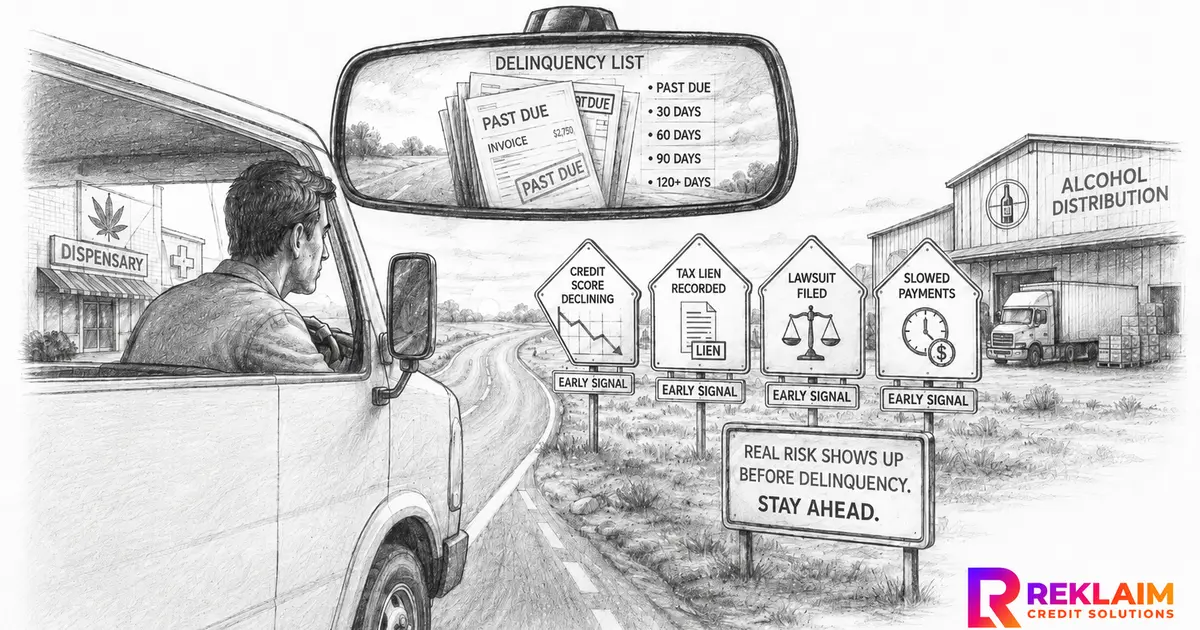
Distress of that kind rarely arrives without warning. We believe it shows up first in payment behavior, in the aging reports of the companies that sold to those operators, well before any court filing or lender disclosure. Term loans have to wait for defaults. Vendors can stop new shipments if they can read the signals early.
Read More: Cannabis Accounts Receivable: When to Use Payment Plans vs. Third-Party Collections
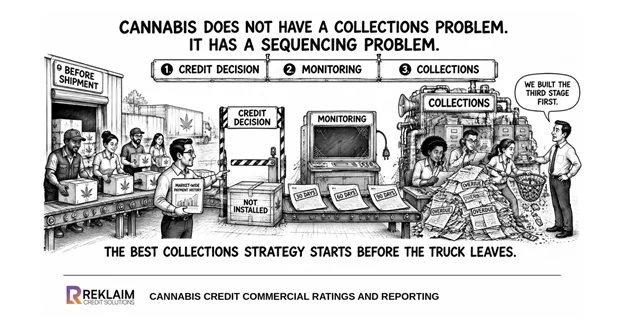
The Three Stages of Cannabis Credit Risk Management
Every trade credit relationship has three decisions that have to be made:
Before shipment: do we extend terms, and for how much? That is the credit decision.
Through the aging window: is this counterparty’s behavior changing while our exposure is open? That is monitoring.
After the invoice ages: how do we recover what is owed? That is collections.
Cannabis has built around the third point. Collection firms exist. State payment rules exist. Both do useful work. The first question has largely been handled by instinct, a reference call, and how badly the seller wanted the order. The second question has often been handled by noticing that a check did not arrive.
By the time an invoice is 90 days old, you are not making a credit decision. You are very likely managing a loss.
How New York’s Cannabis COD List Works
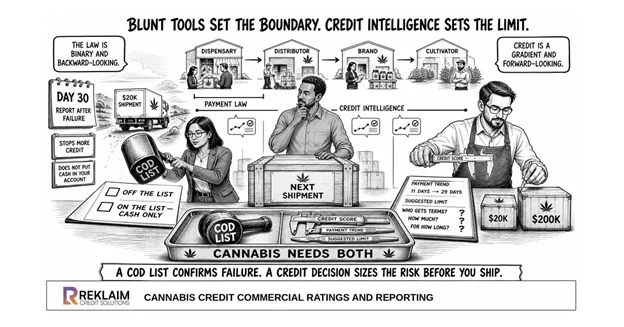
New York’s delinquent payment rule is a good rule, and it illustrates the gap precisely. Retailers buying on credit must pay within 30 days of delivery. If they do not, the supplier is “required” to report them to the Office of Cannabis Management within seven days.
The retailer then goes on a cash-on-delivery list, updated weekly, and no supplier in the state may extend it credit until every reporting supplier confirms payment in full. Suppliers are expected to check the list before selling on terms.
Read More: The Cannabis COD List: Blunt Tools, Not Surgical Instruments
That works as designed. It limits the next transaction across the market once a default has been reported. It does not protect a supplier who just shipped to the newly minted COD retailer. It does not pay the original supplier’s payroll, rent, or upstream vendor. The loss already happened.
A rule that governs future credit is not a substitute for knowing something about the counterparty before the first shipment. Both are needed. Only one currently exists.
Why Cannabis Suppliers Still Extend Trade Credit
Operators share some version of this: “We did not ship on terms because I lacked information. We shipped because if we didn’t, that retailer would have bought from someone else.”
That is true, and, on it’s face, it is the strongest argument against everything above. In an oversupplied market, terms stop being an underwriting decision and become a competitive concession. Right now, we have an oversupply almost everywhere.
But, I don’t think that the logical conclusion is to continue shipping. If the account was never going to pay, the sale was never revenue. It was a gift of inventory then disguised as an unsecured loan, at a price you did not set, on a term you did not underwrite, with no collateral.
Every invoice is an extension of unsecured trade credit whether or not anyone treats it that way.
When that buyer takes the order down the street, your competitor absorbs the write off. Losing a customer who does not pay is not a lost sale. It is a transferred loss.
That reframe only works if you know which accounts belong in which category. Without that, “we might lose the order” is an argument for shipping to everyone.
How Better Credit Data Changes the Sequence
Reklaim Credit Solutions is a commercial credit rating agency purpose built for the state regulated cannabis industry. We operate as a contributory network.
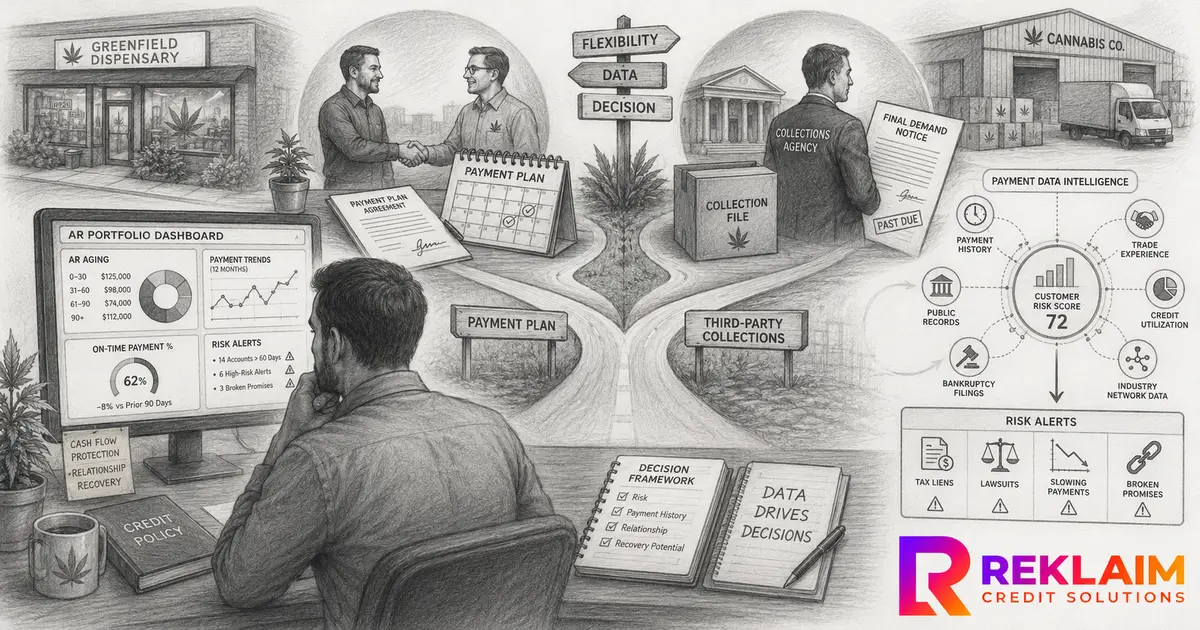
Operators contribute AR aging data, the full picture of how counterparties pay on a state by state basis, from on time payers to slow payers to deeply stressed non-payers, and they receive trade credit scores, suggested credit limits, full commercial credit reports, and continuous AR monitoring.
All contributed data is de-identified immediately upon ingestion, with no attribution back to the contributing party.
Our proprietary ensemble neural network models are trained on that contributed data and improve as the network grows in width across the industry and depth per counterparty. Reports also draw on public records, including regulatory compliance, judgments, tax liens, and UCC filings.
Three things we do not do, by design. We do not collect. We do not lend. We do not factor. A rating is only worth something if the agency has no interest in whether an account scores high or low.
The major commercial credit agencies have not touched this industry. We have built Reklaim to fill that gap, and we are onboarding subscribers and ingesting their AR aging data now.
The Decision
Before extending terms to a new account, ask what you know about how that account pays everyone else. Not how it pays you, which tells you about one relationship. How it pays the market.
If the answer is nothing, you are not extending credit. You are guessing, at scale, with your own working capital. The best collections strategy has always started with a better credit decision.
Frequently Asked Questions
What is cannabis trade credit?
Cannabis trade credit is credit a supplier extends when it delivers product before receiving payment. If a cultivator, processor, distributor, or brand ships an order on Net 15, Net 30, or another payment term, that supplier is financing the buyer until the invoice is paid.
That matters because an unpaid invoice is not just an accounts receivable issue. It is unsecured credit exposure. The supplier has already delivered inventory and is now relying on the customer to pay according to the agreed terms.
What is cannabis credit risk management?
Cannabis credit risk management is the process of deciding which customers should receive credit, how much credit they should receive, and whether their risk changes while invoices remain outstanding.
There are three distinct stages: making the credit decision before shipment, monitoring the account while exposure is open, and collecting the debt after an invoice becomes delinquent. Collections matter, but they are the last stage of the process. By that point, the supplier has already taken the risk.
What should a cannabis supplier check before offering Net 30 terms?
Before offering Net 30 terms, a supplier should understand how the customer has historically paid other vendors, review available commercial credit information, set an appropriate credit limit, and look for factors that could affect the customer’s ability to pay.
That review can include trade payment history, credit scores, existing exposure, judgments, tax liens, UCC filings, and regulatory information. The goal is not simply to decide whether to approve the account. It is to decide how much unsecured exposure the supplier is willing to carry if the customer stops paying.
A reference call can help, but it should not be the entire credit process. The article’s central point is that extending terms based primarily on instinct or the desire to win an order leaves the supplier making a financial decision without enough information.
What is cannabis credit monitoring?
Cannabis credit monitoring means continuing to evaluate a customer after the initial credit decision instead of assuming that an approved account will remain a good account.
A customer’s financial condition and payment behavior can change while invoices are still open. A retailer that once paid consistently may begin paying suppliers more slowly, carry larger balances, or show other signs of financial pressure.
Monitoring gives the supplier a chance to review the account while it can still change future terms, reduce exposure, adjust a credit limit, or stop additional shipments. Waiting until an invoice reaches collections means many of those decisions have already been made.
How does New York’s cannabis COD list work?
New York requires cannabis retailers that purchase inventory on credit to pay within 30 days of delivery. If a retailer fails to pay within that period, the supplier must report the delinquency to the Office of Cannabis Management within seven days.
The retailer can then be placed on the state’s cash-on-delivery, or COD, list. While the retailer remains on that list, other suppliers cannot continue extending credit. Suppliers are expected to check the list before selling on terms. The restriction remains until the reporting suppliers confirm that they have been paid in full.
The COD system helps prevent a delinquent buyer from continuing to accumulate trade credit across the market. It does not protect the supplier that already shipped the unpaid order. That is why a COD list and pre-shipment credit management solve two different problems.