
Consolidation has a bad name in cannabis. It is usually described as something being done to the industry rather than something the industry is doing, and the small operator is cast as the inevitable casualty.
We think both halves of that framing are wrong.
Consolidation is what a distressed industry does in order to stop being distressed or what a smart capitalist does when they see an opportunity that others have missed. It is the mechanism by which excess capacity leaves, fixed costs come down, and productive assets move from operators who cannot support them to operators who can. Ethanol, regulated gaming, and the airlines all went through some version of it. In each case, the industry that came out the other side was arguably healthier than the one that went in, and in each case that happened without waiting for demand to rescue anyone.
But what happens to the small operator?
The answer is that it depends entirely on what kind of operator the small operator is.
A small operator running a scaled-down version of a large operator’s business model likely does not survive consolidation in any industry. A small operator running a different business model, with a different cost structure, serving demand that scale cannot serve profitably, survives consolidation routinely. And, while many resist any comparisons of cannabis to alcohol, from a business perspective, American brewing is the clearest example.
The consumer question is counterintuitive. Consolidation of the channel, meaning retail and distribution, does not necessarily reduce what is on the shelf. In several industries, it actually led to the expansion of what was on the shelf, because a professional purchasing organization with real logistics can carry more products across more markets than the same number of independent operators each carrying what the owner/buyer/budtender happens to like.
None of this is automatic. A transaction that does not remove capacity, lower unit costs, improve utilization, or repair a balance sheet does not create a healthier industry. It creates a larger financially weak company.
What is Cannabis Consolidation?
Consolidation happens through two distinct mechanisms, and combining them can confuse.
The first is combination. Mergers, acquisitions, asset purchases, and the joining of operating businesses.
The second is a forced exit. Bankruptcy, receivership, closure, liquidation, or any other removal of a competitor and its productive capacity from the market because of choices of their own self doing.
The United States Department of Transportation described exactly this pair of issues when discussing airline restructuring, noting that consolidation can occur through the exit of failed companies or through combinations of successful companies. Both count towards consolidation.
Both likely remove capacity.
Only one of them makes headlines.
Does this matter for cannabis? Yes, because most cannabis consolidation to date has been the second kind. License counts have been generally declining for years without a corresponding wave of large mergers. That is still consolidation. It is simply the quieter form of it, and, until recently, it was doing most of the work.
Cannabis does not have too many companies. It has too much capacity.
The most useful comparison here is ethanol, because ethanol shows how fast a policy-created market can build more production than it can support.
The Federal Trade Commission reported that as of September 2007 there were 103 firms producing ethanol in the United States, an increase of roughly 13 firms in one year and roughly 28 over two years. One year later, the FTC counted 160 producing firms, an increase of 57 in a single year.
Over the same period, the largest producer’s share of domestic production capacity fell from approximately 41% in 2000, to 26% in 2005, 21% in 2006, 16% in 2007, and 11% in 2008. In 2009, the FTC again counted approximately 160 firms, with the largest still at roughly 11%.
Read those two series together. The number of producers grew rapidly while the largest producer’s share collapsed. That is not a market being taken over. That feels very much like a market being flooded by capital responding to policy and perceived opportunity faster than demand could absorb it.
Sound familiar?
Cannabis did the same thing, state by state by state, for the same reasons. Capital arrived because policy created a market and capital chased a perceived opportunity. Capital builds physical things. Cultivation canopy, extraction rooms, kitchens, packaging lines, and buildout. Those things do not un-build themselves when wholesale prices fall.
Maybe the question is not how many cannabis companies there are. It is how much of the cultivation and manufacturing capacity constructed during the abundant-capital years is economically viable at current wholesale prices, and what happens to the part that is not. And why do new state markets do their hardest to make the same mistakes?
The concept I think focuses on is capacity rationalization. If a dozen facilities in a state are each running well below efficient utilization, consolidation can allow that production to migrate into fewer facilities running closer to capacity. The economic gain comes from removing redundant fixed cost, not from removing corporate entities. An acquisition that keeps every facility open and every overhead line intact has not rationalized anything.
There is one way cannabis is meaningfully harder than ethanol. Ethanol is part of a national market. Product moves across state lines, and supply rebalances geographically. State-legal cannabis cannot do that, so overcapacity in one state does not relieve tightness in another (diversion and inversion aside).
Cannabis capacity rationalization has to happen state by state, market by market, which makes it slower and more painful than the ethanol comparison.
It also means the small operator’s competitive picture is set by conditions, rules, regulations and consumer demand inside its own state, not by national headlines.
An industry can actually get healthier without selling more.
I think that this is the single most important consideration for any operator currently waiting on demand growth, federal reform, or the collapse of the “unregulated” market to fix their economics.
The airlines proved it can be done the other way.
The DOT described the early 2000s as a period of major restructuring. After consecutive losses from 2001 through 2005, the industry returned to modest profitability in 2006 and 2007, then ran smack dab into rapidly rising fuel prices and the global financial crisis. DOT reported that 2008 and 2009 were among the most difficult years in US aviation history, with operating revenue for the nine largest carriers down 17% year over year during the recession.
The response was not a demand story. Carriers cut costs, managed capacity, restructured through bankruptcy, grounded and removed aircraft, exited the industry, and combined. DOT specifically named Aloha Airlines, ATA Airlines, Skybus, MAXjet, and EOS Airlines as examples of consolidation through company exit. Remember, when they all went down, many travelers in many places considered each of them their “favorite” airline. Not enough, it turns out.
Then look at what happened next. In 2010, DOT reported that eight of the nine largest airlines had either reduced capacity or held it constant while all nine increased revenue year over year. Their combined first-quarter operating result improved from a loss of more than $1b in the first quarter of 2009 to a small operating profit in the first quarter of 2010, excluding special items (please don’t get me started again on “Adjusted” EBITDA)
Less capacity. More revenue. A swing of more than a billion dollars in a single quarter as demand rose.
DOT described the economic objective of successful airline consolidation in terms that translate almost directly to cannabis: lower costs, the ability to compete profitably at relatively low prices, improved efficiency, and rationalization of high-cost capacity.
The structural parallel is real. An airline seat that departs empty cannot be stored and sold tomorrow, which creates enormous pressure to fill capacity at almost any price, hopefully without training consumers on the less expensive pricing.
Cannabis cultivators and manufacturers carry high fixed costs against a product whose value degrades over time and has regulatory set expiration dates, which creates the same pressure by a different route.
In both cases, the rational individual decision, sell it for whatever it brings rather than let it expire, produces an irrational collective outcome when everyone tends to make it at once.
Capacity leaving the market helps break that cycle.
Not enforcement, not legalization, not a marketing campaign.
Capacity leaving the market. Not necessarily SKUs. Mergers of smaller, inefficient operations are a viable option that many cannabis operators are pursuing.
For the cannabis operator, the practical translation looks like this:
- Closing inefficient cultivation.
- Consolidating manufacturing into fewer facilities.
- Eliminating duplicative corporate overhead.
- Consolidating distribution infrastructure.
- Moving licenses and operating assets from insolvent operators to better-capitalized owners.
- Reducing uneconomic production.
- Raising utilization at whatever survives.
None of that is pleasant while it is happening. All of it is what recovery looks like from the inside.
The license is the asset, and consolidation is how it reaches someone who can use it.
Regulated gaming is also a close structural analogue to cannabis, because in both industries the permission to operate has often has economic value independent of the physical property.
Casino operators face state licensing, jurisdiction-specific regulation and taxation, regulatory review of owners and operators, restrictions on ownership transfers, and regulatory oversight of mergers, acquisitions, recapitalizations, and financial restructurings.
New Jersey’s Division of Gaming Enforcement describes its Office of Financial Investigations as evaluating complex financial transactions involving casino businesses, including mergers and acquisitions, bankruptcy reorganizations, recapitalizations, spin-offs, expansions, and major debt issuances.
Any cannabis operator who has made a change-of-ownership filing through a state regulator will recognize all of that quickly.
New Jersey’s own official history records that Harrah’s acquisition of Showboat in 1998 was the start of a period of casino-industry consolidation in Atlantic City, and that history documents the repeated financial restructuring among the weaker casinos while it was going down. The Sands filed for Chapter 11 reorganization.
During the 2008 and 2009 downturn, the Tropicana property went through a regulatory-controlled sale process after its casino license was not renewed, the owners of Resorts Casino Hotel turned the property over to its banks, and Trump Entertainment filed for bankruptcy reorganization again.
Earlier, in 2004, Trump Hotels and Casino Resorts announced a restructuring under which majority equity control would pass to holders of more than 1.3 billion dollars of first-mortgage-note debt through a pre-negotiated Chapter 11 process.
That is a decade of assets moving from operators who could not carry them to parties who, in theory, could, under regulatory supervision, through a mix of sales, lender takeovers, and reorganizations.
It is exactly the process cannabis is now entering, and, guess what, Atlantic City still exists.
Read More: Credit and Sales in Cannabis
Two lessons for cannabis
The first is that a limited license attached to an asset changes what the asset is worth and who is permitted to buy it. A cultivation facility in California cannot transfer its California license and its production capacity to New York.
Regulatory approval determines who can acquire a licensed business and how the transaction has to be structured. This slows consolidation, and it also protects incumbents in ways that are easy to forget. Not every well-capitalized buyer can easily walk into a state and buy its way to scale.
The second lesson might be the most relevant to the small cannabis operator, and it comes from what happened to Atlantic City after the consolidation.
New Jersey subsequently found that expanded casino competition in surrounding states had drawn customers away, and four of the twelve casino properties operating in the city closed.
But, here’s the thing: the properties that closed were among the largest and most heavily capitalized in the market.
What beat them was not a bigger casino. It was a nearer one. Smaller regional properties, closer to where people actually lived, took the business.
Scale lost to proximity. Hold that thought. Anyone with a dispensary in a border town already is.
Cannabis consolidates through different machinery, which changes the shape and the speed but not the direction.
3 structural conditions distinguish cannabis from all 3 of the above industry comparisons, and they are the reason cannabis consolidation looks messier than the historical precedents from other industries.
The first is the absence of interstate commerce. State cannabis markets operate as separate regulatory systems with their own licensing, permitted activities, cultivation and manufacturing rules, retail rules, ownership requirements, taxes, product requirements, and enforcement.
Because marijuana remains federally prohibited (medical on S3 changes the tax consequences, not the legality), excess supply in one state cannot naturally move to a state where supply is tighter.
Cannabis is not one national market working through one imbalance. It is a few dozen markets each working through its own.
The second is federal taxation. Yes, 280E.
The third is bankruptcy access. Plant-touching marijuana businesses have historically had very limited access to federal bankruptcy protection, on the reasoning that federal courts and trustees generally cannot administer businesses whose operations violate the federal Controlled Substances Act.
This is not a small difference. Airlines and casinos used Chapter 11, which allowed them to automatically stay creditors, restructure debt, renegotiate obligations, recapitalize, and keep operating while they fixed themselves.
Chapter 11 is not primarily a recovery mechanism. It is a mechanism for making an ugly outcome orderly and predictable in advance, with a stay, priority rules, disclosure, and a process everyone can price against.
Cannabis distress instead resolves through state receiverships, secured-creditor remedies, Article 9 sales, assignments for the benefit of creditors, negotiated restructurings, and asset sales. Those tools work. They are faster in some respects and far less transparent in others, and they are not designed around the visibility of trade creditors.
The practical consequence for a supplier is that when a counterparty fails in this industry, there is generally no stay, no administrative priority for goods delivered in the final weeks, no reclamation, no critical vendor motion, and no court-supervised disclosure.
Secured lenders and taxes are almost certainly going to get paid first. Yes, some state receiverships provide some of these protections, but it is not the same as Federal bankruptcy protection.
That does not stop consolidation. It changes who bears its cost.
In the airline and casino cases, a meaningful share of restructuring cost was absorbed by an orderly legal process. In cannabis, more of it lands on the supplier who shipped product on terms and finds out late that no money is flowing back to them.
This is the reason the small operator’s survival question is ultimately a credit and efficiency question rather than a scale question.
Read More: The Forth C of Credit – Conditions
The 2026 tax split is now itself a consolidation driver, and this one is new.
Section 280E of the Internal Revenue Code denies deductions and credits for ordinary business expenses incurred in trafficking Schedule I and Schedule II controlled substances, with COGS treated separately. For more than a decade, it applied to essentially the entire state-legal cannabis industry, and it has no equivalent in the ethanol, gaming, or airline comparisons.
That changed partially, and only partially, in 2026 when a federal order moved cannabis subject to a qualifying state medical marijuana license from Schedule I to Schedule III.
Because 280E reaches only Schedule I and Schedule II substances, the order removes the 280E deduction disallowance for state-licensed medical activity on a going-forward basis, and it established an expedited DEA registration pathway for qualifying medical licensees.
What that will mean going forward is really anyone’s guess. The order also expressly states that nothing in it constitutes a determination regarding federal tax liability, and licensees are advised to consult tax counsel. Whether any retrospective relief follows is a separate question that has been raised but not resolved.
State authorized adult/recreational cannabis was not included. It remains Schedule I, and 280E continues to apply to it. We are all eagerly awaiting the final conclusions from the recently concluded administrative law hearing on the broader rescheduling of all marijuana to Schedule III.
If that process completes favorably, 280E relief would extend to the adult-use market as well. Legal challenges are expected regardless of outcome, and most/all will still be operating illegally. Any operator planning on that outcome is planning on a forecast, not a fact.
Now consider what the current situation does to competitive structure.
A dual-license operator selling the same plant into two channels is now operating under two different federal tax regimes simultaneously and must defensibly allocate shared expenses between them. That is a real and non-trivial compliance exercise. It rewards operators with tax departments, sophisticated cost accounting, and counsel. It penalizes single-site operators doing their own books.
Two counterparties of similar size in similar markets can now generate materially different after-tax cash depending on license type and state program. Credit assessments and competitive assumptions built on category averages rather than counterparty-level evidence are likely to be wrong more often than they used to be.
Arguably, this is a temporary structural advantage to scale, and a genuine one while it lasts. It is also the clearest illustration that consolidation pressure in cannabis is not primarily a market phenomenon. It is a policy phenomenon, the same way the ethanol buildout was.
A consolidated buyer is a better counterparty, if you can see it.
What consolidation delivers on the commercial side matters, because the operational benefits are real and they are often skipped over in the rush to worry about “leverage”.
Fewer, larger counterparties mean fewer stops and bigger drops. It means purchasing organizations that forecast rather than guess, that hold to a planning calendar, that have someone whose actual job is inventory, and that can be reached by a human being when something goes wrong. It means lower cost to serve per unit of revenue. It means a supplier can plan production against something other than hope.
Those capabilities were less common in this industry five years ago. They exist now because specific operators invested in building them under conditions that made building them difficult and expensive. Consolidation in cannabis is not something happening to the industry. It is being led, and largely by the people who did the work in the industry.
But let’s also be clear about an important fact that I’ve written about in the past: concentration transfers working capital risk from buyer to seller.
Eight independent accounts of one unit each become 1 account of 8 units, and diversification within a customer base does not survive consolidation of that customer base. A receivables book that looked diversified on Monday can be concentrated on Tuesday without a single new sale being written.
Concentration is not inherently bad. But, I would argue that unmeasured concentration is.
A supplier who knows that one counterparty represents 22% of trailing revenue and 31% of open receivables can make decisions about it, including pricing decisions. A supplier who has never run the calculation carries the identical risk with none of the awareness.
Every sale on terms is a credit decision. A business loan to a financial stranger. That is true in a fragmented market, and it is easier to ignore there.
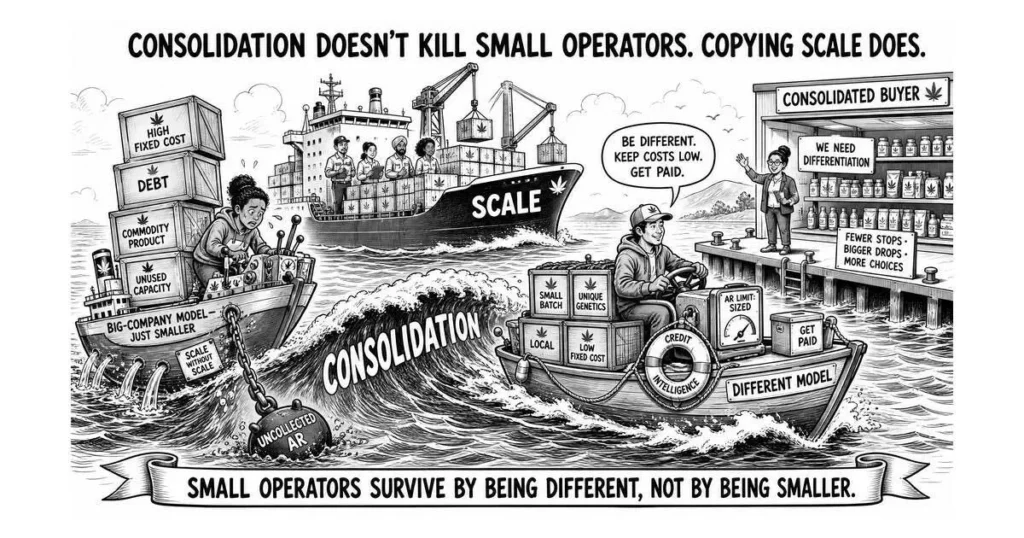
Small operators survive consolidation by being different, not by being smaller.
This is my central argument. It does require focusing on what the three historical comparisons do and do not prove.
They show that consolidation improves industry economics. They do not prove that small operators survive it. In each of those industries, plenty did not. The airlines DOT named as exits were not all small. Four Atlantic City properties closed. Ethanol’s independent producers were absorbed or shut.
So we should be precise about the mechanism, because the mechanism is what determines who survives.
A small operator running a scaled-down version of a large operator’s business model is going to have a very tough time surviving consolidation in any industry. That operator is competing directly on unit cost against a competitor with a structural cost advantage, and unit cost is exactly what consolidation improves for the other side. There is no version of that fight that ends well, and pretending otherwise does the small operator no favors. If this is you, find a merger partner, increase scale, refine operations, or you might face an unpleasant reckoning.
A small operator running a genuinely different business model survives consolidation routinely, and in some industries thrives specifically because of it.
The cleanest precedent is, yes, American brewing.
American brewing consolidated to a degree cannabis has not remotely approached. Over several decades, hundreds of regional brewers disappeared into a handful of national companies, and by the late 1970s the number of operating breweries in the United States had fallen to roughly the level of a small trade association membership. That was the low point. What followed was one of the most durable small-business expansions in American industry, ending with more than nine thousand breweries operating in the country.
The reason it happened is the part that matters here.
The national brewers optimized relentlessly for scale. Consistency across enormous volume, national distribution, mass-market taste, and the lowest possible cost per barrel. Those optimizations were genuine achievements, but they were also constraints. A company built to produce one product at extraordinary volume cannot economically produce four hundred products at small volume.
Its cost advantage in the first case is a cost disadvantage in the second.
That gap was not a niche the giants failed to notice. It was a niche their own structure prevented them from serving profitably. The small brewer did not out-compete the large brewer. It occupied ground the large brewer’s economics could not reach.
The Atlantic City evidence points in the same direction from a different angle. What took business from the largest and most heavily capitalized casino properties in the country was not a larger, newer, more opulent property. It was proximity, in the form of smaller regional casinos closer to where customers lived and offering a very similar product. The winning attribute was not scale. It was a different attribute entirely, one the large property could not replicate.
We would read the airline history the same way.
The consolidation of the legacy carriers, and the cost discipline it forced on them, coincided with room for carriers operating on entirely different cost structures and route logic to establish themselves. Different model, not a smaller version.
From that, some lessons for cannabis, maybe.
Compete on cost structure, not on scale.
Consolidation punishes high fixed cost more than it punishes small size. The operator most exposed in a consolidating market is frequently the mid-size one, carrying facility overhead and corporate structure sized for a growth plan that did not arrive, without either the scale to absorb it or the flexibility to shed it. A smaller operator with genuinely lower fixed costs can survive price levels that bankrupt a larger competitor. That is not a consolation prize. In a capacity-rationalizing market, it is a very durable position.
Occupy what scale cannot serve profitably.
Small batch. Genetics that do not yield well enough to interest a large cultivator. Regional identity. Product formats with real demand and unattractive volume. High-touch categories. In cannabis specifically, the fact that consumers can and do distinguish between cultivars, growing methods, and producers is an enormous structural advantage for the small operator, and it is an advantage the commodity industries in this paper never had. Nobody has ever asked for a specific farm’s ethanol. Of course, if you’ve taken on outside capital, you are likely being pushed in a different direction. Think about pivoting now, before it’s too late.
Be the supplier the consolidator needs rather than the competitor it fights.
A consolidated retailer’s commercial problem is differentiation. A chain of two hundred and sixty stores carrying the same national products as every other chain of two hundred and sixty stores has competed itself into interchangeability, which is a bad position in retail, and the smart operators know this. The solution to that problem is products the other chain does not have, which is to say, products from operators too small to supply everyone. Scale creates the demand for the thing scale cannot produce. This is not sentiment. It is how the chain protects its own margin.
Get paid.
This is the mechanism that actually determines survival, and it is the one least discussed (not by me, of course).
Small operators in consolidating industries fail far more often from working capital than from competitive displacement. The pattern is consistent. The counterparty gets larger. Terms stretch, sometimes contractually and more often informally, where the stated terms remain net 30, and the behavior drifts to N55 and then to N70 without anything being renegotiated or announced.
The option to stop shipping to a slow payer, which is a real and disciplining remedy in a fragmented market, becomes theoretical once that payer represents a quarter of volume. And when a consolidated buyer fails, it does not take down one supplier. It can take down every supplier that served it, at the same moment, none of whom have liquidity to absorb it because all of them were financing the same buyer.
A small operator with a strong product, a low cost base, and an uncollected receivable is a small operator that is about to close. Cash trapped in receivables cannot be reinvested, and receivables are assets right up until they are losses.
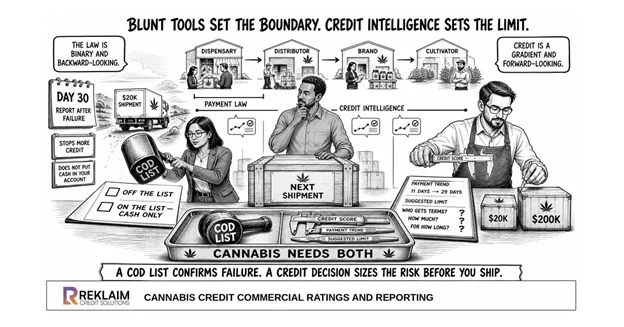
The defensible position is not to refuse credit.
Refusing credit in this market means refusing revenue.
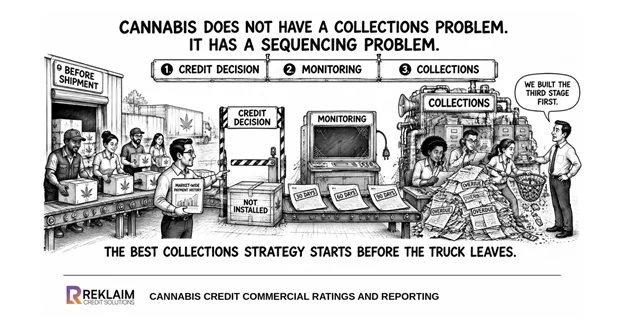
The defensible position is to size exposure deliberately rather than let it accumulate order by order, to price terms rather than simply grant them, and to see payment behavior deteriorating while it is still deteriorating rather than when you were sitting in the back of the room at the receivership hearing.
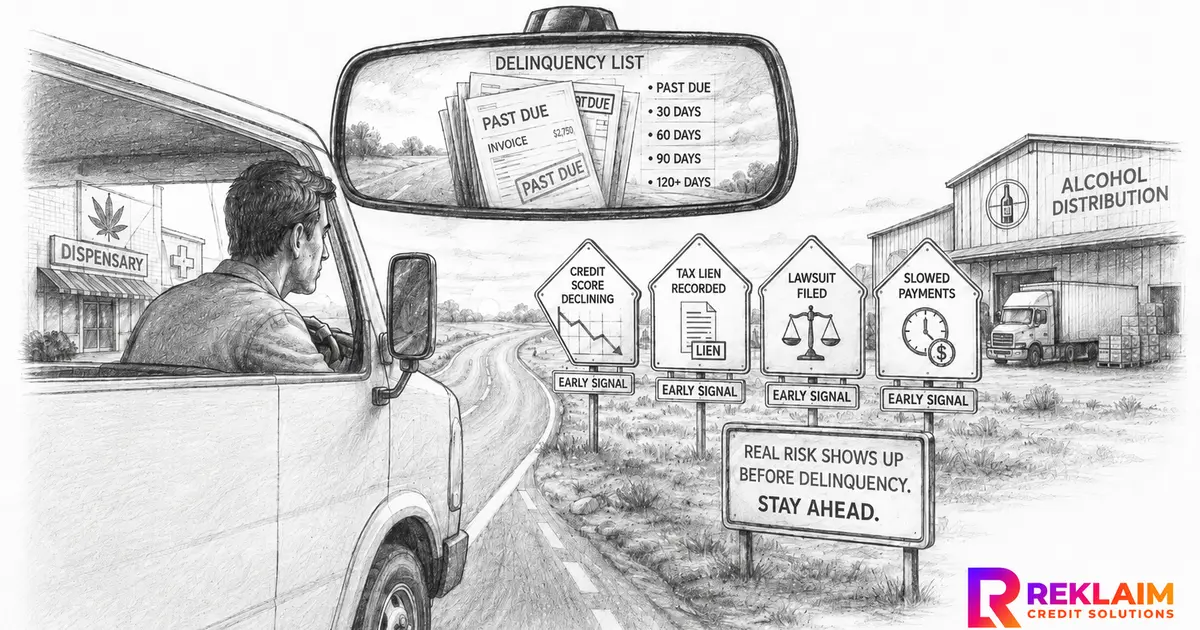
Delinquency rarely appears overnight. Counterparties show payment stress long before default, usually against several suppliers at once, and usually before their behavior toward any single supplier changes enough for that supplier to notice.
Even if you have leverage because you control shelf space, a counterparty that is current with you and stretching with everyone else is the most dangerous position in any receivables book.
It is invisible from inside one ledger but visible across many. That is the entire premise on which contributory commercial credit networks are built, and it is what Reklaim Credit Solutions has built for this industry.
Keep the option to sell.
Consolidation creates buyers where none might have existed. An operator with clean books (dare I say audited?), verifiable payment behavior, defensible margins, and a differentiated product has an exit that did not exist in a fragmented market, and has it on better terms than an operator who arrives at the negotiation in distress.
Surviving consolidation and being acquired during consolidation are both acceptable outcomes.
Being acquired in a fire sale is a different outcome, and the difference between them is usually decided eighteen months earlier by ordinary financial discipline.
The consumer can get more choice, not necessarily less.
This might feel counterintuitive. The conventional expectation is that consolidation reduces competition, which reduces variety and raises prices. In many industries and many circumstances, that expectation is 100% correct, and I am not arguing that concentration is costless.
The distinction to consider is between consolidation of producers and consolidation of the channel.
Cannabis consolidation is happening most visibly in retail and distribution. Consolidation of the channel does not reduce the number of products available. It changes who decides which products reach shelves and how efficiently they get there.
A professional purchasing organization operating in multiple states with real logistics and efficient category management can carry more products, in more places, than the same number of independent stores each stocking what the owner happens to prefer and can pay for.
American brewing again supplies the evidence. The period during which more than nine thousand breweries came into existence was not a period of fragmented distribution. It was a period in which consolidated distribution and consolidated retail made it possible for a brewery producing a few thousand barrels to reach a shelf several states away.
Consolidation of the channel, along with self-distribution (a topic for another article), is what made the proliferation of producers commercially viable. Without it, most of those breweries would have remained taprooms serving local customers only.
Three further consumer benefits follow from capacity rationalization itself.
- The first is that below-cost pricing is not consumer-friendly, whatever the shelf tag says. An industry selling below cost stops investing in genetics, testing, quality control, packaging, and people, because it cannot fund any of it. Prices that stabilize off the floor are what allow product quality to stop degrading.
- The second is that operator failure is itself a consumer harm. A consumer whose preferred producer disappears mid-year because it could not collect its receivables has lost choice, and it happened through disorder rather than through anyone’s competitive decision. Orderly consolidation removes capacity deliberately. Disorderly failure removes it randomly, and randomness does not preserve the good ones.
- The third is professionalization. Consistent availability, reliable inventory, functioning recalls, accurate labeling, and staff who are still employed next quarter are all consumer benefits. They are also the direct output of counterparties large enough to fund them.
In total fairness, there is a real limit to this argument. Beneficial rationalization can become harmful concentration at some point.
The honest questions are how many viable operators remain in each state, whether consolidation is removing uneconomic capacity or eliminating healthy competition, and whether eventual pricing power gets weaponized against consumers. Those questions are answerable with evidence; they are answerable state by state, and nobody in this industry is currently collecting the evidence that would or could answer them.
Not all consolidation is healthy consolidation.
Everything so far implies that consolidation is the mechanism by which a distressed industry repairs itself. To be clear, that is a claim about the mechanism, not a blessing on every transaction.
A transaction that does not lower costs, remove redundant capacity, improve utilization, or otherwise improve the economics of the combined business does not produce a healthier industry. It produces a larger financially weak company, frequently with more debt than either party carried alone and with the same facilities running at the same utilization under a new name.
The questions are obvious:
On capacity. Is cultivation capacity actually declining? Are inefficient facilities closing rather than idling? Is manufacturing consolidating into fewer facilities? Are the survivors running at higher utilization?
On pricing. Are wholesale prices stabilizing for everyone after capacity exits. Is consolidation reducing destructive below-cost selling? Is concentration eventually producing pricing power that harms customers?
On operating efficiency. Is duplicative overhead being eliminated? Are distribution networks being combined? Are unit costs falling?
On capital structure. Is debt being reduced or merely moved? Are distressed assets being acquired at a basis the acquirer can actually operate profitably against.
On market structure. How many viable operators remain in each state, and is what is being removed uneconomic capacity or healthy competition?
The precise question for cannabis is not whether fewer companies would be better. It is whether the industry currently contains more production capacity, fixed cost, debt, and operating infrastructure than its sustainable revenues and margins can currently support.
I believe the answer in most mature state markets is plainly yes, and that the adjustment is already well underway through exit and distressed combination.
What this means for the operator reading it
Consolidation is not the threat and, even if it is, it’s not going anywhere. If anything, it’s accelerating.
Consolidation is the correction, and cannabis needs it more than most industries that have been through it, because cannabis built more capacity per dollar of sustainable demand than most of the others did, and it has fewer tools available to unwind it.
The 3 historical comparisons say the same thing from 3 directions. Ethanol says a policy-created market will overbuild. Airlines say economics improve when capacity leaves, with little help from demand. Gaming says licensed assets move to operators who can carry them, under regulatory supervision, and that scale is not the only attribute that wins.
For the small operator, the strategic instruction is narrow, and it is not what the industry usually says and certainly not what investors push for.
Do not attempt to match scale. Match nothing. Build a business that a scaled competitor cannot economically replicate, keep fixed costs low enough to survive prices that bankrupt larger operators, sell into consolidated buyers rather than against them, and treat the collection of your own receivables as the strategic function it actually is. Of yeah, and provide something different that consumers want.
The operators who fail in the next 12 to 24 months will mostly not be the smallest ones. They will be the ones carrying a cost structure built for a market that did not arrive, and the ones who financed a large counterparty without knowing they were doing it.
Receivables performance is a leading indicator of business health, and in a consolidating market it is very close to the only leading indicator a supplier gets. Better information supports better credit decisions, and better credit decisions are what let a small company keep operating long enough for its differentiation to matter.
Stated terms tell you what was agreed to. Payment behavior tells you what is likely to happen next.
In a market where a shrinking number of buyers increasingly matter, the distance between those two is where the money goes.