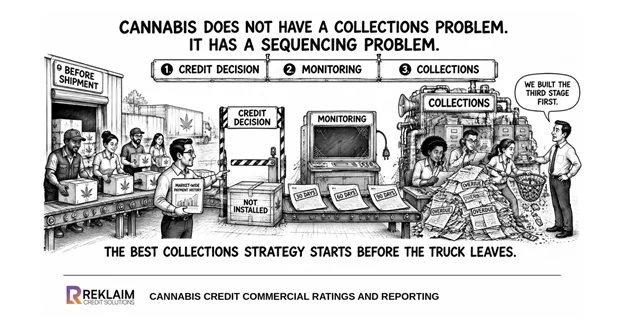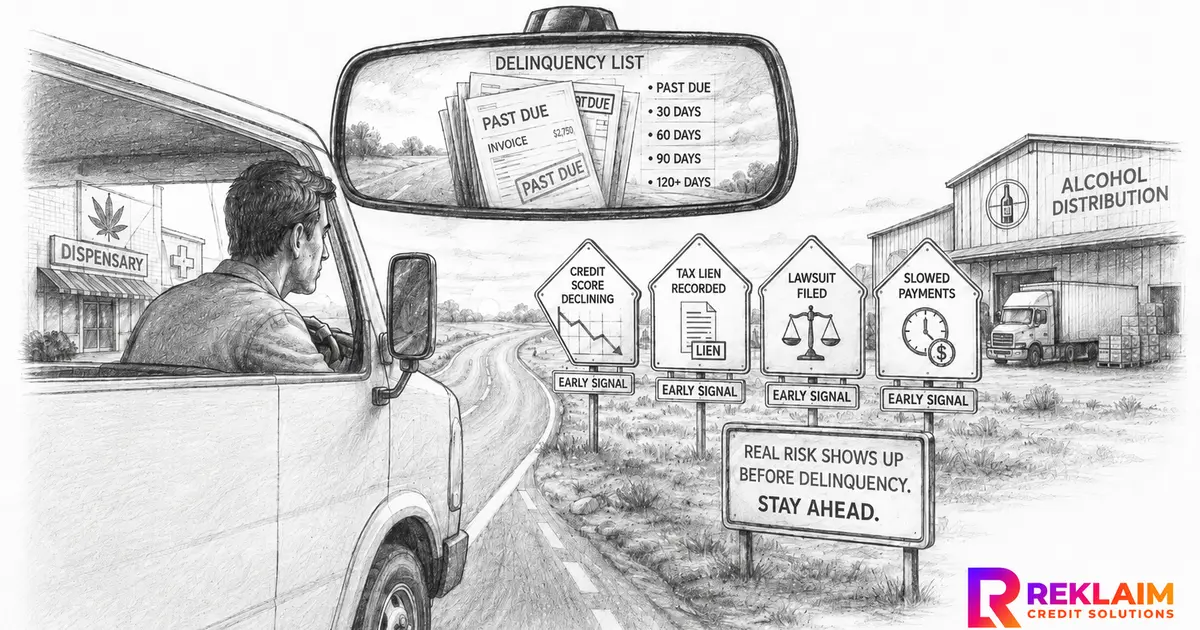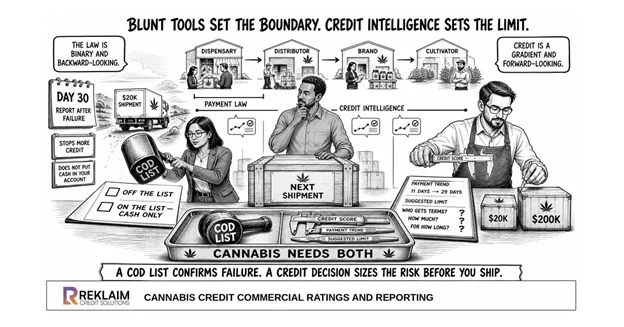

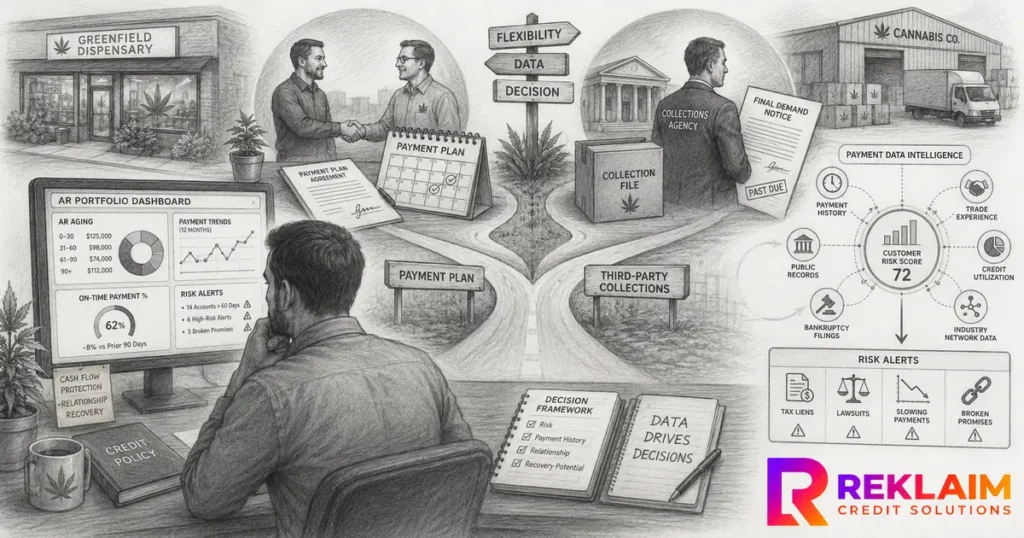
A practical framework for cannabis credit and accounts receivable teams: when to work with a delinquent customer, when to escalate to third-party collections, and how contributed payment data can sharpen every decision in between.
One of the hardest decisions in cannabis accounts receivable management is not simply how to collect an unpaid invoice. It is deciding how far to work with a delinquent customer before you escalate, and how to make that call with confidence rather than on instinct.
Do you place the account on credit hold? Do you offer a payment plan? Do you move the customer from Net 30 or Net 60 terms to COD? Or has the account reached the point where it should be referred to a third-party commercial collection agency?
There is no universal answer, because every customer and every delinquency is different. Accounts receivable management has never been a one-size-fits-all process, and cannabis receivables can be even more complicated because of the industry’s credit and cash-flow challenges.
The objective is obviously to get invoices paid, but it is easy to become so focused on reducing aging accounts receivable that you lose sight of the business relationship behind the outstanding balance.
If a customer has purchased from you consistently for years and suddenly experiences a temporary cash-flow problem, escalating after the first missed payment may not be the best business decision. The goal should be to get paid while protecting the customer relationship when that relationship is still worth protecting.
What makes each of these decisions harder in cannabis is the limited commercial credit infrastructure historically available to the industry.
In mature B2B credit markets, a credit manager weighing a payment plan against escalation can draw on commercial credit reports, credit group members, payment history, public records, credit scores, and shared trade-payment information showing how that customer is paying other suppliers.
Cannabis companies have largely been asked to make the same decisions with far less visibility. The challenge is not that cannabis operators make poor credit decisions.
Often, experienced operators are being asked to make reasonable decisions with only part of the customer’s credit picture.
That thread runs through everything below. At each stage, the decision improves when you can see more than your own accounts receivable aging report.
Reklaim Credit Solutions is a contributory commercial credit reporting and rating agency built specifically for the state-regulated cannabis industry.
Participating companies contribute de-identified accounts receivable aging information, which builds a broader picture of cannabis customer payment behavior across the market.
In return, users gain access to commercial credit information including credit scores, suggested credit limits, payment performance, public records, cannabis licensing information, and portfolio monitoring.
The purpose is not to replace the judgment of an experienced credit professional. It is to give that professional better information before each decision is made.
Here is how that plays out at every step.
1. Start With Why the Customer Has Not Paid
The first discipline in cannabis accounts receivable management is simple: do not assume a customer has not paid because they do not intend to pay. Sometimes that is exactly what is happening. Often it is not.
There is the dispensary that lost a major location, the distributor waiting for its own accounts receivable to clear, or the cannabis brand that experienced one difficult quarter. They may not be refusing to pay. They may simply be unable to pay every supplier at once. If a company owes 20 vendors but only has enough cash to pay 15, five suppliers are going to get stretched.
Then there is another kind of delinquent customer. They promise a payment Friday. Friday comes and goes. They promise the following Friday. Nothing arrives. Six weeks later, you have six broken promises to pay and no cash. Anyone who has spent time managing commercial accounts receivable knows that customer, and those two situations should not be treated the same.
Before deciding how aggressively to pursue an unpaid cannabis invoice, you need to understand what is driving the delinquency. A short conversation can reveal a great deal. Is the customer candid about what is happening? Do they acknowledge the balance? Are they proposing a realistic solution and returning calls, or simply buying time?
The challenge in cannabis is that the conversation may be almost all you have. Your own AR aging tells you how the customer is paying you. It cannot tell you whether the same behavior is showing up everywhere else, and that distinction changes the decision. A
historically reliable customer who is behind with you but current across the rest of the market is likely dealing with a timing problem. A customer slowing payments across many suppliers at once is showing something closer to financial deterioration.
This is where contributed industry payment data does the work a single phone call cannot.
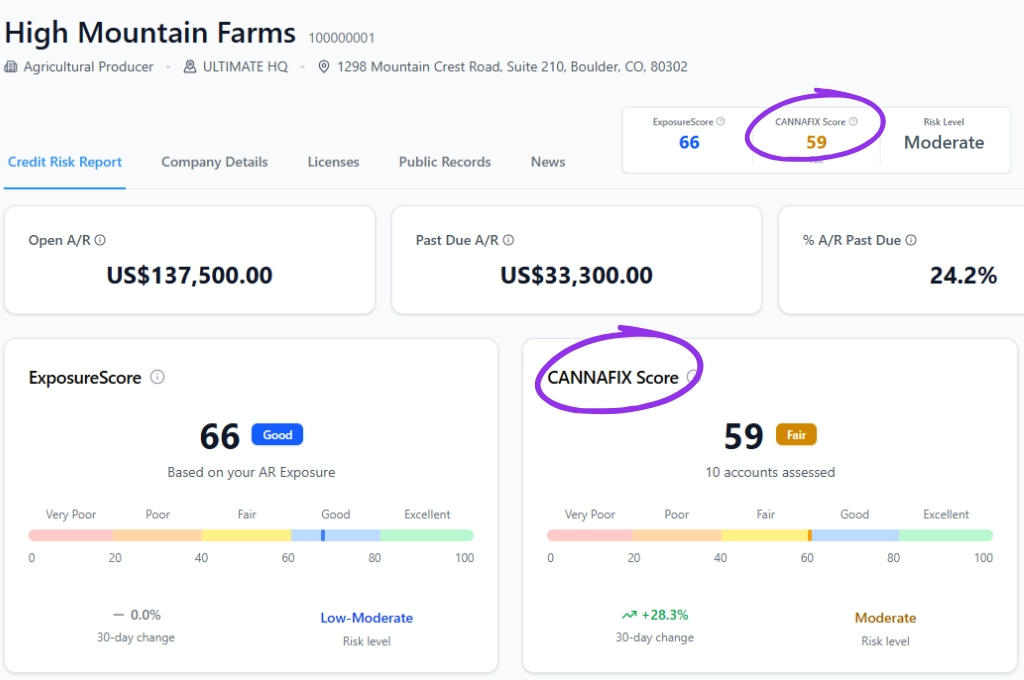
The Reklaim ExposureScore is a credit score on the individual counterparty you are selling to, built from the accounts receivable and payment data reported on that company across the contributor network rather than from your history with them alone, which is what lets you assess a customer, even one you have not sold to before.
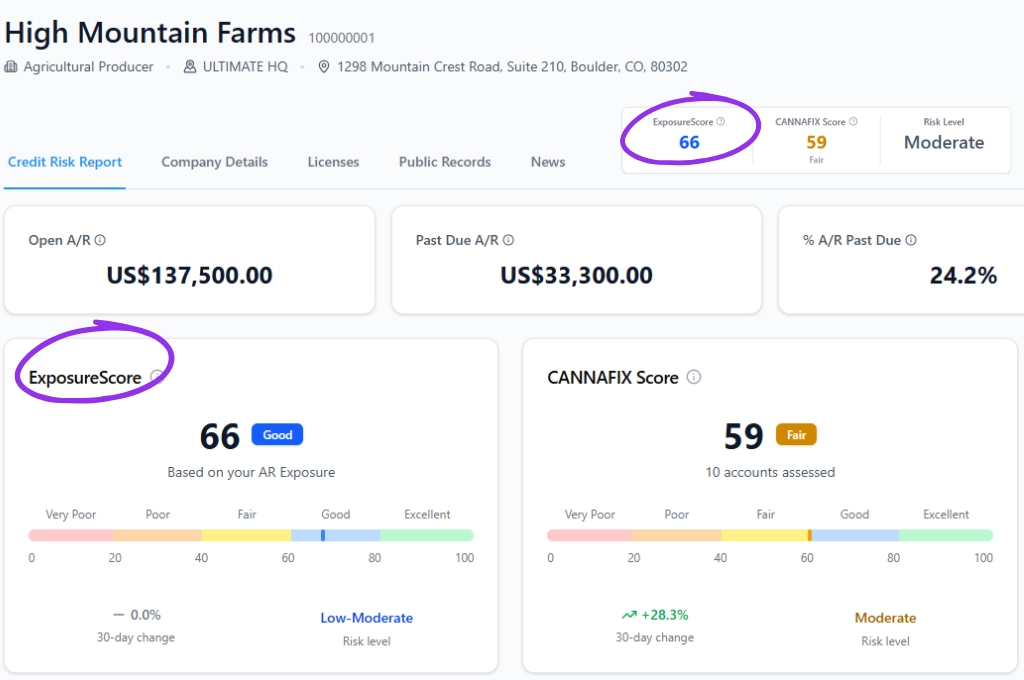
The Reklaim CANNAFIX Score rolls the individual ExposureScores for all tradelines reported on that counterparty into a single weighted view of how the company pays across the network. Together they help you answer the question the customer’s explanation cannot settle on its own: is this an isolated issue with you, or a pattern across the market.
2. Deciding Whether a Payment Plan Makes Sense
A cannabis payment plan should not be offered simply because a customer asks for one. A payment plan makes sense when there is a reasonable probability the customer can and will honor it.
If the customer has stayed in communication, acknowledges the debt, has historically paid you, and appears to be dealing with a temporary cash-flow problem, working with them may be the right decision.
One of the biggest mistakes companies make is structuring a payment plan around what the seller wants rather than what the customer can realistically afford.
Everyone would like a $50,000 past-due balance cleared in two weeks, but if the customer can realistically generate only $5,000 or $10,000 of excess cash each month, a two-week schedule is not a payment plan. It is a plan designed to fail.
A longer arrangement the customer honors is usually better than spending three months chasing promises that are repeatedly broken.
A commercial payment plan is not about giving the customer a break. It is about creating a structured agreement that increases the probability of collecting the receivable without immediately moving the account to outside collections. Whenever possible, the agreement should be documented in writing and clearly defined:
The total outstanding accounts receivable balance
- Payment amounts
- Payment due dates
- How future cannabis purchases will be handled
- Whether future orders will be COD, prepaid, or on reduced credit terms
- What happens if an installment is missed
- When normal trade credit terms may be reconsidered
The objective is clarity. Both the creditor and the customer should understand exactly what is expected.
A payment plan is ultimately a bet on future payment behavior, and the more complete the customer’s credit picture, the better that bet. A commercial cannabis credit report can add context your own file does not carry: a credit score showing overall risk level, relevant public records, UCC filings, tax liens, suits and judgments, and license information.
A customer openly working through one difficult quarter reads very differently from a company simultaneously showing deteriorating payment behavior, fresh tax liens, litigation, and licensing concerns. Suggested credit limits then help you size the plan so the exposure you carry forward stays inside what the data supports.
Read More: Cannabis Consolidation: Why the Small Operator Can Survive It
3. The Relationship Still Matters
Credit and collections professionals often see a side of the customer relationship that salespeople do not. They speak with customers when business is good, and when cash flow deteriorates, and invoices go past due.
How those conversations are handled tends to be remembered. Customers remember suppliers that worked constructively with them through a difficult period, and some become stronger, more loyal accounts because of it.
That does not mean ignoring delinquent receivables or accepting explanations indefinitely. It means understanding the difference between a cannabis customer that needs a temporary bridge and one whose promises no longer match its payment behavior.
Cannabis also remains a relatively small business community. Operators move between companies, licenses change hands, and reputations travel quickly. How you handle a struggling customer can affect a commercial relationship long after the original invoice is resolved.
Data does not decide the relationship for you. It simply helps you tell which kind of customer you are dealing with, so the flexibility you extend goes to the accounts that have earned it.
4. Keeping a Payment Plan Accountable
This is where many well-intentioned payment plans fall apart. You negotiate the payment plan agreement, get it signed, and then stop actively monitoring the account. Three missed installments later, everyone realizes the plan failed. A payment agreement is not something you set up and forget. It must be monitored.
Every installment becomes a new data point.
- Did the payment arrive on time?
- Did the customer call before the payment date when something changed?
- Did they make a meaningful partial payment?
- Have they stayed responsive?
Those behaviors tell you whether the plan is working or whether the customer’s credit risk is deteriorating. Good communication matters as well: a reminder shortly before an installment is due, a quick acknowledgment when payment arrives, a call the moment a payment is missed. Small steps, but they keep both sides accountable.
Monitoring one account by hand is manageable. Monitoring a whole portfolio that way is not, and it usually means you learn about deterioration late. This is the work that portfolio monitoring was built to absorb.
Instead of manually reviewing every cannabis customer, you are alerted when a counterparty’s payment behavior shifts across the network or when a new public record appears.
If a customer on a plan with you starts slipping with other suppliers, or a fresh judgment or lien lands, you see it while there is still room to tighten the agreement or accelerate collection. If the customer stabilizes and consistently honors the plan, that shows up too and may eventually support rebuilding normal credit terms.
5. Knowing When to Escalate Internally
Not every customer earns a payment plan. At some point, flexibility stops helping the customer and simply delays the inevitable. The warning signs are usually straightforward: the customer stops returning calls, payments repeatedly fail to arrive, every commitment requires another extension, the customer wants to keep placing cannabis orders while making little progress against the old balance, or management keeps changing the explanation. Most importantly, promises consistently fail to turn into payments.
Broken promises to pay are one of the clearest signs that your internal collection strategy is no longer working. An honest customer in a temporary cash-flow problem can often be worked with. A customer that repeatedly makes commitments and fails to honor them presents a very different credit risk.
Escalation does not always mean immediately placing an account with a collection agency. Depending on the circumstances, it may include:
- Placing the cannabis customer on credit hold
- Reducing the customer’s credit limit
- Moving the customer from open trade credit to COD or prepayment
- Involving senior sales management
- Escalating the matter to the customer’s ownership or executive team
- Requiring a written payment agreement
- Referring the unpaid account to a third-party commercial collection agency
Some cannabis suppliers respond to credit uncertainty by putting virtually everyone on COD. That protects cash, but it also restricts sales growth and unnecessarily penalizes reliable customers. A stronger strategy differentiates customers based on their actual payment behavior and credit risk.
That differentiation is exactly where broader data earns its place. Escalation is easier to justify when your own experience with the customer and the wider market data point in the same direction.
If a customer is breaking commitments to you while payment behavior is worsening across the network, extending more time usually just increases the eventual bad-debt loss.
If the same customer is behind with you but paying other suppliers normally, that is a reason to stay at the table a little longer rather than default to COD.
The point is not to hand the decision to a score. A score cannot read a customer’s intentions. The point is to make the call with more than a single ledger and a gut feeling.
6. Escalating to Third-Party Collections
Working with a customer makes sense only as long as there is evidence that working with them produces results. Eventually, every professional managing accounts receivable must draw a line, and that line should be based on measurable behavior, not frustration.
Five factors tend to matter most when deciding whether a cannabis receivable belongs in third-party collections:
Length of delinquency
An invoice 30 days past due is a very different problem from one at 90, 120, or 180 days. Aging is not the only factor, but it is a primary escalation trigger.
Amount owed
A $5,000 invoice and a $250,000 balance do not warrant the same timetable. The more money at risk, the less room there is to let an account keep aging without a defined strategy.
Broken promises to pay
One missed promise happens. Multiple promises followed by multiple missed payments establish a pattern, and at some point, another promise is not information; it is another delay.
A defaulted payment agreement
If you negotiated a realistic plan, documented it, gave the customer a chance to cure, and they broke it, the argument for renegotiating again becomes much weaker.
No communication
A customer in genuine difficulty may not have the cash to pay today, but they can still communicate. When calls and emails consistently go unanswered, the situation has fundamentally changed.
A cannabis company that is communicating, making meaningful payments, and honoring a realistic plan may deserve more time. A deeply delinquent company that has broken multiple promises, defaulted on a written agreement, and gone quiet is sending a very different signal. At that point, continuing the same internal efforts often just lets the receivable deteriorate further.
When internal collection efforts have clearly stopped producing results, referring the account to a reputable third-party commercial collection agency can be the next appropriate step.
The purpose is not to punish the customer. It is to maximize recovery before the balance becomes uncollectable, and to free your team from spending a disproportionate amount of time on one account while many others need attention.
The longer a severely delinquent account sits unresolved, the fewer options a creditor tends to have, so delaying placement simply because no one wants to make the decision can become its own form of credit risk.
If you do place an account with a third party, choose the agency carefully. You are trusting another company with your customer relationships and your money, so the decision should not come down to the lowest contingency fee.
At a minimum the agency should be properly licensed, bonded, and insured wherever required, and staffed by experienced commercial collectors who know how to work with controllers, CFOs, and owners.
For cannabis receivables, meaningful cannabis-industry experience matters as well, because state-by-state licensing, limited banking access, and distributor and dispensary payment cycles are not issues traditional commercial collectors encounter every day.
Data does not just inform the decision to escalate. It helps you time it. Placing an account too early can cost a relationship that was recoverable. Placing it too late can cost the money.
Watching payment behavior across the network, alongside your own experience and the five factors above, helps you tell those two situations apart and act while recovery odds are still in your favor.
When the broader data confirms what your own file is already telling you, escalation stops being a judgment call you second-guess and becomes one you can stand behind.
Payment Plans and Collections Are One Credit Decision
Payment plans and collection placements are often treated as separate tactics, but they are really points on the same credit-management continuum.
A successful payment plan improves cash flow, reduces bad-debt exposure, and preserves a customer relationship that may have taken years to build.
A well-timed collection placement recovers money that would otherwise age into a loss. Both decisions get easier and more defensible when the credit team can see beyond its own AR aging report.
Final Thoughts
There is no universal script for handling a seriously delinquent cannabis customer. Every account tells a different story. Some need flexibility, some need firm boundaries, and some ultimately need to be referred to a third-party commercial collection agency. The skill is recognizing the difference and acting before the situation gets away from you.
A payment plan should not be the automatic response to every overdue cannabis invoice, and it should not be treated only as a last resort. Used with good judgment, clear expectations, and consistent follow-up, it can improve cash flow while preserving a valuable customer relationship. But flexibility without accountability is not a collection strategy. At some point, promises have to become payments, and when they do not, you must be willing to draw the line.
What ultimately improves every one of these decisions is visibility. It is far easier to distinguish between a customer that needs a temporary bridge and one whose financial condition is deteriorating when you can see payment behavior beyond your own AR file. That broader credit visibility is something the cannabis industry has historically lacked, and building it for this industry is one of the reasons Reklaim Credit Solutions exists.