
Why COD Payment Laws Never Replaced Credit Ratings and Why Cannabis Needs Both
A dispensary in California stops paying its distributor. The distributor is now short on cash, so it slows payment to the brands whose product it already sold. Those brands slow payment to their packaging supplier, their extractor, their cultivator, their taxes, etc.
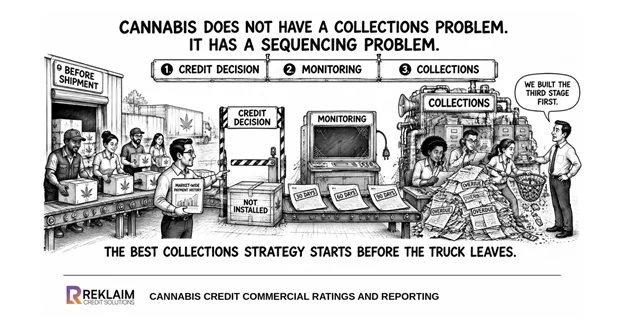
Nobody in that chain did anything wrong except sell on terms to the buyer in front of them. Every sale on terms is a credit decision, whether anyone treats it as one or not.
That is the ugly weather pattern I see moving through cannabis right now. It does not start with a bad brand or a weak distributor. It starts at the register and travels backwards.
The question cannabis operators keep asking, and the question regulators in several states are now asking on their behalf, is whether a law can stop it. Force retailers to pay net 30 or net 60 and publish the names of the ones who do not. Cut off their credit until they cure. NY has it. MA has it.
It is a reasonable instinct. It has also already been tried, at scale, for ninety years, in the alcohol industry and beyond.
Payment laws work, within limits
Payment laws work. They just do not do the job most people think they do.
A statutory credit limit shortens the window during which you should be an unsecured creditor. It creates a public facing consequence for nonpayment and a reason for a counterparty to prioritize your invoice over someone else’s. Those are benefits, and I believe cannabis would be better off with them than without them.
What a payment law does not do is tell you whether the counterparty was ever good for the money in the first place…BEFORE YOU SHIP. It does not tell you how much to ship. It does not follow your exposure up the chain when the party who owes you fails to remit to the party who owes them. It does not put a single dollar in your account, and it does not protect the shipment that just left your doors.
These are blunt tools, not surgical instruments.
That is why every regulated trade-credit industry in the United States that has payment protection statutes also participates in commercial credit rating and reporting. The two run alongside each other.
What Alcohol’s Credit Laws Actually Built
After Prohibition, the states built the three-tier system and wrote what are generally called cash and credit laws. The mechanics vary, but the pattern is consistent. New York gives retailers 30 days on liquor and wine and runs beer on a 12 to 26 day cycle, and the parties are not permitted to negotiate their own terms.
Massachusetts caps ordinary-course credit at 60 days from delivery. Texas requires cash on delivery for malt beverages and runs wine and spirits on semi-monthly payment dates with a short cure window.
Federally, the Alcohol and Tobacco Tax and Trade Bureau (the TTB) has indicated that terms of up to 30 days are generally unlikely to be treated as consignment sales, which is the anti-inducement rationale underneath the whole structure.
California went further and, effective January 1, 2026, requires electronic funds transfer by day 30, initiated by the wholesaler.
Every one of these regimes ends the same way. A delinquent retailer is reported. The state posts the name. Licensees may no longer sell that account on credit. Sales become cash on or before delivery until the balance clears.
New York’s cannabis rule is close to a direct transplant of it. Mass isn’t far off.
How New York’s Cannabis COD List Works
New York adopted a cannabis credit regime at 9 NYCRR section 124.2.
A licensed retailer buying cannabis product on credit must pay in full within thirty days of delivery. If the retailer does not, the supplier is not merely permitted to report it. The supplier is required to report it, to both the retailer and the Office of Cannabis Management, within seven calendar days of the final payment date.
OCM maintains a COD list, updated weekly, which will now be attached to METRC reporting per the OCM’s rule making in August 2026. Suppliers may not extend credit to anyone on it, and any sale to a listed retailer must be paid in cash at the time of delivery.
Read More: KPI’s for Cannabis Credit
When the balance clears in full, the supplier must report that within one business day so the name comes off. Retailers who fail to pay are in violation of the regulation, and the Cannabis Control Board has authority to suspend, cancel, or revoke a license.
That list is growing exponentially daily.
In theory, that is a serious rule. It is more prescriptive than most people realize, and New York deserves credit for being early. However, in practice, it is widely known that manufacturers are not reporting and retailers who are reported on are retaliating.
It’s also a look backwards. You may ship out $20k of product to a retailer on a Monday and then on Tuesday find out that they are 37 days late to other manufacturers. Too little, too late.
Massachusetts enacted similar legislation, but it’s 60 days before reporting. The reporting element and published lists won’t come until January 1, 2028, but the framework is there at a time when MA brands are feeling it, like every other state before them.
California tried to do something similar and could not get it across the legislative finish line. Assembly Bill 766 in 2023 would have required payment within 15 days of the final invoice date, capped that invoice date at thirty days from transfer, required licensees to report unpaid invoices of $5k or more to the Department of Cannabis Control, directed the department toward disciplinary action, and barred the delinquent licensee from buying on credit until it cured.
It failed in February 2024.
Assembly Bill 2888 reintroduced substantially the same section in 2024 and was held on the Assembly Appropriations suspense file. Neither became law.
So the largest cannabis market in the country, and the one with the most visible receivables problem, and some of the highest profile distribution collapses that have hurt small businesses has attempted a statutory payment fix twice and does not have one. New Jersey is now looking at a New York style approach. This is a live legislative question in multiple states, not a thought experiment.
What a payment statute answers, and what it leaves open
There is a clean way to evaluate all of these regimes, whether it is alcohol in Massachusetts or cannabis in New York or whatever New Jersey ends up drafting. I ask the same five things of each one.
Does it create a payment deadline? New York’s rule does. Thirty days, calculated off delivery, published on a credit calendar so there is no argument about the date.
Does it specify the payment instrument and what happens when payment fails? Alcohol has moved toward this, and California’s alcohol EFT mandate is the clearest example. Cannabis has not, and given the payment “rails” that the industry actually operates on, that gap is far more complicated to close.
Does it provide a remedy before more inventory goes out the door? Yes, and this is the strongest feature of every one of these regimes. Once you are on the naughty list, you’re facing a stop-supply mechanism. It prevents a retailer from running a balance with one supplier, getting cut off, and starting fresh with the next one. At least in theory, if not in practice.
Does it secure or segregate funds for the party upstream of the direct seller? No. Not in alcohol, not in New York cannabis. The retailer owes the distributor. The distributor owes the brand. The brand owes the cultivator. The cultivator owes their suppliers. Those are separate obligations under separate contracts. A rule governing the first one does not create a waterfall into the second.
Does it address insolvency and priority? No. A payment statute is not a lien, not a trust, not a guaranty, and not a priority scheme. When the counterparty fails, you are where you are. For trade creditors, that is likely the back of the line.
The regimes answer the first and the third, and partially the second. The fourth and the fifth require entirely separate legal architecture, and a shorter shot clock does not supply it.
RNDC, the second largest wine and spirits distributor in the country, filed Chapter 11 this year. Reporting in the Lexington Herald-Leader described a suit by Sazerac over roughly $41m in unpaid invoices and a filing reflecting more than $400m in unsecured claims, a large share of them held by suppliers. Every retailer sale that fed that business was governed by state cash and credit law. The retailers largely paid on the state’s clock.
BUT…The distributor did not pay the brands. The suppliers still ended up unsecured. The system worked as it was designed to. Tell that to the employees upstream who have lost their jobs and the founders who have lost their equity.
This is a cautionary tale for cannabis. The law worked exactly as designed and the suppliers still lost.
Read More: Cannabis Consolidation: Why the Small Operator Can Survive It
Where Cannabis Credit Reporting Fits
Alcohol has had statutory credit limits for 90 years. It still has commercial credit reporting.
So does produce, which has the most protective trade credit statute in American commerce. So does construction, which has lien rights in all fifty states. So does freight. So does electrical distribution, plumbing supply, building materials, and food service.
The National Association of Credit Management alone sponsors more than seven hundred and fifty industry credit groups, nearly two hundred of them national in scope, and those groups exist in precisely the sectors that already have statutory payment protection.
If a payment law were a substitute for credit intelligence built on data shared with independent parties, and the credit scoring and reporting that come with it, this would not be true. But it is true, everywhere.
Produce: Why PACA Still Needs Credit Ratings
Produce is arguably the most direct challenge to my thesis.
The Perishable Agricultural Commodities Act does something no cannabis or alcohol payment law does. It creates a federal statutory TRUST. When a buyer receives produce, the buyer holds that produce, and the proceeds from selling it, in trust for the unpaid seller. Trust assets are not part of the buyer’s bankruptcy estate. The unpaid produce seller stands ahead of the secured lender.
AHEAD of the secured lender. That is the single most protective position Congress has ever handed a trade creditor, and it exists today, and it works.
But…produce manufacturing still buys credit ratings. Blue Book Services (www.bluebookservices.com) has been rating produce buyers for 125 years and is doing it right now, layering credit scores, payment trends, dispute history, and trade ratings on top of the public federal license database.
Why would an industry with a super-priority trust need credit ratings?
Because the trust is binary and credit is not. The trust either attaches or it does not. Sellers preserve it by putting statutory language on the invoice, and unlicensed sellers must give separate written notice. Terms cannot exceed thirty days from acceptance or the transaction is ineligible. Miss the paperwork, extend terms to help a struggling customer, trade with a party whose license has lapsed, and the protection is simply gone. The strongest statute in American trade credit can be forfeited by a simple clerical error.
Because a license is not a credit score. The federal database tells you a company is legally permitted to trade. It tells you nothing about whether that company pays on time or at all. Those are different facts and only one of them is a credit decision.
Blue Book’s own framing of the distinction is about as clean as it gets: the government registry tells you a company CAN trade, and the credit file tells you whether you SHOULD. That is the entire relationship between regulation and credit intelligence in one line, and it holds in every industry where both exist.
Construction: Why Lien Rights Don’t Replace Credit Reporting
Construction is the other industry to take a look at, because its protection is even older and even more familiar.
Every state gives contractors, subcontractors, and material suppliers lien rights. Most states layer prompt payment requirements on top of them for public work and often for private work as well. A supplier who ships materials to a job and does not get paid can attach a claim to the improved property itself. That is leverage, it predates almost every other trade credit protection in American law, and it works.
So, why is construction one of the most heavily represented sectors in organized commercial credit reporting?
Credit groups covering building materials, electrical distribution, plumbing supply, and utility construction have run for decades, exchanging payment experience on shared customers on a monthly cycle in parallel with the lien statutes. Nobody in that industry treats the two as alternatives.
A lien is a deadline exercise. Preliminary notices, filing windows, and service requirements are strict and unforgiving, and a supplier who misses one has an unsecured claim like everyone else. A lien is also not cash. You can’t pay bills with a lien just like you can’t pay in invoice with LinkedIn followers.
It is a claim against real property that has to be enforced, which costs money and takes time, and on a project already carrying a construction loan the value of what sits behind the lender may be considerably less than the invoice.
And most importantly, a lien has nothing to say about the decision that created the exposure. It does not tell a supplier whether a general contractor should get $50k of material on terms or $500k. It does not tell you that the contractor’s payment behavior slowed across its last 4 jobs. The statute recovers. The credit file decides. An industry that has run both side by side for a century has settled the question of whether you need both.
Read More: Cannabis Accounts Receivable: When to Use Payment Plans vs. Third-Party Collections
6 Reasons COD Laws and Credit Ratings Cannot Substitute for Each Other
There are at least 6 structural reasons a COD payment statute and a credit rating do different jobs, and none of them are specific to cannabis.
1. The law is binary. Credit is a gradient.
A retailer is either on the delinquency list or off it. There is no in-between. But almost all of the useful information about a counterparty lives in the in-between.
A customer who has paid you on day twenty-nine for six straight months, after paying on day eleven for the two years before that, is telling you something urgent. Under the statute, that customer is perfectly compliant and invisible.
By the time a name appears on a state list, the deterioration that put it there has been running for months.
2. The law is triggered and backward-looking. Credit is continuous and forward-looking.
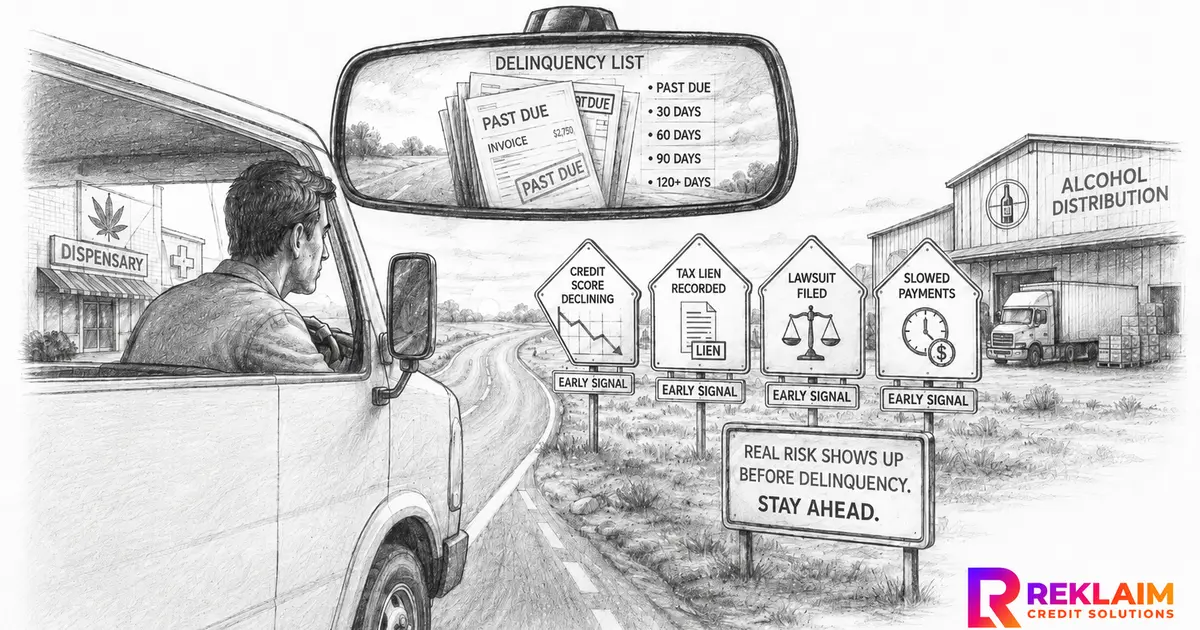
A delinquency list confirms a failure. A rear view mirror like a credit association. It does not anticipate one. The entire value of a credit rating is that it changes before the default. It is the windshield and the rear view mirror.
3. The law governs one relationship. Your exposure runs through several.
This is the structural point the alcohol experience proves and cannabis has already lived through. The cannabis supply chain runs in sequence. The dispensary pays the distributor. The distributor takes its fee and remits to the brand. The brand pays its cultivator, its packaging vendor, and its extractor.
A rule that governs the dispensary-to-distributor leg does not reach the rest of it. Your money rides on collections you do not control and cannot see.
4. The law caps duration. It does not cap amount.
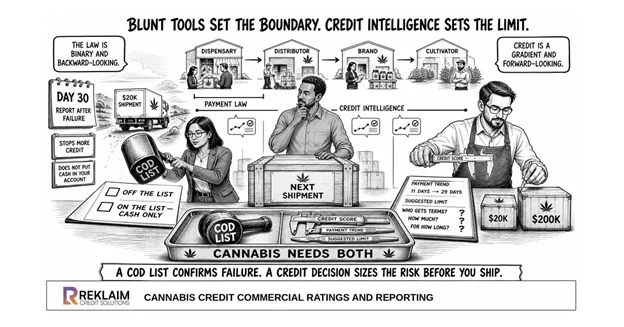
New York’s rule says a retailer must pay within thirty days. It has nothing to say about whether you should have shipped that retailer $20k of product or $200k. The statute governs the clock. It is silent on the number, and the number is where the loss lives.
37 days of exposure on the wrong counterparty at the wrong size is still a write-off. It is just a faster one.
5. The law is jurisdictional. Your counterparties are not.
New York’s rule protects you in New York. It does nothing for the same operator’s affiliate in Michigan, and it does nothing for a multi-state operator whose entities in 5 states have very different payment behavior behind a single brand name. Credit risk does not respect a state line. A statute has no choice but to.
6. The law tells you what happened. It does not tell you what to do.
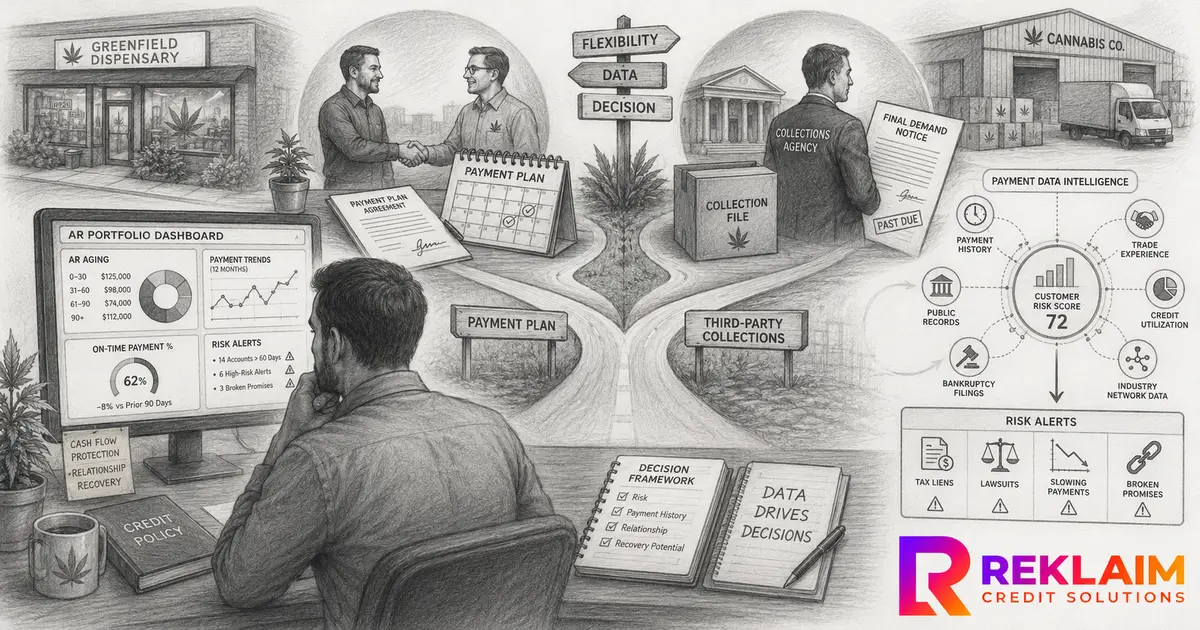
A statute can tell you a counterparty defaulted. It cannot tell you what limit to set, whether to require a deposit, whether to shorten terms, whether to keep shipping while you work the balance down, or what the exposure should be six months from now if nothing changes. Those are credit decisions.
Nobody writes them into a regulation because they cannot be written into a regulation. They are judgments, and judgment requires information the statute does not collect.
What Credit Intelligence Cannot Do
Credit intelligence does not collect a dollar either.
A credit score is not a lien. It is not a guaranty. It does not give you priority, it does not put cash in the account, and it will not save a receivable that has already gone bad. Anyone selling it as debt recovery is selling something else.
The two things do different jobs. A payment statute governs what happens after you are already exposed. A credit decision governs whether you become exposed, to whom, and for how much.
Regulation sets the floor. Credit intelligence sets the limit.
An industry that has one and not the other is only half covered, and, until now, cannabis has had neither in most of the country.
Why the New York Cannabis COD List Is Not a Credit Rating
The C.O.D. list is useful. It is a public good and any supplier operating in New York should be checking it every week, or maybe every day. Certainly before you ship that next box of carts, AIOs, gummies, jars, wax or pre-rolls.
It is also not a credit rating, for several reasons. It confirms rather than predicts; a name reaches that list after the failure, and the decision that mattered was made 30 to 60 days earlier, when the product went out the door.
It is one bit of information, on or off, with no limit, no trend, no severity, no direction of travel, and no sense of whether a counterparty is stabilizing or accelerating. It captures only what suppliers report, and only in one state.
Reporting is mandatory in New York, which is a meaningful design choice, and as of late August 2026, industry reporting indicated the list carried the names of roughly 1/8 of the retailers in the state and growing.
But the presence or absence of a name on a regulatory list is not a measure of credit risk, and no credit manager in any mature industry would treat it as one. And it says nothing about size.
It cannot, because the state is not in the business of telling you how much product to ship. That decision is yours, and it is the one that determines whether you get hurt.
A delinquency list confirms a failure. A credit score anticipates one. Both are worth having. Only one of them is a credit decision.
Why Cannabis Needs Credit Intelligence More Than Other Industries
Every argument above applies to any regulated industry. Cannabis has additional challenges that most industries don’t face.
There is generally no bankruptcy backstop. Plant-touching operators have generally been denied access to federal bankruptcy. That means no automatic stay, no administrative priority for goods delivered in the final twenty days, no reclamation, no critical vendor motion, no estate-funded creditors’ committee, and no court-supervised disclosure.
When a cannabis counterparty fails, what is available is a state receivership, an assignment for the benefit of creditors, an Article 9 proceeding or nothing at all.
HERBL moved a reported $700 million of product in 2022 and was in receivership by 2023, and its receivable book, listed above $7 million, sold for roughly nine cents on the dollar. Alcohol suppliers in the RNDC case are getting a federal court, a published claims register, and a line. It is a bad outcome with a process. Cannabis gets the bad outcome without the process.
There is no pricing mechanism for the risk. In mainstream commerce, a large buyer that extends its terms can hand its suppliers a reverse factoring facility priced off the buyer’s own credit rating. The buyer’s creditworthiness is the collateral that makes its own terms extension survivable.
Without Reklaim Credit Solutions, cannabis buyers do not have credit ratings, so there is nothing to key a facility to. The terms extension is arriving without the instrument that normally makes it tolerable.
The recovery math is worse at every stage. Delinquent accounts receivable across US cannabis operators exceeded $3.8 billion way back at the end of 2023 against roughly $28.8 billion in legal sales, per Whitney Economics, which is equivalent to something like one and a half months of total industry revenue.
In the same body of research, a majority of surveyed operators said delinquent receivables hurt their business more than Section 280E. In an industry where margins are thin, a $50k write-off at a 25% margin requires $200k of new revenue just to get back to even.
And the balance itself becomes the constraint. This is the dynamic operators struggle with the most and the one that a payment statute is least equipped to address. Once a counterparty owes you enough, cutting them off does not get you paid. It likely converts a receivable into a write-off. The only hopeful path back to your cash is to keep shipping so they keep selling through. Capable operators with other options keep shipping anyway, because the balance is what holds them.
The only leverage you ever had was before the balance got large enough to hold you. That is a credit decision, made early, with information. No statute can make it for you.
What Cannabis Operators Can Do Without Legislative Help
None of this requires waiting on a legislature. Set a limit per counterparty in writing before the first shipment, and treat it as a ceiling rather than a target. The question was never whether to ship. It was how much to let ride at once. Define in advance what has to change before that number moves. If you cannot state the condition, you do not have a credit policy, you have a hope.
Watch drift as closely as delinquency. A customer sliding from eleven days to twenty-nine days is the signal. Thirty-one days is the confirmation, and by then you are reacting. Delinquency rarely appears overnight. Treat concentration as a credit issue. If a single counterparty is a large share of your receivables, its payment behavior is your solvency.
Check the public record before you extend, and check it again on a schedule. License status, judgments, liens, and UCC filings are all knowable, and all of them move. In New York, check the C.O.D. list weekly and calendar your seven-day reporting obligation. It is mandatory, and it protects the next supplier in line the same way the last one protected you.
And know what a counterparty owes everyone else, not just you. This is the one an individual operator cannot solve alone, and it is the single most predictive thing about how a counterparty will treat your invoice.
What we are building
That last item is the reason Reklaim Credit Solutions exists, and the reason I co-founded it.
The signal that predicts a cannabis default is not hidden. It sits in the accounts receivable aging of every operator shipping to that counterparty. It sits in silos separated by state boundaries. It has simply never been pooled, so each operator sees only its own slice and none of them sees the pattern.
Reklaim Credit Solutions is building a purpose-built commercial credit rating agency for the state-regulated cannabis industry. Operators contribute de-identified accounts receivable aging data, the full picture from on-time through late through stressed, and receive commercial credit scores, suggested credit limits, full credit reports on the counterparties they all sell to, and continuous credit monitoring.
All contributed data is de-identified immediately on ingestion, with no attribution back to the contributor. Our models are trained on that contributed AR aging. Public records, including cannabis license status, judgments, tax liens, and UCC filings, appear in the credit reports and the continuous monitoring, where they belong.
Dun and Bradstreet and Experian have not touched this industry. Cannabis has been left to make its largest recurring financial decisions with less information than a plumbing supply distributor has had for fifty years.
Better information supports better commercial credit decisions. Accounts receivable is one of the largest unsecured assets on an operator’s balance sheet, and commercial payment behavior is one of the most reliable things you can know about a counterparty. Payment transparency benefits buyers and suppliers alike. It rewards the operators who pay, which is many of them, and it prices the ones who do not.
If a state passes a thirty-day rule, take it. It shortens the window, it creates a consequence, and it is better than nothing. Then go find out who you are actually shipping to, because the statute is not going to tell you, and it was never designed to.
Blunt tools set the boundary. Credit intelligence is the scalpel. Cannabis is going to need both.