
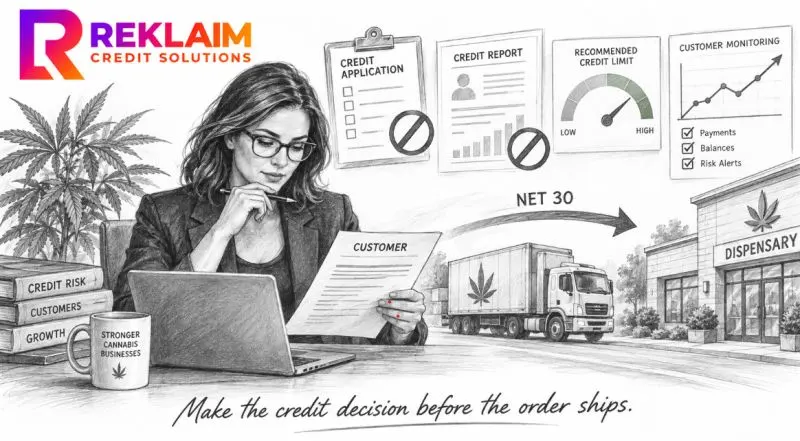
A sales rep lands a new dispensary account. The buyer wants Net 30, the first order is ready to go, and everyone wants to get the product on the truck.
That is usually treated as a sales decision. It is also the first credit decision you will make on that customer.
If we ship $20,000 worth of product today and agree to get paid 30 days from now, we have extended $20,000 of unsecured trade credit. The sale may look complete from the sales side, but from a credit standpoint, our money is still sitting in someone else’s inventory until the invoice gets paid.
That does not mean we should stop offering terms. Credit helps good customers buy more products and helps suppliers compete for good accounts. The problem starts when we extend credit without first deciding how much risk we are willing to take.
Whitney Economics estimated delinquent cannabis accounts receivable at roughly $3.8 billion in 2023. Its research showed how much working capital can get trapped when unpaid invoices pile up across the supply chain.
So before we put that first order on the truck, we should know who we are extending credit to, how they have paid other businesses, and how much exposure makes sense.
Net 30 Is Credit, Not Just a Payment Term
Sales teams often talk about Net 30 as a term attached to an order. Credit teams look at the same transaction differently because we know what happens after the product leaves.
If you ship today and wait 30 days for payment, you are financing that customer for 30 days. If another order ships before the first invoice gets paid, your exposure grows again.
That can work perfectly well when the customer pays as agreed. In fact, trade credit has supported B2B commerce for generations because it gives customers room to buy inventory, sell it, and then pay their suppliers.
What matters is whether the terms match the risk.
The National Cannabis Industry Association has recommended that cannabis businesses moving beyond cash and COD establish a formal trade credit policy. A policy gives your team a repeatable way to decide who receives terms, who does not, and how much credit each account should carry.
That is where the credit application comes in.
What Should You Check Before Offering Net 30?
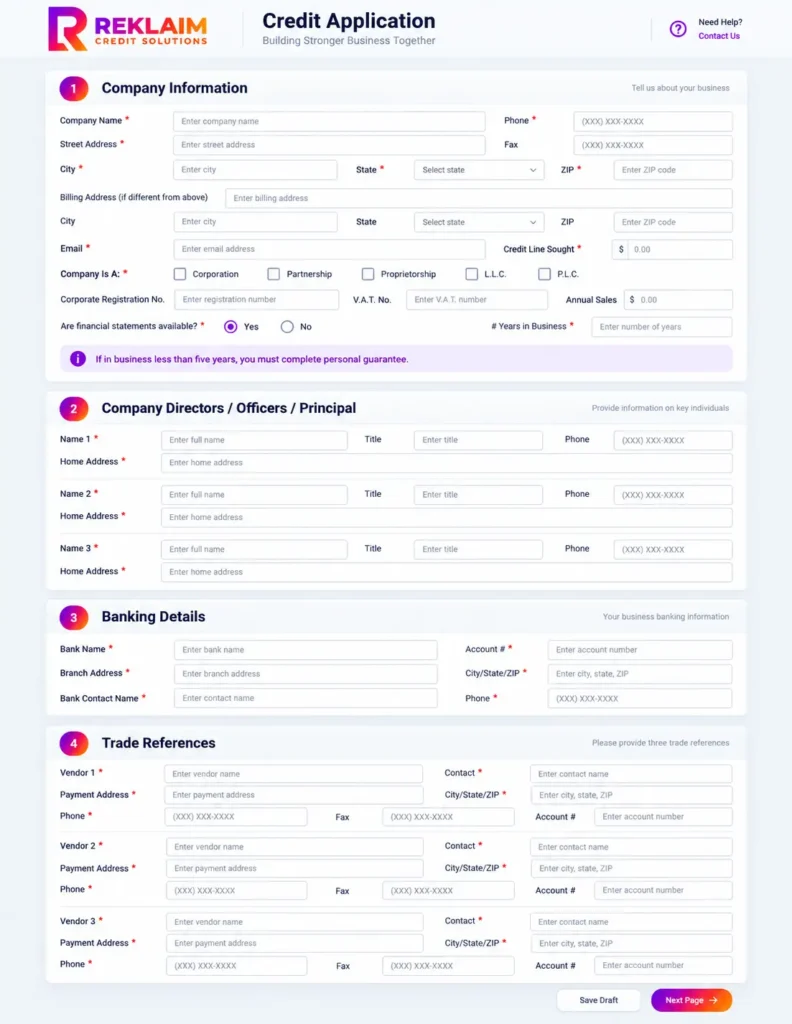
A credit application should provide us with enough information to understand who is asking for credit. It should not, by itself, decide whether we approve the request.
Before we approve Net 30, we should know a few things, including:
1. Make Sure You Know Who Owes You the Money
You want the legal business name, any DBA, business address, license information, billing contact, and accounts-payable contact tied to the account.
That sounds basic until an invoice goes unpaid and the company name on the order doesn’t match the entity that holds the license or owes the debt.
Your credit file should make it clear who you are doing business with before the first invoice is created.
NCIA has described the credit application as one of the main tools a business can use to gather information and control risk when it begins extending trade credit.
Once you know who the customer is, the next question is how they actually pay.
2. Look Beyond Your Own Payment History
If this is a brand-new customer, you may not have any payment history of your own yet. Even after you have worked with the account for a while, your own receivables show only one relationship.
That creates a blind spot.
A customer might be paying you at day 30 while pushing several other suppliers out to day 45 or day 60. Your aging report would tell you how the account looks current. The broader payment pattern may tell you something different.
We discussed this problem in more detail in Who Is Paying Late?. Your own AR data tells you what is happening between you and the customer. Broader trade-payment information can help you see how that customer is behaving across the market.
Neither view should stand alone, but together they give you a much better basis for a decision.
3. Review the Rest of the Credit Profile
Payment history is one part of the file. We also want to understand whether anything else may affect the customer’s ability to pay.
That can include commercial credit scores or ratings, tax liens, judgments, UCC filings, license information, and other public records.
We should not treat one filing or one score as an automatic reason to decline an account. A UCC filing simply show that the company has financing in place. A lien may deserve a closer review, but it still needs context.
The main point is to look at the account as a whole before deciding how much credit we are comfortable putting at risk.
A Credit Application, Credit Report, and Credit Limit Do Different Jobs
One of the most important provisions in a credit application is the language covering collection costs, attorneys’ fees, and interest if the customer doesn’t pay. If properly drafted and enforceable under applicable law, that language may allow a creditor, or a third-party collection agency acting on its behalf, to recover those additional amounts from the customer.
For example, if a customer owes $10,000 and the account is placed with a collection agency charging a 25% recovery fee, and the agreement also allows 10% interest, the amount pursued could potentially be $13,500: the original $10,000 debt, $2,500 in collection costs, and $1,000 in interest.
If the full $13,500 is collected, the creditor could recover its entire $10,000 while the additional amounts cover the cost of collection. In other words, the creditor would get paid in full without having to absorb that cost.
Without the proper contractual language, however, a creditor generally can’t assume those additional costs can simply be passed on to the customer. The same issue can arise in litigation, where recovery of collection costs, attorneys’ fees, and contractual interest often depends on what the parties agreed to in writing and what applicable law permits.
That’s why this language belongs in the signed credit application, credit agreement, or other governing contract, rather than added later to an invoice, purchase order, or statement. It’s a provision I’ve seen collection agencies rely on for years, and it’s one of the first things I’d look at when reviewing a company’s credit application.
Because enforceability varies by state, the language should always be reviewed by qualified counsel in the states where the company does business.
This distinction gets lost surprisingly often.
- Credit Application: A credit application tells us who wants credit and what they are asking for.
- Credit Report: A credit report provides us information we can use to judge the risk behind that request.
- Credit Limit: A credit limit tells our sales and credit teams how much exposure we are willing to carry.
You need all three because they answer different questions.
If a dispensary asks for Net 30 and expects to purchase $40,000 every month, approving the terms does not automatically mean we should allow $40,000, $80,000, or $120,000 of invoices to remain open.
We still have to decide where the limit belongs.
That decision should take into account expected order size, buying frequency, payment history, the customer’s credit profile, and our own tolerance for exposure.
When we skip that step, the limit often gets set by accident. Sales keeps shipping, invoices remain open, and the balance grows until someone notices how much money is outstanding.
By then, we are managing exposure we never consciously approved.
Good Credit Decisions Should Help You Sell More Safely
Credit departments get treated as the team that says no, while sales gets treated as the team that drives growth. That is the wrong relationship.
We wrote about that tension in Credit and Sales in Cannabis.
A good credit process should help sales understand where the company can comfortably extend more credit and where it should slow down.
If a customer has a strong payment history and can support a larger line, increasing the limit may help the sales team grow that account.
If the customer is new or the information is limited, we might start with a smaller line and increase it after we see how the account pays. Another customer may make more sense on shorter terms, partial prepayment, or COD.
We do not have to treat every buyer the same because not every buyer carries the same risk.
And once we approve an account, the work is not finished. Customer behavior changes, open balances grow, and information that supported the original decision can change over time. That is why cannabis credit risk also requires monitoring after the account is opened.
Make the Decision Before the Product Leaves
When a new dispensary places its first order, we do not need to turn the credit process into a week-long obstacle course.
We do need enough information to answer a few basic questions before we ship.
Who are we selling to? How have they paid other suppliers? What does their credit profile tell us? What terms are appropriate? How much exposure are we willing to carry?
Those questions are easier to answer before the first invoice exists than after the first invoice is 60 days past due.
That is where Reklaim Credit Solutions fits. Reklaim Credit Solutions brings cannabis-specific trade-payment data together with commercial credit reports, ratings, suggested credit limits, license information, public records, and portfolio monitoring so companies can make credit decisions with more information behind them.
The goal is not to extend less credit. It is to know when you can extend more, when you should extend less, and why.