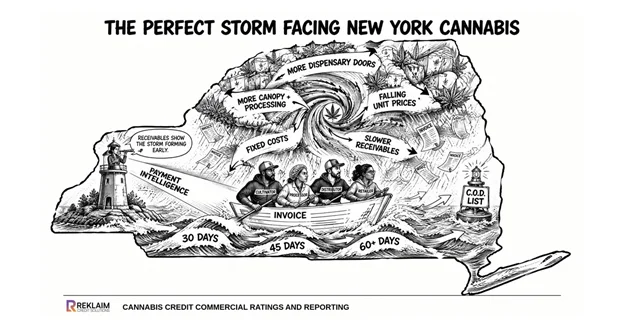

Last week we covered the New York cannabis market; now let’s take a look at Mass.
In September, Massachusetts adult-use retailers passed $10 billion in all-time gross sales. June was the best month the market has ever had, at $156.4 million.
BUT, over the same stretch, the average price of a gram of flower fell to a record low of $3.81. When the first two stores opened in November 2018, that gram cost $14.09!
In New York, volume and margin are moving in opposite directions. Massachusetts is the same story, eight years further along. I’ve been in this industry since 2014, and I have watched this movie play out in several states. We all have.
In September, Lit Alerts’ East Coast Eighth Index recorded record-low eighth prices in all five markets it tracks: New York, New Jersey, Maryland, Connecticut and Massachusetts. It was the first time that had happened. Massachusetts was the cheapest of them, at $22.72 on listed menu prices, $14.22 below New York.
The ending depends almost entirely on how operators adapt while prices continue to settle.
Massachusetts Cannabis Sales Are Holding While Prices Keep Falling
The top line looks healthy. Adult-use sales were $1.64 billion in 2024 and $1.65 billion in 2025. Tuross Group, a leading financial services firm that provides outsourced accounting and AR management to cannabis operators, aggregated the Commission’s daily sales data and found 2026 running about 3% ahead of last year through late August.
Take a look under the hood and the picture changes.
The Commission’s own long-run series shows the average adult-use gram falling 62% between November 2018 and April 2024, from $14.09 to $5.36. Annual averages tell the same story: $10.20 a gram in 2022, $6.07 in 2023 and $3.81 by August 2026. Even last year’s decline was steep. A gram averaged $4.42 in January 2025 and $4.05 in January 2026.
Wholesale moved first and hardest. Cannabis Benchmarks tracked Massachusetts flower falling from $3,387 a pound in January 2022 to $1,416 a year later, a 58% drop in twelve months. It hasn’t recovered. What didn’t change was the price to produce that pound.
On May 29, 2026, the Massachusetts wholesale index was 9.8% below its year-earlier assessment. In February, then-Commissioner Kimberly Roy said wholesale flower prices had “crashed 60% to 70% since the market launched.”
Transactions tell the same story. Retailers rang up 46.3 million sales in 2025, about 3.4 million more than in 2024. Total dollars rose by only $3 million. By my math on the Commission’s figures, the average transaction fell from roughly $38.43 to $35.68, about 7% in a single year.
In its August 2026 point-of-sale sample, Headset puts the average item in Massachusetts at $16.80, against $29.05 in New York and $29.74 in New Jersey. Headset also shows where the money is going: Massachusetts flower sales fell 8.7% from a year earlier, while vape pen sales rose 10.5%.
The divergence did not start last year. From 2023 to 2025, gross sales dollars rose 5.1% while units sold rose 29.2%, according to Commission data. Dollars per unit fell from $28.72 to $23.35, and through 2026 the figure is $22.69.
Flower is where it really bites. Tuross’s analysis of Commission transaction data shows flower revenue of $671.8 million on 134.9 million grams in 2024, against $661.1 million on 160.0 million grams in 2025. Volume rose 19%. Revenue fell.
Consumers are buying more product for less money (“price rationalization”). The dollars held. The margin inside each dollar did not. And that hurts operators all the way up the supply chain.
The medical market shows what happens when the cheaper option wins. Medical sales fell from $270 million in 2021 to $162 million in 2024, a 40% decline, as adult-use prices dropped below what many patients had been paying. Medical’s share of the legal market went from 26% in 2020 to 9% in 2024.
Is the Massachusetts Cannabis Market Oversaturated?
Supply explains most of the price curve. The Commission estimates Massachusetts has roughly 1 to 1.2 square feet of licensed canopy for every adult 21 and older, well above neighboring Connecticut, where prices are higher. Active cultivators and microbusinesses held licensed capacity for up to 4.57 million square feet of canopy at the end of 2025. Nearly 3 million square feet was active, with another 700,000 pending.
The Eighth Index puts the gap in dollars: in September, the average Massachusetts eighth was $22.72. In Connecticut it was $31.25. And none of the Massachusetts supply is supposed to leave the state. As Commissioner Anthony Wilson put it: “Massachusetts can’t sell to Connecticut, Connecticut cannot sell to Massachusetts.” Of course, “can’t” does not equal “doesn’t”.
Retail has the same problem. The Commission counted an average of 5.1 retailers for every 100,000 residents statewide, with Berkshire County at 18.9 and Hampshire County at 16.6. MariMed told investors this summer that Massachusetts “now has one of the highest dispensary per capita ratios in the country, which has driven elevated promotional activity and basket compression.” It cited competition in Massachusetts and Illinois for a roughly 180-basis-point year-over-year decline in adjusted gross margin.
Tuross puts the retail math in one number. Using Commission sales data and operating license counts, it calculates that open stores grew from 145 in 2021 to 406 by August 2026.
Over the same stretch, revenue per open store fell by more than half, from about $765,000 a month to roughly $353,000. Flat sales spread across nearly three times as many doors goes a long way toward explaining why credit stress is rising and operators are struggling.
A study prepared for the City of Boston’s Cannabis Board put numbers to it. Whitney Economics estimated that average revenue per Massachusetts store fell 8.9% in 2025, to about $2.9 million. Over the same year, it estimated the revenue a Boston store needs to be economically viable rose 10.4%, to about $5.3 million.
Its conclusion: licenses are “at or above the level of saturation.” Those are modeled estimates, not audited financials. But the direction is hard to argue with. Revenue per door is falling while the cost of running each door is rising.
You can see it town by town. Brookline once hosted one of the busiest dispensaries in the country. Its local cannabis tax receipts fell from $1.84 million in fiscal 2020 to $386,574 in fiscal 2024, as stores opened in surrounding towns and prices fell.
Public company disclosures point the same way. TILT described Massachusetts in early 2024 as “incredibly price competitive,” with roughly 25% price compression during 2023.
A year later it sold its Massachusetts dispensaries for $2 million, and its CEO said “the high cost to produce products in the state coupled with low selling prices has turned off many MSOs who have begun to leave Massachusetts.” AYR Wellness, as part of a restructuring with its lenders, closed four Massachusetts dispensaries and its Milford cultivation and manufacturing facility in 2025, affecting 157 workers.
In September, Lit Alerts put it bluntly: “Price points that were considered deep promotional discounts just six months ago are rapidly becoming the standard retail baseline.” History does have a nasty habit of repeating itself.
Regulators have started to respond but of course with a mallet, not a hammer.
In April, the Commission voted to stop accepting most new cultivation license applications for at least 120 days beginning June 16. Applications filed by June 16 and qualifying microbusiness applications from Social Equity Program participants and Economic Empowerment Applicants were exempt, and existing licensees could still request canopy changes. Yet again, state legislatures are leading social equity applicants to slaughter.
A review from the Commission should land this fall, just as the fall harvest moves into wholesale channels. Starting in 2026, the Commission can also move a cultivator to a lower tier, and cut its canopy, if it sells less than 70% of what it grows.
The same month, the Legislature doubled the number of retail licenses a single operator can hold, from three to six. Consolidation can be good and lawmakers framed it as a way to spread overhead across more stores.
I read it as a green light for consolidation, which, as I’ve written before, is coming anyway. And with the ownership threshold for counting toward the cap raised from 10% to 20%, owning six stores might mean an operator effectively influences many more.
Meg Sanders, chief executive of Canna Provisions, summed up the math for regulators at a March hearing, when a gram averaged $4.05: “No matter how good you are as an operator with your profit margins, at some point there’s not enough money to pay your bills.” At a Commission listening session the same month, it was reported that she warned that receiverships could double without a cultivation freeze. Gabriel Londono of Harbor House Collective described operators facing “razor thin or even negative margins.”
The price has fallen further since. Eighths are still falling too, but more slowly than in nearby markets. Over the 13 months through September, the Massachusetts eighth fell 7.34% from its peak, on listed menu prices. New Jersey and Connecticut each fell about 19.5%. I read that as a market nearing its floor, while younger markets slowly and then quickly follow down to it.
New entry points the same way. According to Tuross, 174 licenses commenced operations in 2021. So far in 2026, 36 have, down 79% from the peak. Retail openings went from 97 to 17.
Massachusetts Cannabis Taxes Add More Pressure to Margins
Every adult-use sale in Massachusetts carries a 10.75% state excise tax, 6.25% state sales tax and up to 3% local option tax. That’s roughly 20 cents on every retail dollar, collected at the register.
Because the excise is a percentage of price, the tax collected on each unit falls with the price. But consumers have made up the difference by buying more, so total collections have held remarkably steady.
According to Department of Revenue figures compiled by Tuross, combined state and local cannabis-specific tax collections were $320.3 million in fiscal 2024, $340.4 million in fiscal 2025 and $336.1 million in fiscal 2026.
The State Auditor’s figures show the excise line alone slipping just 1.19% in fiscal 2026, to $181.1 million. The Massachusetts Budget and Policy Center counts nearly $1.9 billion in state and local cannabis revenue from fiscal 2019 through fiscal 2025.
Now compare that to what the industry keeps. Tuross estimates that the entire value chain, from the grower to the retailer, retains roughly 6 to 10 cents of each retail dollar as pre-tax income.
It is not a like-for-like accounting comparison, because the roughly 20 cents is consumer tax collected and remitted at retail. But it illustrates the scale: taxes on a fully taxed retail sale equal roughly two to more than three times the estimated pre-tax income retained across the supply chain.
And that pre-tax income is before the federal bill, if it even gets paid. The Commonwealth decoupled from Section 280E in 2022, so state tax falls on net income. The federal government has not done the same for adult use.
An April 2026 federal order moved MEDICAL marijuana in FDA-approved products or subject to a state medical marijuana license to Schedule III. Adult-use marijuana generally remains in Schedule I. Treasury and the IRS said tax guidance would follow and that Section 280E would apply only to activities that still involve Schedule I or II substances.
The Boston Globe has reported operator-described effective federal tax rates of 60% to 80% for cannabis sellers. Operators with high COGS fare better than those who live with high SG&A.
Community impact fees added another burden. Historically, some host community agreements assessed up to 3% of gross sales. Northeastern University researchers queried 88 municipalities; 47 reported collecting $53.3 million in impact fees from 2018 through May 2022.
Those fees were assessed on revenue, not profit. A 2022 reform now requires fees to reflect documented municipal costs, caps them at 3% and ends them after a licensee’s eighth year. The cleanup is still going on. By December 2024, the Commission had found about 461 of 615 submitted host community agreements noncompliant. Operators have been suing to get money back: an Uxbridge retailer recovered nearly $1.2 million, and in August a judge ordered Newton to return more than $2 million to three retailers.
This matters for credit in a specific way. Sales and excise taxes are collected from the consumer and owed to the state. They come off the top. When cash gets tight, an operator has a powerful reason to prioritize the Department of Revenue, because DOR can levy assets and tax compliance is required for licensing and renewal.
In early 2025, the Globe reported operators using cash set aside for operations to pay taxes so they could renew their licenses.
When margins shrink, the tax bill doesn’t wait. The supplier does.
Cannabis Receivables, Closures and Financial Distress in Massachusetts
Plant-touching cannabis businesses generally cannot obtain federal bankruptcy relief. In Massachusetts, distressed operators often go into state court receivership instead. In January 2026, 24 licensees were in receivership. By April, the number was 31, and then-Chair Shannon O’Brien said roughly 30 more were in the pipeline.
According to Commission figures reported by Axios on April 16, 2026, 124 cannabis businesses closed in 2025, and 37 more surrendered or let their licenses expire in the first months of 2026.
This is not a Massachusetts problem alone. Back in 2023, nationally, Beau Whitney of Whitney Economics estimated that delinquent payments across legal cannabis topped $3.8 billion, about 1.6 months of all legal retail sales.
Read More: Massachusetts Cannabis Delinquent List: What the 60-Day Rule Means for Suppliers
Suppliers feel it first, and longest. A West Boylston grower told the Boston Globe that half his orders last year were paid late, and a few were never paid at all. Before 2025, he said, it was barely a problem.
Nova Farms estimates it was shorted about $4.5 million in product in Massachusetts over two years, far more than in its other states. CommCan said it wrote off roughly $40,000 after one too many trips to small claims court and now gives new accounts a discount to pay cash on delivery. Berkshire Roots CEO Kris Foley has gone to court to recover money he says about a half dozen retailers owe his company. Collection companies win where there is no shared credit intelligence before your product ships.
Operators have been saying this to regulators for a while.
In February 2025, Timothy McNamara of Holistic Health Group told the Commission that the accounts receivable issue affected every licensee, and that current regulations did not account for “bad actors who accrued debt.” In March 2026, Londono described retailers moving from vendor to vendor, taking product without paying on time.
Revolutionary Clinics went into receivership owing nearly $10 million to creditors while carrying more than $3 million in its own unpaid receivables. It was a debtor and a creditor at the same time. That is how nonpayment moves through a supply chain, one balance sheet at a time.
Look at what that means in practice. In April 2026, Pure Oasis temporarily closed its two Boston stores after the Department of Revenue froze its bank accounts over approximately $400,000 in unpaid sales taxes, according to co-owner Kobie Evans.
Three months earlier, a brand had sued the company over roughly $63,000 in unpaid invoices. When Atlantic Medicinal Partners shut three locations in May, lawsuits against it sought a combined $6.11 million, from unpaid rent and utilities to a loan default. The same operator can be dealing with tax arrears, trade debt and landlord claims all at once. Guess who typically gets paid at the back of the line.
Delinquency rarely appears overnight
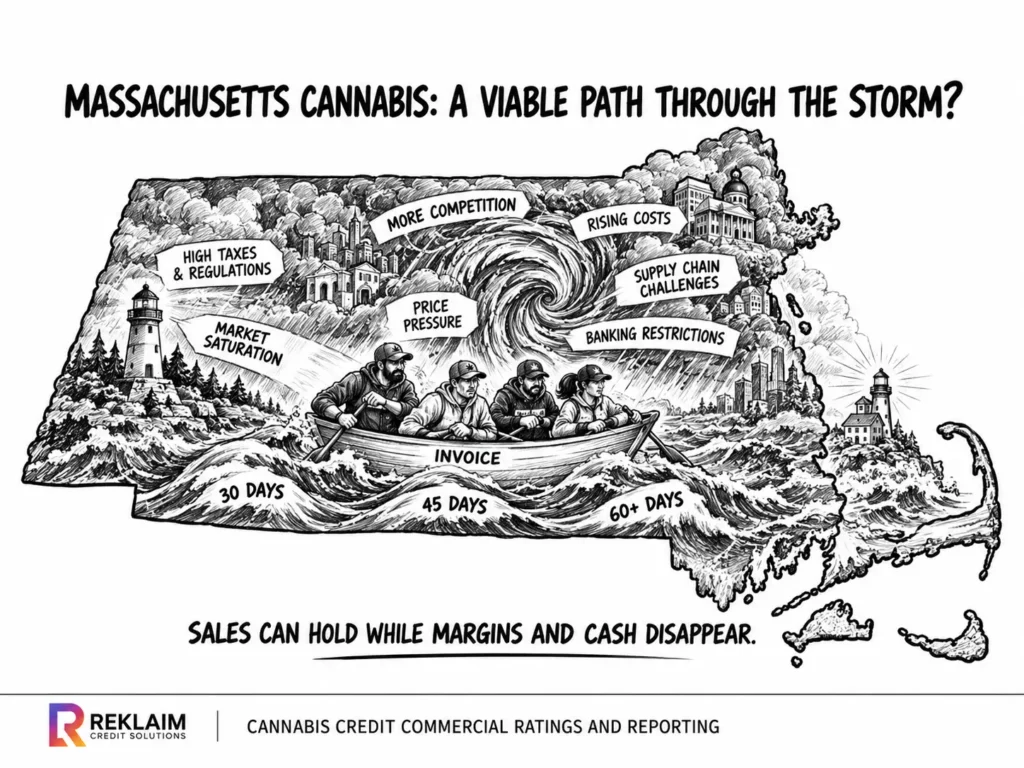
A retailer that pays in 30 days, then 45, then 60 is telling its suppliers something. The trouble is that each supplier only hears its own part of the conversation.
Who Gets Paid When a Massachusetts Cannabis Licensee Fails?
Like Sheldon waiting for a special screening of Raiders of the Lost Ark, the trade creditor is often near the back of the line. Court-approved receivership expenses and secured creditors with valid, perfected liens typically have priority in specific collateral. Tax liens, lease rights and court orders can change the result in a particular case.
A landlord may have eviction rights, but that does not automatically create priority in sale proceeds. The cultivator that shipped product on 30-day terms is usually a general unsecured creditor unless it obtained collateral, a guaranty, a judgment lien or another enforceable priority right.
This is where credit applications and specific order confirmations come in handy.
Massachusetts adds a second layer.
A court-appointed receiver can stabilize a business, market it and ask the court to approve a sale. But a cannabis license does not move on a court order alone. Any change of ownership or control still needs the Commission’s approval. Every distressed sale becomes two transactions, one in court and one before the regulator. The time between them shrinks the pool of buyers, and with it, the money that ever reaches unsecured creditors.
To its credit, the Commission is paying attention. In January it directed staff to build monitoring of receiverships, and in June it published a list of pre-approved court appointees. What the public record rarely shows is how much the unpaid suppliers get back when it’s over. I believe the answer, for most of them, is little or nothing.
Receivables are assets until they become cash or losses.
Massachusetts Regulators Have Been Watching the Credit Problem
None of this surprised the Commission.
In May 2024, commissioners discussed delayed payments as a threat to financial stability across the supply chain. Then-Commissioner Bruce Stebbins laid out an unpaid supplier’s options: negotiate, stop selling, or go to court. A month later, the Commission asked licensees to quantify their outstanding balances, explain their credit controls and suggest a way to identify customers who don’t pay.
The Commission knows firsthand how easily receivables slip. An independent audit it commissioned, released in August 2025, found that about $550,000 in prorated license-extension fees granted between August 2022 and June 2024 had never been billed.
When the Commission finally sent invoices for $535,000, it collected a little more than $350,000. Those are government receivables, not trade debt. But the lesson is the same one every supplier learns: an invoice nobody tracks is an invoice nobody pays.
Nearly two years after that 2024 meeting, the Legislature answered.
Massachusetts Cannabis Credit Rules Change on January 1, 2028
On April 19, Governor Healey signed An Act Modernizing the Commonwealth’s Cannabis Laws. It cut the Commission to three members appointed by the governor, doubled the possession and purchase limit to two ounces, opened statewide delivery and raised the retail license cap. Most of it took effect immediately.
One section waits until January 1, 2028. From that date, a licensee may extend credit for cannabis products only in the usual course of business and for no more than 60 days, and receiving credit beyond that is just as unlawful as extending it.
If a debt isn’t paid in full within 60 days, the supplier must notify the Commission and the customer within three days. The Commission then has five days to confirm the report and post the delinquent licensee to a list available to licensees and authorized agents, not the general public. A listed business can buy only with full payment on or before delivery. The Commission also cannot approve a change of ownership or control until the delinquency is paid. The exceptions are narrow: court-appointed receivers and trustees under a voluntary assignment for the benefit of creditors, subject to Commission approval and notice requirements. Violations carry fines of up to $5,000 each.
Kudos for the attempt, but if you’re a supplier who just shipped $20,000 of gummies and the next day you find out that your buyer is already 70 days late on paying other vendors, that COD list isn’t much help.
Compare that to New York. At a September 10, 2026 Cannabis Advisory Board meeting, the Office of Cannabis Management reported 87 retailers on its C.O.D. list, owing about $3.89 million to 44 suppliers. The average delinquency was roughly 281 days. Industry representatives acknowledged what NY operators already knew: some suppliers kept delinquent retailers off the formal list while they worked out side arrangements.
New York’s official guidance requires suppliers to report defaults and limits listed retailers to cash on delivery. Massachusetts attempts to close the same door. Reporting will be mandatory within three days, and a supplier that carries a customer past 60 days will be breaking the law, too. But unlike Massachusetts, New York’s reporting requirement doesn’t move up the supply chain. Distributors not paying manufacturers do not get reported.
It is a decent law. It also has limits. It doesn’t collect an old invoice, create a lien or move an unpaid supplier up the line. It covers product sold between licensees, not rent, equipment, build-outs or services. And like New York’s list, it counts the businesses that have already failed to pay. It says nothing about the ones heading that way.
Massachusetts Question 8 Could Change the Cannabis Market in 2028
Question 8 on the November ballot would repeal the adult-use commercial licensing and sales framework, effective January 1, 2028. It would preserve the medical program, give existing adult-use businesses an expedited path to apply for a medical license, and change adult possession rules. Recent polling suggests voters will reject it. If it passes, most of this conversation changes. But the stakes are worth knowing.
Tuross, which discloses that it would itself be affected by repeal, has modeled the fiscal exposure. The clearest published baseline is the approximately $336 million in cannabis sales tax, excise tax and local option tax generated in fiscal 2026. Because medical purchases are exempt from these taxes, ending commercial adult-use sales would eliminate most of that revenue stream, although receipts would phase out rather than vanish on the effective date. The Marijuana Regulation Fund is not a separate revenue stream to add on top of the $336 million, because excise receipts flow into the fund. A repeal would nonetheless sharply reduce the resources the fund supports. The Massachusetts Budget and Policy Center reports that the fund now supplies more than 70% of the funding for the Bureau of Substance Addiction Services. Cities and towns would also lose their local option tax, which the Commission puts at more than $43 million in fiscal 2026.
The Commission reports about 15,000 people directly employed in the industry. Tuross estimates that repeal could eliminate roughly 13,200 of those direct jobs and about 16,200 jobs when ancillary roles are counted. Presumably, most of those employees are votes with a mail-in ballot sitting on their kitchen table.
The Commission also estimates that 35% to 60% of current demand could move to the illegal market and another 25% to 30% to neighboring states. Tuross separately estimates total public revenue exposure of as much as $448 million a year when income, payroll and other taxes are included. To be fair, those are scenario estimates, not published collection totals. They depend on assumptions about enforcement, consumer behavior, medical conversion and neighboring-state capacity. A meaningful shift to illegal sources would also increase the risk that consumers buy untested and potentially unsafe products.
For suppliers, the problem is more immediate. If Question 8 passes, collecting receivables from adult-use-only customers gets a lot harder as those businesses wind down, seek medical conversion or sell permitted assets. Anyone extending credit during 2027 needs to be thinking about what happens to that receivable on January 1, 2028.
I think everyone is still planning for the market that exists. But anyone extending terms into late 2027 should know which market they’re underwriting.
The next 15 months: What Massachusetts Cannabis Suppliers Should Do Before 2028
Until 2028, there is no cannabis-specific statewide ceiling on terms and no regulator-run delinquency list. A supplier can still give a customer 60, 90 or 120 days, with no state-run signal showing who else that customer owes. Reklaim Credit Solutions was built to provide that transparency.
That window cuts both ways. Operators have time to bring terms inside 60 days gradually, one account at a time. The supplier who waits may be forced into a hard reset at the worst possible moment, just as its weakest customers can least afford it.
What Massachusetts Regulators Could Change Before 2028
None of this reverses price compression, and it shouldn’t try. The goal should be a credit framework that works and is used on day one, and a tax and fee structure that doesn’t push struggling licensees past the point where they can pay anyone else.
Write the rules early
The statute leaves open questions for rulemaking. How will the date of delivery be established for split shipments, rejected deliveries and corrected manifests? How are quality disputes, returns, credits, offsets and partial payments handled? Where do consignment and sale-or-return arrangements, which are common in this market, fit under a law that covers credit “directly or indirectly”? What happens to invoices still open on January 1, 2028? Operators need those answers early enough to adjust their terms without being forced into it at the last minute.
Make disputes fast and fair
The Commission must confirm each report within five days. That time frame is a challenge for most government agencies.
There also needs to be a fast way to challenge a bad report. Retailers need protection against being wrongly put on the list, and suppliers need to know that when someone is on it, it means something.
Publish the aggregate numbers
Only licensees and their authorized agents will see the list. The Commission can still publish the count, total dollars reported and average age of delinquency, the way New York does. It could also release an anonymized summary of what licensees told it in 2024. Shared trade payment data makes a market more transparent, and sales totals alone will never tell lenders, investors or policymakers how healthy credit is. Again, that is clearly where a service like Reklaim Credit Solutions can play a significant role.
Use the excise study
The new law requires the Commission to report on the cannabis excise rate. That study should look past total collections and explore what the tax does to margins. Flat collections on falling prices mean the state is holding its take while the industry absorbs the compression.
Finish the fee cleanup
Three of every four host community agreements the Commission reviewed were noncompliant, and courts are now ordering refunds town by town. A faster, statewide resolution would return cash to operators who need it and reduce the legal costs on both sides.
Let supply follow the data
The cultivation freeze and tier relegation are a start. The review this fall can use the seed-to-sale data the Commission already has to decide whether, where and how fast to add capacity.
What Massachusetts Cannabis Operators Can Control Now
Policy moves slowly. Receivables don’t wait.
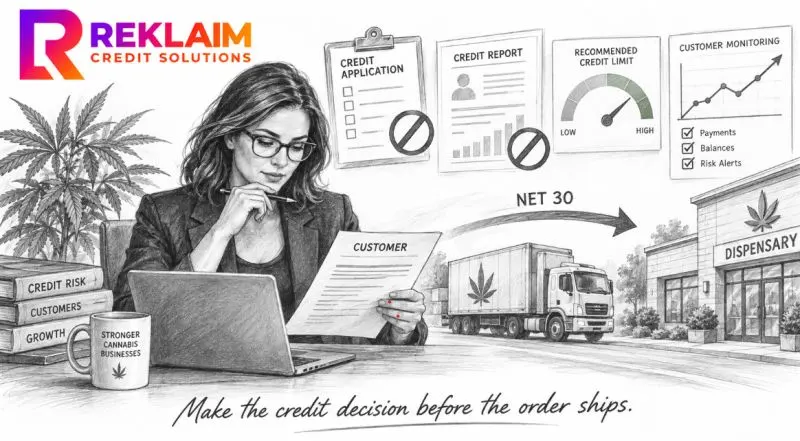
Every sale on terms is a credit decision. When the price of a gram has fallen by roughly three quarters, a credit limit you set two years ago was set for a customer whose business looked entirely different. Credit risk changes over time, and in Massachusetts it has been changing fast.
The objection we hear most is some version of this: “If I shorten my terms, that retailer buys from someone who won’t.” Today, that’s true. In 2028, the supplier offering 90 days will be breaking the law. You can make that adjustment on your own schedule now, or on the state’s schedule later. And a sale that never converts to cash is not a sale at all.
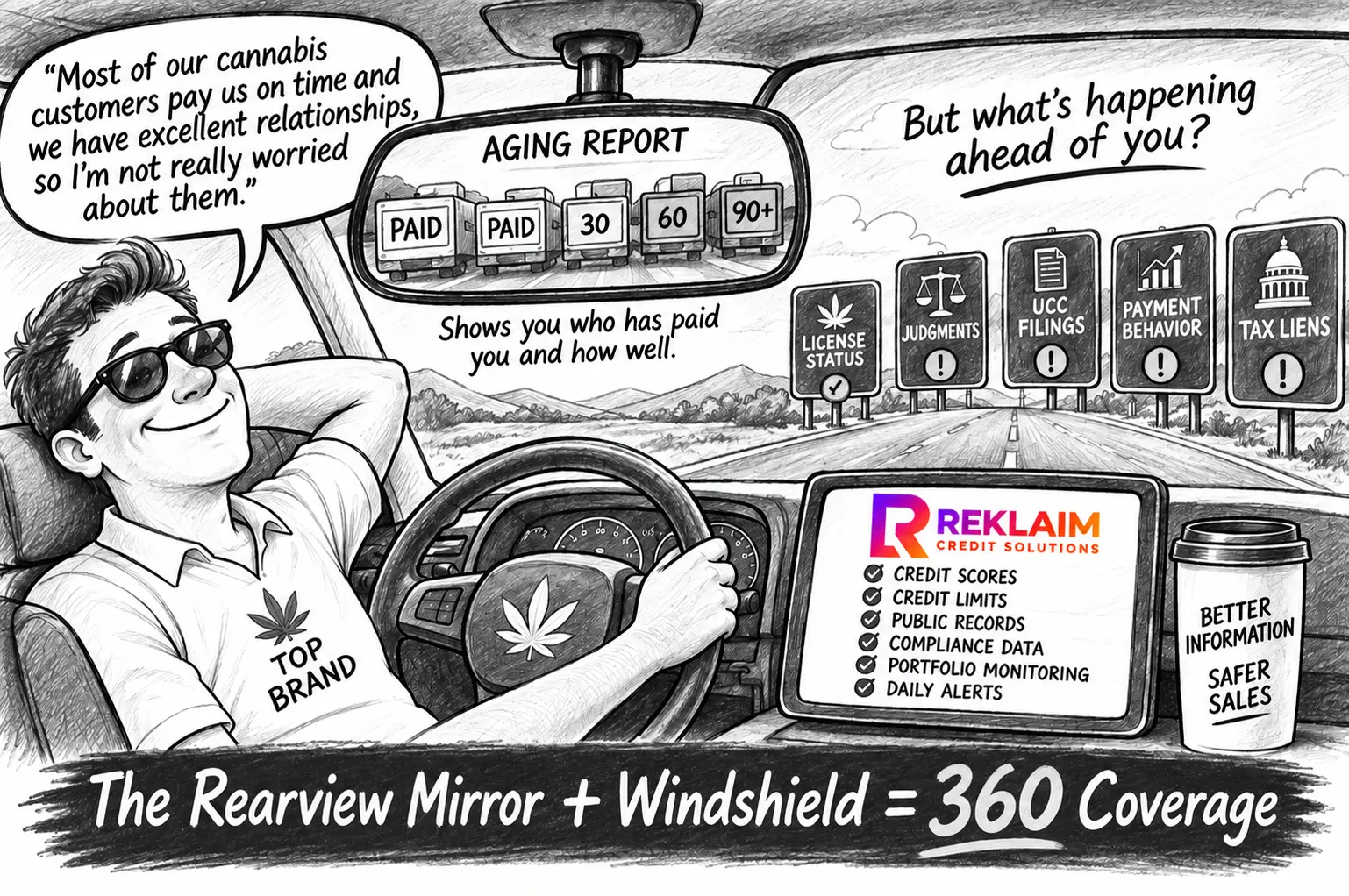
AR aging often shows risk before a financial statement or a regulatory list does. A customer that is slowing down with you is often slowing down with several suppliers at once. No single supplier, distributor or trade association can see that pattern alone.
That blind spot is one of the reasons we built Reklaim Credit Solutions, a commercial credit rating agency for the regulated cannabis industry. No supplier can see how a customer is paying everyone else. By combining AR aging data from across the industry, we can. That allows us to provide commercial credit scores, suggested credit limits, credit reports and continuous monitoring based on what is happening across the market, not just what one customer is doing with one supplier. We are onboarding subscribers now and ingesting their AR aging data.
A supplier that sees stress forming early has options. One that learns about it from a list has a loss.
So, is there a viable path?
Yes. Demand in Massachusetts has held for eight years. More than 300 of the state’s 351 cities and towns now host a business or allow delivery. The market set a monthly record this summer. The customers are there.
The question is whether operators can make money serving those customers. The ones that survive won’t necessarily be the biggest. They’ll be the ones that understand their margins, protect their cash and stop treating receivables like sales until the money shows up. And if they’re going to extend credit, they need to know who they’re extending it to. Selling to fewer retailers that actually pay is far more logical than selling to everyone who places an order.
In 2028, Massachusetts is going to force some of that discipline on the industry anyway. There is no reason to wait.
Thank you to Tuross Group for sharing its analysis.
Sources
- Massachusetts Cannabis Control Commission, “Massachusetts Marijuana Establishments Hit $10 Billion in Gross Sales,” September 9, 2026
- Massachusetts Cannabis Control Commission, “Massachusetts Adult-use Cannabis Sales Generated $1.65 Billion in 2025,” January 8, 2026
- Massachusetts Cannabis Control Commission, “Cannabis Control Commission Releases Industry Report Assessing Adult- and Medical-Use Cannabis Markets,” February 26, 2025
- Massachusetts Cannabis Control Commission, Bulletin: Temporary Moratorium of Marijuana Cultivator License Applications, June 12, 2026
- Massachusetts Cannabis Control Commission, Bulletin: Tier Relegation, October 30, 2025
- Massachusetts Cannabis Control Commission, Public Meeting Minutes, February 27, 2025
- Massachusetts Cannabis Control Commission, Public Listening Session Minutes, March 18, 2026
- CliftonLarsonAllen LLP for the Cannabis Control Commission, Accounts Receivable and Collections Performance Audit, August 27, 2025
- Massachusetts General Court, Acts of 2026, Chapter 65 (An Act Modernizing the Commonwealth’s Cannabis Laws), and G.L. c. 94G, s. 23
- Massachusetts General Court, Fact Sheet: An Act Modernizing the Commonwealth’s Cannabis Laws, April 6, 2026
- Vicente LLP, “Massachusetts Governor Signs Comprehensive Cannabis Reform Bill Into Law,” April 21, 2026
- Massachusetts Department of Revenue, Marijuana Retail Taxes FAQs, April 24, 2026
- Massachusetts Office of the State Auditor, Net State Tax Revenues, Exhibit VI, September 15, 2026
- Massachusetts Budget and Policy Center, “Show Me the Money: Cannabis Revenue, Spending, and Equity in Massachusetts,” September 15, 2025
- Tuross Group, Question 8 Repeal Impact Model and Municipal Exposure analysis, September 2026
- Tuross Group, analysis of Cannabis Control Commission retail sales, operating license counts and transaction data, 2026
- Lit Alerts, “The East Coast Eighth Index,” September 10, 2026
- Headset, Massachusetts market data, August 2026
- Cannabis Benchmarks, U.S. Cannabis Spot Index, May 29, 2026, and Massachusetts market analysis, March 5, 2024
- Cannabis Business Times, “Inside the Cannabis Market in Massachusetts, Operators Find (Cautious) Optimism,” February 2023
- Cannabis Business Times, “Massachusetts Medical Cannabis Sales Drop 40% Since 2021 Peak,” September 8, 2025
- Cannabis Business Times, “AYR Wellness’ Massachusetts Exit Includes 4 Dispensaries, 157 Layoffs,” 2025
- CRB Monitor, “MA Regulators Consider Cultivation Freeze,” February 12, 2026
- CRB Monitor, “Colorado Lender Sues MA Retailer for Unpaid Loan,” January 24, 2026
- Whitney Economics and Community-Led Solutions for the City of Boston Cannabis Board, Boston Cannabis Retail License Saturation Analysis, revised February 20, 2026
- Whitney Economics, “Cash Starved Cannabis Operators Topped $3.8 Billion in Delinquent Payments in 2023,” April 2024
- MariMed, Q2 2026 earnings call
- Investing.com, TILT Holdings Q4 2023 earnings call coverage, March 15, 2024
- Green Market Report, “TILT Faces Speed Bumps on Road to Vape-Only Business,” April 18, 2025
- WROR / Brookline.News, Brookline cannabis economy reporting, September 2025
- Axios Boston, “Massachusetts cannabis regulators freeze cultivation licenses,” April 16, 2026
- Axios Boston, “Pure Oasis closes amid mounting debts, frozen account,” April 14, 2026
- The Boston Globe, “Pure Oasis closes as financial strains mount for social equity weed shops,” April 15, 2026
- The Boston Globe, “‘We need to hit the brakes’: Plummeting pot prices are tanking the Massachusetts marijuana industry,” March 11, 2026
- The Boston Globe, “Should government solve cannabis industry’s debt crisis?,” March 15, 2026
- The Boston Globe, “Free-for-all market,” March 18, 2026
- The Boston Globe, “For the Massachusetts marijuana market, the money tree has dried up,” May 1, 2025
- The Boston Globe and Northeastern University, “Local marijuana fees soar past $50 million,” June 9, 2022
- CommonWealth Beacon, “Regulators Take Aim at ‘Wild West’ of Cannabis Host Community Agreements,” February 18, 2025
- MJBizDaily, “Why a Massachusetts town owes the cannabis industry $2 million,” August 7, 2026
- MJBizDaily, “Massachusetts caps cannabis cultivation, expands retail,” 2026
- Worcester Business Journal / MMJDaily, Atlantic Medicinal Partners closure and lawsuits, May 19, 2026
- WBUR / State House News Service, Massachusetts cannabis sales top $10 billion, September 9, 2026
- WBUR, Governor Healey’s Cannabis Control Commission appointments, May 19, 2026
- Agency Checklists, “Cannabis Sector Hits Sales Milestone Ahead of Repeal Vote,” September 14, 2026
- U.S. Department of the Treasury, “Treasury, IRS Announce Process for Tax Guidance Following DOJ Final Order on Medical Marijuana Rescheduling,” April 2026
- Foley Hoag, “DOJ Immediately Reschedules State-Licensed Medical Cannabis to Schedule III,” April 2026
- New York Office of Cannabis Management, Delinquent Payment Reporting guidance, and Cannabis Advisory Board meeting, September 10, 2026
- University of New Hampshire Survey Center, Bay State Poll, September 2026, as reported by MJBizDaily