
We’ve covered New York and Massachusetts. Now let’s head west to Oregon, where more than a decade of legal sales shows pretty clearly where oversupply and burdensome structural hurdles hamper the industry.
Picture a dispensary chain that racks up 30 lawsuits from brands, labs, landlords and accountants alleging more than $1.7 million in unpaid bills. Add a growing stack of state tax liens. Add at least $225,000 in political contributions and a sitting Secretary of State on a $10,000-a-month consulting contract with one of its affiliates while her office audits the cannabis regulator.
Now guess how many times that regulator denied the chain a new license.
Zero.
Welcome to Oregon.
What Does the La Mota Case Reveal About Oregon Cannabis Enforcement?
The chain is La Mota, and it’s a rare public glimpse into what happens when unpaid bills, political money and weak enforcement land in the same place.
In March 2023, Willamette Week counted 30 lawsuits against La Mota and related companies since 2017, alleging more than $1.7 million in unpaid bills. One $717,000 claim had been settled. Drops, an edibles maker, separately alleged roughly $390,000 in unpaid product. La Mota denied most of the claims in court filings.
The same reporting found at least $621,000 in state cannabis-tax liens, at least $137,000 of which had been paid. In August 2026, Willamette Week reported more than $7.9 million in new liens issued this summer against owner Aaron Mitchell and dozens of his companies, covering weed, income, withholding and corporate activity taxes going back to 2020.
According to the reporting, Mitchell and co-founder Rosa Cazares did not immediately respond. To be clear, a lien is a claim, NOT a judgment.
Willamette Week also reported at least $225,000 in political contributions by the founders and their companies beginning in late 2019, including $45,000 to then-Secretary of State Shemia Fagan.
In February 2023, while her office was auditing the OLCC’s cannabis program, Fagan signed a $10,000-a-month consulting contract with a La Mota affiliate. She recused herself from the audit, which was released that April. After the contract became public, she ended the consulting work and resigned as secretary of state in May.
Federal prosecutors subpoenaed records. The FBI closed its inquiry into Fagan in late 2024 without charges, and no charges against La Mota’s founders have been publicly reported. A 2025 ethics settlement imposed $3,600 in penalties across three matters, including the consulting contract; Fagan disputed the finding that she used her office to get it. In March 2025, Secretary of State Tobias Read withdrew the audit altogether, citing “potential predetermination of its conclusions.”
Meanwhile, back at the ranch, Willamette Week’s May 2023 review of OLCC records found 208 matters involving La Mota licenses: 143 investigations and 65 business-change reviews. Of those, 111 ended in verbal instructions, 81 ended with no action and 16 reached a hearing. Penalties totaled about $34,000. Through all of it, the OLCC never denied the company a new license.
Read More: The Cannabis COD List: Blunt Tools, Not Surgical Instruments
Somewhere in Oregon, a small dispensary owner who got written up over a camera angle is still trying to figure out how that works.
Then the state protected itself. In 2023, the OLCC began requiring retailers to be current on their taxes, or on a qualifying payment plan, before renewing a license. Those hurt brands. The Oregon Court of Appeals upheld the rule in 2025. When it was adopted, the state said it was owed about $18.9 million in unpaid cannabis taxes.
A novel idea that should extend to trade payables, no?
An Oregon industry trade group did ask lawmakers in 2023 to make sure vendors got paid too. Guess what? Three years later, Oregon still has no cannabis-specific COD rule and no maximum payment term. Suppliers have the same remedies as any creditor: demand letters, lawsuits and judgments, all of which take time and money while the customer gets weaker.
The state protected its receivable. Suppliers are still on their own.
Why Has the Oregon Cannabis Market Been Oversupplied for More Than a Decade?
La Mota is the extreme (and public) case. The rest of Oregon’s problem is quieter, and it starts with price.
In 2015, a gram of flower in Oregon cost about $14, according to an Office of Economic Analysis estimate reported by the Associated Press. In September 2026, the OLCC’s median retail gram sold for about $3.29. Different measures, yes, but same direction.
Oregon had cheap land, outdoor growing conditions other states and OG growers envy and decades of kind growing experience (some of it even legal). What it has today is persistent oversupply, a regulator that seems to have rarely used the tools it had, and suppliers financing customers they can’t see clearly.
I’ve been in this industry since 2014, and I’ve watched this movie in several states. Oregon is just the longest-running version.
Consumers are still buying. Licensed retailers sold about $683.5 million from January through September, down 1.8% from the same nine months of 2025. Like every other state, demand is there. The problem is turning those sales into enough cash to pay everyone up the supply chain.
And it isn’t the calendar. According to Seth Yakatan and Danny Cirulnick of Ordo Verde, whose third-quarter Oregon summary is built on Hoodie Analytics retail data, mature U.S. markets grew about 1.8% in the third quarter while Oregon fell 1.7%, trailing the national number in every month of the quarter. Their verdict was blunt: “Oregon’s softness is not seasonal; it is specific to Oregon.”
Oregon’s oversupply is not new. In January 2019, the OLCC told the Legislature the state already had 6.5 years of theoretical supply on hand. That report set the roadmap for everything that followed. Unfortunately, it appears as though they used MapQuest and not Waze.
Lawmakers responded with a moratorium on new producer licenses in 2019, broadened it in 2022, and in 2024 took a third swing by replacing it with population-based caps that took effect in 2025: one producer or retailer license per 7,500 residents 21 and older, and one processor or wholesaler license per 12,500. The caps limit new applications. They don’t touch existing licenses.
The result?
The crop kept growing anyway. The OLCC’s own harvest data shows licensed growers harvested about 12.27 million wet pounds in 2024 and 13.56 million in 2025, up 10.5% in a year and 41.3% from 2023. October 2025 alone produced about 6.28 million wet pounds.
Of course, wet, out-of-the-ground weight isn’t dried, cured, saleable flower, but measured the same way every year, the trend is clear.
The OLCC’s 2025 supply and demand report estimated that demand equaled 57% of supply in 2024, down from 71% the year before. Translation: Oregon grows far more than Oregonians buy legally.
Beau Whitney of Whitney Economics, one of the industry’s most respected analysts and who has tracked this market for years, puts it in pounds. “Based on our models, there is TOTAL consumer demand for roughly 650,000 pounds of cultivated output. Legal demand is 470,000 pounds,” he told me. By his estimate, Oregon sends roughly 2.7 million pounds to other states. Interstate sales are illegal, so that product isn’t leaving through the front door. “THIS IS WHY OREGON HAS A PROBLEM,” he wrote. The caps are his.
Prices did what prices do. The OLCC’s 2024 median retail price for usable marijuana was $3.75 a gram. By December 2025, the monthly median was $3.33. Wholesale got there first. The median pound hit a then-record low of $550 in December 2022, and in January 2026, Cannabis Benchmarks reported large-volume outdoor trades at $150 to $250 a pound. That’s the price some growers had to take, not terms in most cases, while their costs held steady or grew and had to be paid in real time.
At $150 a pound, an ounce of Oregon outdoor costs less than a movie night for a family of four… and nobody’s making popcorn money on the side.
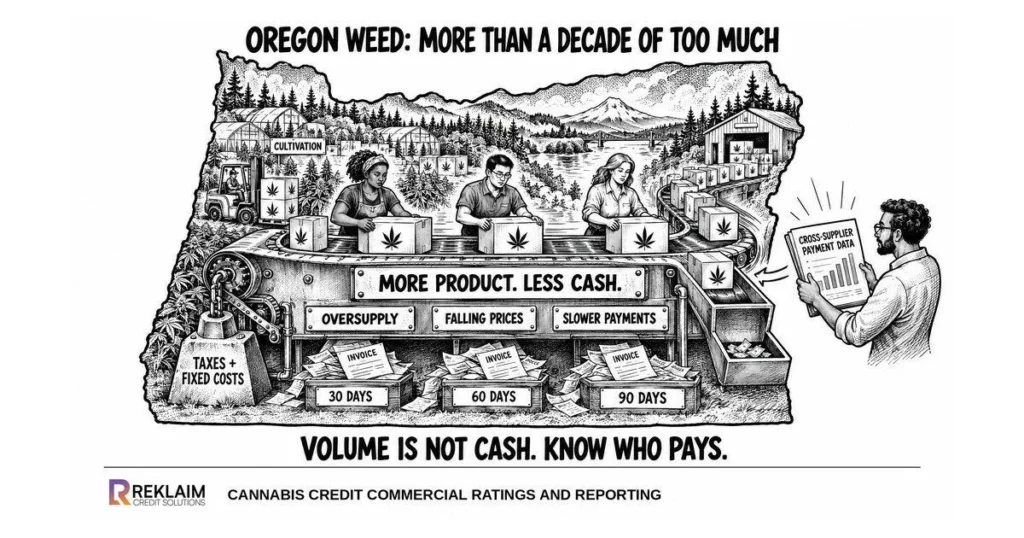
Annual retail sales peaked at about $1.18 billion in 2021. The OLCC’s current reports put 2025 at roughly $926 million, down 21.8% from the peak. Selling more units hasn’t fixed it. Headset’s September data shows the average item at $11.12, down from $12.77 a year earlier. Units rose 15.1%. Dollars rose 0.2%. Retailers moved a lot more product for the same money. That does not help margins.
Yakatan and Cirulnick boiled it down to one line: “Oregon is a volume-up, value-down market.” Third-quarter sales slipped 1.7% to $236.5 million while units rose 1.6%. Flower fell 9.1% on a per-gram basis, to $3.39. In their words, “The same shoppers are buying slightly more items and a lot more product, and paying less for it.”
More weed, same money. Welcome to the treadmill.
Why Are Oregon Cannabis Operators Selling More but Keeping Less?
Grown Rogue is one of the few public companies that reports Oregon separately. Obie Strickler is by all accounts a GREAT grower and operator, but per its filings, Grown Rogue’s Oregon gross margin fell from about 40.6% in 2024 to 28.5% in 2025. In the first half of 2026, Oregon revenue rose 9.4% while gross profit fell 25.8%. Its Oregon business is still profitable, and the second quarter improved. That is impressive. Still, the direction is hard to miss.
Its pricing shows how bumpy any recovery is.
Grown Rogue’s reported average Oregon bulk flower price fell from $787 a pound in the first quarter of 2024 to $466 in the fourth quarter of 2025, then climbed back to $592 in the second quarter of 2026. It reported a production cost of $326 a pound that quarter. If one of the best growers in the state is riding that roller coaster, imagine the small farm with no bulk contract.
Retailers are squeezed too.
In 2025, Whitney told KOIN the average Oregon retailer brings in roughly $1.1 million a year, against the $2.5 million to $2.9 million he considers necessary to be financially viable. Even if he’s off by a lot, that’s a problem. And by his numbers, Oregon ranks 27th out of 40 states in average retail revenue.
Portland shows what that squeeze looks like up close. The metro was the only Oregon region growing in the third quarter, up 4.4%, and it got there by cutting flower prices 17% per gram while the share of sales made on promotion jumped from 16% to 22%. Ordo Verde called it “volume bought with margin,” and “the clearest sign of where competitive pressure in the state is concentrated.” When a retailer buys volume with margin, guess who often ends up financing it.
The license counts tell the same story in a different way. Harris Sliwoski’s December 2025 review reported that Oregon ended 2025 with 769 retailer licenses, down from 789 a year earlier and 833 at the end of 2022. Across all categories, licenses fell by a net 74, to 2,649. Producer licenses fell from 1,375 to 1,351 while the crop grew. Fewer licenses did not mean less cannabis.
A net license decline isn’t necessarily a body count. Licenses expire, get surrendered or change hands, and one company can hold several. The state doesn’t track how many businesses failed. Maybe it should.
Large companies pulled back. In January 2023, Curaleaf announced the closure of the majority of its operations in California, Colorado and Oregon, citing “recent legislative decisions, price compression, and lack of enforcement of the illicit market.” Halo Collective walked away from consignment sales in Oregon in 2022 and stopped selling wholesale flower, trim and oil.
Acreage’s exit shows how even selling out can leave you exposed.
In 2021, it agreed to sell its four Oregon Cannabliss stores to Chalice Brands for $6.5 million, most of it on a 10-month seller note. By the time the deal closed in July 2022, the terms had been reworked: still $6.5 million, but with a $5.85 million secured note stretched to 36 months. Ninety per cent of the price was seller financing for the buyer. Feels a lot like sellers of cannabis financing retailers.
In Oregon, even the exit comes with terms.
Who Gets Paid When an Oregon Cannabis Licensee Fails?
In January 2023, four Oregon farmers told Willamette Week that Chalice owed them more than $100,000 combined, some of it more than a year old. One grower put it plainly: “Chalice is financing its business on the backs of small farmers.” Chalice blamed market conditions and said its own wholesale customers owed it money. A debtor and a creditor at the same time. The same story is playing out state by state.
Four months later, Chalice asked a court to put its Oregon subsidiaries into receivership.
Its complaint put trade payables at about $3.7 million, most of that likely inventory owed to brands and growers. By August, the proposed sale of all but three stores was $3 million, still subject to court approval. A year earlier, Chalice had agreed to pay $6.5 million for four of them. What, if anything, individual suppliers recovered isn’t public. The math doesn’t suggest much.
Chalice wasn’t alone. In September 2024, Tumalo, which operated five dispensaries, two cultivation facilities and an extraction center under brands including Dr. Jolly’s, Local Leaf, Parlour Cannabis Shoppe and The Herb Center, announced the appointment of CannXperts as receiver.
The company said it appeared to be “generally cash flow positive but for the legacy debt” and that it had honored its obligations to trade creditors. That’s the other side of receivership: sometimes the operation works and the balance sheet doesn’t. Legacy debt financing is a balance sheet issue plaguing many, many companies across the country.
I’ve written about this before. Legacy funding for expensive buildouts and growth when the weather forecast was bright and sunny for the entire future is hampering current operations and slowing down restructuring.
With federal bankruptcy generally off the table for plant-touching adult-use businesses, Oregon operators end up in state receivership.
Whitney sees a second consequence. With no bankruptcy protection and little access to normal financing, operators take on high-interest loans, often backed by personal guarantees. “When confronted by the prospect of losing their house or farm, or selling into the illicit market, operators sell into the illicit market,” he told me. “So farmers over supply, drive down prices, and make it up on the illicit side.” So, maybe they are making some popcorn money on the side!
Under Oregon’s receivership statute, ordinary unsecured trade claims sit near the back of the line, behind perfected liens on collateral, the receiver’s administrative expenses, certain wages and pre-receivership state tax claims, among others. When the money runs out before the line does, as it tends to do, suppliers get little or nothing.
Hello HERBL?
An unpaid invoice can survive long enough to become a legal claim without ever becoming cash. And guess what, an uncollectible legal claim is FUBAR.
Read More: Cannabis Accounts Receivable: When to Use Payment Plans vs. Third-Party Collections
Competition outside the licensed market
The illegal market adds pressure nobody can measure. Oregon’s Criminal Justice Commission has awarded more than $41 million in enforcement grants covering July 2021 through December 2025.
Its 2026 report says the scope of the illegal market is unknown and that it can’t conclude the grants in any way reduced it. Whitney Economics estimates licensed retailers’ share of Oregon cannabis sales fell from 75% in 2020 to 68% in 2024. That’s $41 million, and nobody can say whether it worked.
Hemp gets blamed for a lot of this. Whitney isn’t buying it. Oregon’s hemp output has fallen 97.4% since 2019, he says, and the state already confines intoxicating hemp to licensed dispensaries. “Hemp is a narrative that the MJ market claims is the reason for the economic distress, but hemp has little to nothing to do with this,” he told me. His bottom line: “The problem in the Oregon market is over supply.”
Federal changes won’t fix this on their own. The April 2026 rescheduling moved qualifying state medical marijuana and FDA-approved products to Schedule III and left the rest in Schedule I. Adult-use operators can’t count on relief from Section 280E yet, and the change doesn’t open interstate commerce.
Oregon’s biggest competitor is Oregon.
How Do Oregon Cannabis Taxes Affect Operator Cash Flow?
Oregon and Massachusetts land at the same combined retail tax rate: 17% at the state level and up to 3% local. Oregon retailers keep 2% of what they collect to cover the cost of collecting it. The bigger question is where the rest goes.
In Oregon, much of it goes to addiction treatment. Under the current distribution formula, the original recipients, including schools, state police and local governments, receive an inflation-adjusted annual benchmark, originally $45 million. Most of what’s left after administration funds treatment and recovery services, including the Behavioral Health Resource Networks created under Measure 110.
Because the tax is a percentage of price, cheaper cannabis means less tax per sale. Marijuana tax collections fell from $203.5 million in fiscal 2022 to $170.5 million in fiscal 2025, about 16%. In September 2026, the Office of Economic Analysis said revenue had declined for six straight quarters and cut its 2025 to 2027 forecast by $14.1 million.
The Oregon Journalism Project reported in January that funding for the Behavioral Health Resource Networks has fallen 38% since 2021. The pain of falling prices doesn’t just stay inside the industry.
Consumers pay the tax and retailers remit it, so suppliers don’t pay it directly. But they compete with the state for the same retailer’s cash, and that retailer can’t renew its license without staying current with the state. The state has liens and the license. A small farm or producer has an invoice.
Whitney would go further and scrap the tax-compliance rule altogether. In his view, it “only hurts the industry and drives payment issues into the supply chain.”
The state’s collection department has a badge. The farmer, manufacturer or brand has a stamp, an envelope, an email address and, maybe a cell phone number.
Guess who gets paid first.
Where Does Oregon Cannabis Market Pressure Show Up in Accounts Receivable?
Oregon leaves payment terms to the parties.
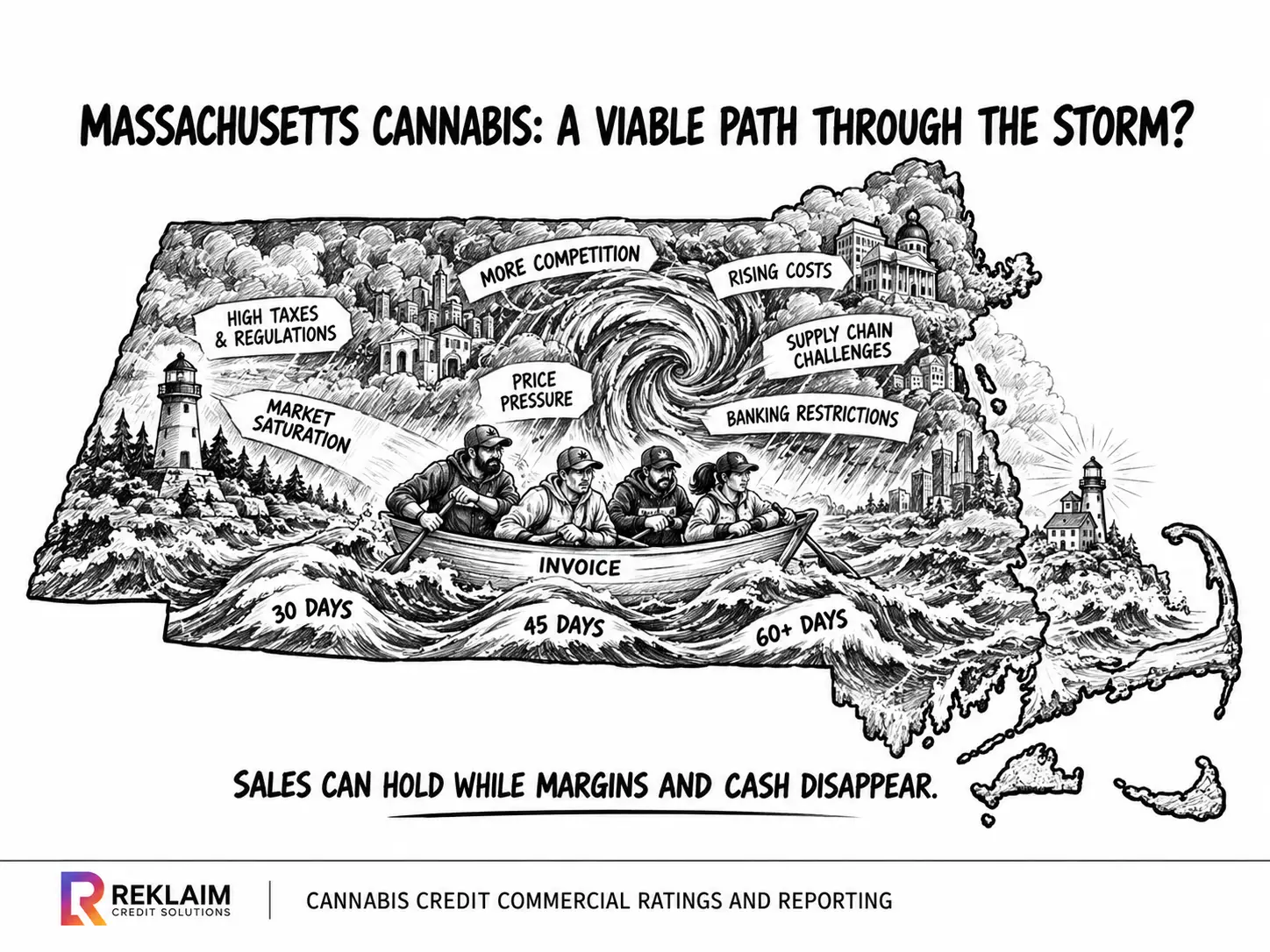
Washington requires payment before or at delivery, or payment initiated by the next business day and completed within five. New York requires retailers to pay within 30 days and limits those on its delinquent-payment list to cash on delivery. Massachusetts will cap trade credit at 60 days starting January 1, 2028. Three states, three approaches. Oregon has adopted none of them.
The OLCC can tell you, almost to the pound, how much cannabis was harvested last October, but nobody can tell you how much of it has been paid for.
There’s no public statewide data on receivables aging, days sales outstanding, delinquent invoices or write-offs between Oregon licensees. Receiverships and company filings show distress one case at a time. They don’t add up to a full picture. They are a collection of rearview mirrors. None are a windshield.
Grown Rogue’s audited 2025 filing offers one additional interesting data point. Its bad-debt provision roughly doubled, to about $731,000 from $360,000, and it wrote off about $403,000 of receivables. Those figures cover all of its states, and the company says it sells primarily on cash on delivery or short terms. Even a disciplined seller had to reserve a lot more.
Shrinking margins make every bad debt bigger. Say a supplier loses $10,000 to a customer who never pays. At a 20% contribution margin, it takes $50,000 in new, COLLECTED sales just to earn that back. At 10%, it takes $100,000.
One customer who doesn’t pay can wipe out the profit from several who do.
And according to Whitney, the trouble usually starts in one place: “Retailers are the biggest problem when it comes to delinquencies.”
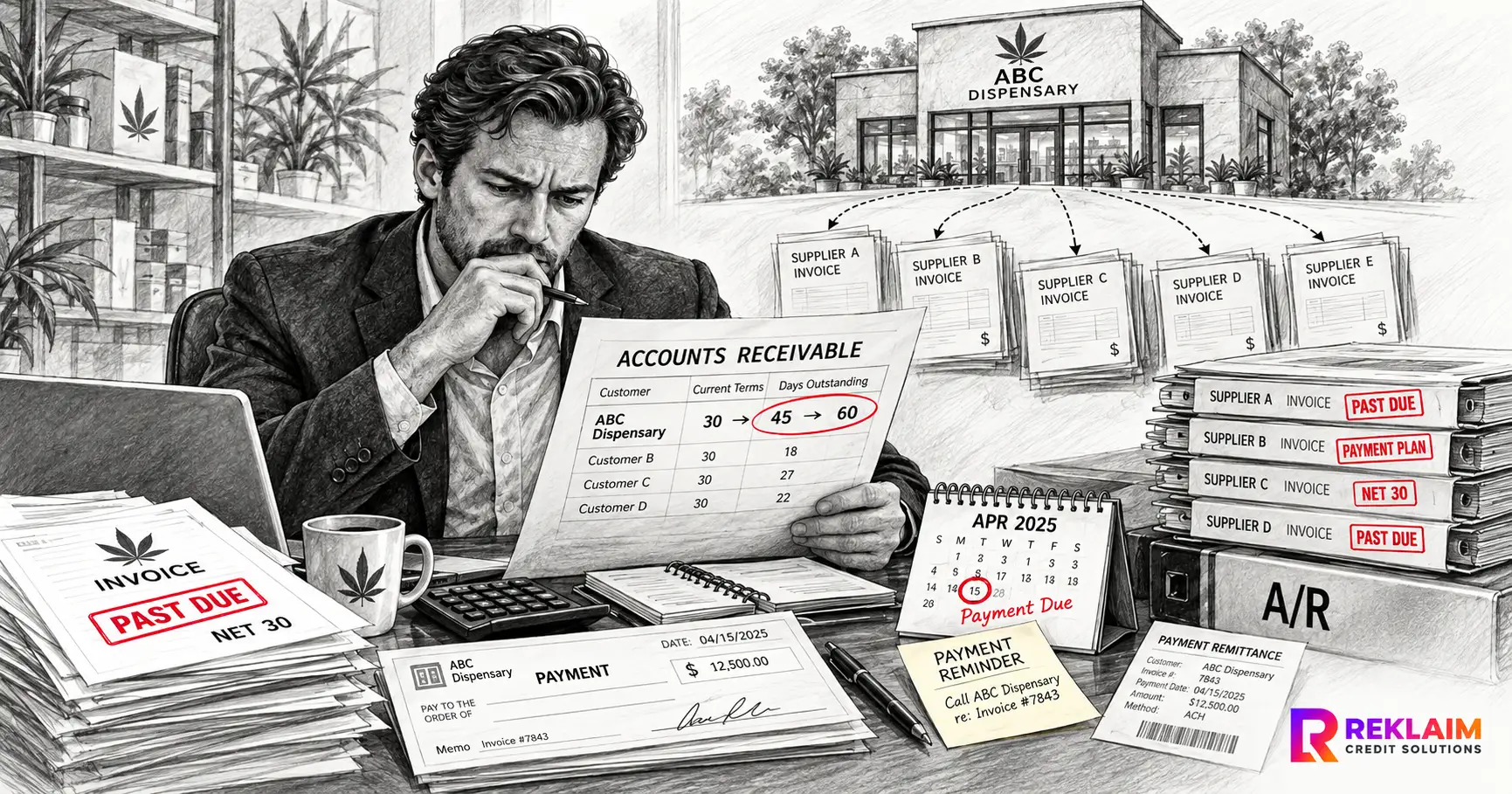
Delinquency rarely appears overnight. A retailer that pays in 30 days, then 45, then 60 is telling its suppliers something. The trouble is that each supplier only hears its own part of the conversation.
By the time they compare notes, it’s usually in a courtroom.
What Could Oregon Do to Reduce Cannabis Payment and Credit Risk?
Institute mandatory credit reporting via an independent third party who can analyze and report on the data. A service like Reklaim Credit Solutions (www.reklaim.io) is literally designed to pay for itself by saving vendors from extending credit that won’t get repaid. Self-serving? Yes. But accurate nonetheless.
Set a payment rule. Washington’s cash-on-delivery model, New York’s 30-day rule and delinquency list, and Massachusetts’ 60-day cap all offer starting points. They are a rear view mirror, yes, but they can inform and reduce pain. Whatever Oregon picks needs a fast process for disputed invoices and a practical way to enforce it.
Bring supplier judgments into license review. The tax-compliance rule already ties renewal to paying the state. Unsatisfied final court judgments for trade debt could get a look too, with notice, a chance to respond, and protection against anyone using a disputed invoice as a weapon.
Publish better distress data. Break out voluntary surrenders, expirations, revocations, ownership changes and replacement licenses. Report receiverships. Put those numbers next to the harvest and sales data so policymakers can see whether capacity is leaving the market or just changing hands.
Measure capacity, not licenses. A wholesale license doesn’t grow anything, and another warehouse isn’t another farm. In 2025, the harvest grew while producer licenses fell. Supply policy should follow the crop, inventory and demand. Whitney puts it simply: “If you do not sell what you produce, then you should not have a license or you have too much capacity.”
Reduce the administrative and structural burdens that already cost cannabis operators more than operators in other industries. That will create better margins throughout the supply chain where every dollar matters.
Oregon doesn’t need to invent anything here. It just needs to borrow from its neighbors and finish what it started.
What operators can control now?
Running a cannabis business in Oregon means being a farmer, a chemist, a compliance officer and an unpaid lender. Only one of those jobs comes with a license.
Policy moves slowly. Receivables don’t wait.
Every sale on terms is a credit decision. A credit limit set a year ago was set for a business that very likely looks entirely different today. Before you ship more, look at how the customer is paying, how much is overdue and how much of your book that customer represents. And know what a loss would cost you at today’s margin, not the one you earned two years ago.
AR aging often shows a slowdown before a lawsuit or a lien does. The hard part is seeing past your own ledger. A customer can be current with you while falling behind with three other suppliers.
That blind spot is one of the reasons we built Reklaim Credit Solutions. No supplier can see how a customer is paying everyone else. By combining de-identified AR aging data from across the industry, we can. Using advanced proprietary prediction models built by one of the most experienced data scientists in commercial credit, we provide commercial credit scores, suggested credit limits, credit reports and continuous monitoring based on what is happening across the market, not just what one customer is doing with one supplier.
We are onboarding subscribers now and ingesting their AR aging data.
A supplier that sees stress early can shorten terms, cut exposure or require payment before the next delivery. By the time a receiver is appointed, most of those options are gone.
After that, you’re just another name on the creditor list.
Is there a viable path?
Yes!
Like every state, demand is there, and with each new generation passing their 21st lap around the sun, demand will grow.
Oregon still has customers, capable operators and hundreds of millions of dollars in annual sales. Some operators are still profitable. But when prices fall and invoices take longer to collect, volume is a poor way to keep score.
The businesses that last will know their costs, protect their cash and stop treating receivables like sales until the money shows up. Selling to fewer retailers that pay is a better business than filling every order that comes in.
Oregon has had more than a decade to build that discipline into its rules. Operators don’t have to wait for Salem to do it.
Sources
Sources and live-data checks current through October 8, 2026. Live datasets and market pages may be revised.
Associated Press, Oregon marijuana glut reporting, May 31, 2018 (syndicated by VOA). AP syndication
OLCC open data: harvest, retail sales and median retail prices. Calendar-year totals and January to September comparisons calculated from the live series retrieved October 8, 2026. Harvest data | Sales data | Median prices
OLCC 2019 supply and demand report, January 31, 2019. Report
2022 HB 4016 Moratorium Legislative Report, March 2023. Report
Oregon Legislature, HB 4121 staff summary, March 4, 2024; ORS 475C.155 (license limits). Staff summary | Statutes, chapter 475C
OLCC 2025 supply and demand report, February 1, 2025. Report
MJBizDaily, Oregon marijuana prices reach new lows amid oversupply issues, March 13, 2023. Wholesale lows
Cannabis Benchmarks, U.S. Cannabis Spot Index, January 9, 2026. Report
Headset, Oregon market data, September 2026 comparison. Market page
Ordo Verde (Seth Yakatan and Danny Cirulnick), Oregon Cannabis Market Q3 2026 Summary, October 9, 2026, based on Hoodie Analytics Market Intelligence data.
Grown Rogue International, 2025 Form 10-K, June 2026 Form 10-Q and quarterly results releases. 2025 10-K | June 2026 10-Q | Q4 2025 release | Q2 2026 release
KOIN 6, Oregon saw too much marijuana, February 8, 2025 (Yahoo syndication). Syndicated article
Harris Sliwoski, Oregon Cannabis: State of the State 2025, December 29, 2025. 2025 review
Cannabis Business Times, Oregon shy of $1 billion in cannabis sales for first time since 2019, January 18, 2023. Article
Curaleaf closure announcement, January 26, 2023. Company release
Halo Q3 2022 results, November 14, 2022. Release reprint
Acreage Holdings, sale announcement with original terms, September 16, 2021 (SEC exhibit). 2021 SEC announcement
Acreage Holdings, Oregon sale closing announcement, July 5, 2022 (SEC exhibit). Closing release
WW, small businesses say Chalice owes money, January 4, 2023. Article
WW, Chalice requests receivership, May 23, 2023. Article
Harris Sliwoski, Chalice Receivership Update, August 18, 2023. Article
Tumalo, appointment of CannXperts as receiver, September 11, 2024 (company and receiver announcement). Tumalo receiver announcement
Oregon Receivership Code, ORS 37.370; U.S. Trustee explanation of bankruptcy treatment of federally unlawful marijuana assets. Oregon code | U.S. Trustee explanation
Federal Register, rescheduling of qualifying medical and FDA-approved marijuana, final rule, April 28, 2026, 91 FR 22714. Final rule
Willamette Week, The Power Couple of Oregon Cannabis, March 29, 2023. Article
WW, Drops sues La Mota, January 11, 2023. Article
Willamette Week, Murmurs: Owner of La Mota Issued $7.9 Million in Liens, August 19, 2026. Article
Oregon Capital Chronicle, Fagan consulting-contract and resignation reporting, May 1 and 2, 2023. May 1 article | May 2 resignation chronology
Oregon Capital Chronicle, federal investigation, June 8, 2023. Article
WW, Fagan federal inquiry dropped, April 21, 2025. Article
Oregon Capital Chronicle, $3,600 ethics fine, May 9, 2025. Article
Oregon Capital Chronicle, withdrawn audit, March 12, 2025. Article
Willamette Week, review of OLCC enforcement involving La Mota, May 31, 2023. Article
WW, appeals court upholds tax-compliance rules, July 21, 2025. Article
WW, trade-group letter, May 4, 2023. Article
WAC 314-55-115. Washington rule
New York Office of Cannabis Management, delinquent-payment FAQ; Massachusetts General Laws, Chapter 94G, §23. New York FAQ | Massachusetts Chapter 94G §23
Oregon Criminal Justice Commission, 2026 Illegal Marijuana Market Enforcement Grant Program Annual Report. 2026 report
InvestigateWest, Oregon has spent $46 million fighting black market cannabis, April 1, 2025. Original article
Beau Whitney, Whitney Economics, email correspondence with the author, October 9, 2026.
Oregon Department of Revenue, Marijuana Tax Distributions, August 2024, and marijuana tax guidance. Presentation | Current DOR guidance
Massachusetts Department of Revenue, marijuana retail tax regulation, 830 CMR 64N.1.1. DOR regulation
Oregon Journalism Project, Oregon’s Crashing Pot Prices Put Drug Treatment at Risk, January 25, 2026. Article
Oregon Office of Economic Analysis, September 2026 forecast and March 2026 Other Funds Revenue Report. September forecast | March Other Funds