
New York cannabis market has two stories running at once. One is about volume. The other is about margin. They have started moving in opposite directions.
The volume story is familiar. According to OCM’s March 2026 Cannabis Control Board presentation, adult-use sales rose from $155.2 million in 2023 to $889.9 million in 2024 and $1.69 billion in 2025. At its May 7 meeting, the Board reported more than 2,250 adult-use licenses issued.
OCM’s August release counted 705 legal dispensaries open statewide, and at the September Cannabis Advisory Board meeting, OCM reported approximately 709 retail stores open, 160 of which opened in 2026.
The margin story comes from OCM’s own data. The agency’s market assessment survey went to all adult-use licensees in September 2025 and drew 356 responses, a 17% response rate.
Among operational respondents, fewer than half reported being profitable, with microbusinesses facing the greatest strain. Twice as many respondents reported a decrease in profit margins over the prior six months as reported an increase: 40% saw margins fall, while 18% saw them rise. OCM also found that margin compression is more common among mature licensees.
Operators are already cutting to adapt. Among the top actions respondents took to improve margins, 51% switched vendors (did they pay the open invoices owed to the vendors they left behind?), 50% cut marketing and promotional spending (a likely harbinger of more bleeding to come), and 41% reduced staff hours (good for protecting strong wages, less helpful for workers who cannot get enough full shifts).
Sales growth is also running below the state’s recent forecasts. In March, OCM forecast $2.6 billion in 2026 sales. Reporting on OCM’s September data put 2026 sales at about $1.24 billion as of September 3, a pace that trails that projection significantly.
In April, OCM announced that its market updates would use seed-to-sale data from January 2026 onward, so comparisons across that transition deserve some caution. The direction is still clear enough.
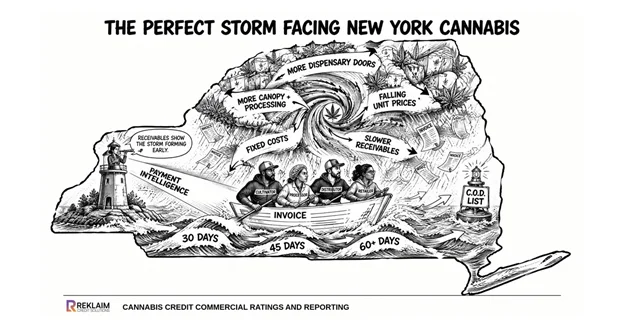
We believe the pressure New York operators are feeling is structural. More stores, more canopy and more processing capacity are arriving in a market where the price of each unit is already falling.
Unless something changes on the cost side, margins will likely compress further before they stabilize. Private ledger data suggests the official numbers, if anything, understate how far that pressure has already spread.
New York Cannabis Prices and Margins Are Falling
Retail prices in New York have been coming down for two years. OCM’s 2025 Annual Report shows that average retail prices peaked near $39 per unit sold in early 2024, then declined roughly 15% through Q3 2025 to settle near $32.
OCM described that decline as a sign of market maturity and more competitive pricing, while noting that New York prices remain well above the national median, which suggests they potentially have further to fall.
OCM’s daily data for April 2026 showed average unit prices near $28 in mid-April, falling to $24.90 on 4/20 itself.
Menu pricing tells the same story. Lit Alerts’ East Coast Eighth Index is built from retail menu pricing, not point-of-sale data. It shows New York hit an all-time high of $39.73 for an average eighth in August 2025.
The September 2026 average stood at $36.94, still the highest-priced market in the index. New York remains expensive relative to its neighbors, which again suggests there is more room to fall.
Wholesale is where the squeeze shows up most clearly, and it is also where public data is thinnest. In a recent white paper, Nabis, a statewide distributor, reported that wholesale gross margin per item on its New York platform fell from $18.52 to $14.71, a decline of $3.81 or 20.6%, with average item prices falling faster than unit costs.
Tuross Group, one of the leading financial services platforms serving the cannabis industry, sees the same trend in its own books. The firm provides outsourced accounts receivable management, accounting, payroll and reporting, among other financial services, and has a view of the market the state does not have.
Tuross estimates that 15% to 20% of New York’s wholesale cannabis transactions run through its books. As the firm puts it, “The state tracks the product. We see the money.”
Tuross notes that there is no current public New York wholesale price series. Its own estimates show average wholesale flower falling from about $1,450 to about $1,150 per pound over the past 12 months, a decline of roughly 21%.
Over the same period, the average discount off list price rose from 9% to 17%. Discounts off list rarely appear in any public price data. We believe that means the published retail numbers understate how much margin has already left the supply chain.
Lower prices are not a failure. Analysts studying other states argue that price compression is a key mechanism for moving consumers from the illegal market to the legal one, alongside access, convenience and product quality.
Consumers benefit, and so does the regulated market’s share of total demand. The problem is that prices have compressed as competition has increased, while the cost of operating a licensed business in New York has not come down.
A perfect storm for NY operators.
More New York Cannabis Dispensaries Are Splitting the Same Demand
The retail pipeline is still full. Reporting from the September Cannabis Advisory Board meeting put the count at 917 retail licenses against roughly 709 open stores, leaving about 200 licensed locations not yet open. Behind them sits a larger queue.
As of March 2026, OCM showed 2,704 retail dispensary applications and 873 microbusiness applications pending in what it calls its December Queue, from the application window that closed in late 2023.
OCM’s official per-store data runs through the spring. Retailers open more than a year averaged $3.95 million in annualized sales as of March 2026, while the average across all stores was $2.75 million.
In May, OCM reported that sales per store were holding stable as the adult-use store count rose from 565 to 645 over four months. OCM also flagged wide variation. Among retailers open at least a year, top-quintile stores earned more than four times their bottom-quintile peers.
More recent estimates suggest the stability OCM saw in the spring did not hold through the summer. Lit Alerts’ September 2026 analysis compared trailing 90-day estimated sales, from June 22 to September 20, against its February benchmark. The results showed revenue falling across most of the market.
The top of the market fell hardest. The top decile’s average monthly revenue dropped 48%, from $1,768,000 to $918,000. That is roughly $11 million annualized, down from about $21 million. The second and third deciles fell 41% and 39%.
The middle of the market fell too. Deciles 4 through 7 dropped between 15% and 31%, and the fifth decile went from $269,000 to $202,000 per month.
Only the bottom two deciles rose. Decile 9 climbed 8% to $62,000 per month, and decile 10 rose 39%, from $23,000 to $32,000.
Lit Alerts attributes the pattern mainly to density. As more stores open, consumers who once traveled to a destination store now have a neighborhood option nearby, and revenue spreads across more doors.
The rising floor deserves a closer look. Lit Alerts offers two likely explanations.
The first is that the weakest stores ran out of capital, closed and dropped out of the dataset, which lifts the average of those that remain. The second is that some dispersed revenue, along with aggressive discounting, reached smaller stores.
If the first explanation holds, it matters for anyone extending trade credit. A store that closes leaves the revenue data, but its unpaid invoices stay on its suppliers’ books. Part of what looks like a healthier bottom decile may reflect losses that cultivators, processors and distributors have already absorbed without knowing it.
These are Lit Alerts estimates derived from menu and inventory data, not OCM figures, and they cover a different period and method than OCM’s spring data. Both sources point the same way: sales in New York are being spread across more stores, and the top of the market is giving back the most.
Tuross Group’s client data points the same way. Among its New York retail clients open 12 months or more, Tuross estimates same-store sales are down about 11% year over year. That is a sharper picture than the stable per-store averages OCM reported in the spring, and it is consistent with what the decile data shows. Open stores are growing faster than sales, and each store is left with a smaller share of the same demand.
Microbusinesses are further behind still. OCM’s May data showed that only 29.2% of microbusinesses authorized for retail had an open store, averaging $619,000 in annualized sales per store.
As I have written about extensively before, the fixed costs of running stores do not fall with their revenue. A sixth-decile store now averaging about $159,000 per month still carries rent, payroll, security, compliance and tax obligations sized for a busier market.
Labor is one example.
A self-reported survey of 40 licensees, commissioned by a coalition of operators, found that labor costs took up 19% of revenue for cannabis retailers, more than double the total labor costs for other retailers in the state.
With roughly 200 licensed stores still to open and thousands of applications in the queue, the number of doors splitting that demand is likely to keep growing.
And this is hurting the operators supplying these stores.
Jason Ambrosino, Founder and CEO of well respected NYS licensed cannabis operator, Veteran’s Holdings, added this: “New York does not have a demand problem. It has an economic-design problem. The state can celebrate more stores, more licenses and larger sales numbers, but none of that is success if the people growing, processing and supplying the market cannot collect their invoices or earn a sustainable margin. A regulated industry cannot be built on unsecured supplier credit and wishful thinking.”
New York Cannabis Supply Is Expanding Too
The supply side is expanding at the same time, by design. In March, OCM reported that the Board had licensed 560 cultivating licenses, authorized for 9.1 million square feet of canopy. OCM estimated those licensees had activated only about 46% of their maximum capacity by the end of 2025, producing roughly 588,000 pounds of biomass.
Even with that, OCM projects a supply gap and has moved to close it. The agency recommended letting growers licensed for at least a year and provably operational move up one cultivation tier, and committed to reviewing the remaining December cultivator queue. OCM projects those steps will add 850,000 pounds of production potential, for a total of 2.16 million pounds by 2028.
But is that cultivation needed?
OCM has been candid about the risk on the other side. Its own framing of the supply decision lists what happens if supply exceeds demand: price compression, grower financial distress, business failures and long-term structural instability.
OCM also noted that excess authorization contributed to oversupply-driven price destabilization in other mature markets. The state has seen this movie before.
To be fair to the agency’s analysis, OCM projects that even if 100% of the new potential is activated, New York would remain well below the oversupply levels seen in other states. It also plans to monitor supply through “periodic reviews.”
Processing licenses are growing alongside cultivation. OCM’s license totals show processor licenses issued rising from 532 in March to 553 by early May.
More supply is good for consumers and, presumably, for the long-term health of the legal market. Its first effect, though, usually lands on wholesale price.
Cultivators and processors also carry some of the longest cash conversion cycles in the supply chain, since they fund production months before they collect, which makes them among the most exposed when prices fall and payments slow.
A retail market where revenue per store is falling at the top and spreading thinner in the middle is not the market those growers were counting on when they planned their canopy. And almost all of them have extended trade credit into the market without true intelligence on the party they are selling to.
Margin Compression Is Showing Up in Cannabis Accounts Receivable
When margins tighten, the stress often shows up in accounts receivable before it appears on a profit and loss statement.
New York’s trade credit rules come from a Cannabis Control Board regulation, 9 NYCRR § 124.2, which OCM administers.
Licensed suppliers may, but are not required to, sell to retailers on credit, and retailers who buy on credit legally have only 30 days to pay in full. If payment does not arrive by the final due date, the supplier is legally required to notify both OCM and the retailer within seven calendar days. Delinquent payment reporting is not optional.
OCM is explicit that it is not a collections agency or payment enforcer; the C.O.D. list exists to prevent suppliers from extending credit to licensees who are delinquent with others. It is a rearview mirror asked to prevent the accident in front of you.
The latest figures show how much stress that list is now carrying. At the September 10 Cannabis Advisory Board meeting, OCM reported that 87 retailers, roughly 12% of the retail licensee base, were on the C.O.D. list, with approximately $3.89 million in delinquent obligations owed to 44 suppliers.
The average listed retailer owed about $45,000 across nearly 10 invoices, with an average delinquency of approximately 281 days.
That figure likely understates the problem. Industry representatives at the meeting said some suppliers keep delinquent retailers off the formal list while working out informal payment arrangements. Participants also alleged that some larger suppliers keep extending credit to listed retailers after smaller suppliers have stopped.
Data from outside the list points the same way. Based on its own New York platform data, Nabis, known for its strong presence in California and now operating in New York and New Jersey, reports that retailers are paying on average about 35 days past due on Net 30 invoices, roughly 65 days after an invoice is issued. It also found that the share of receivables 90 or more days overdue on its platform has roughly tripled since early 2025, to 14.2%.
Tuross Group’s ledger goes further. Across its New York book, Tuross estimates retailers are averaging about 45 days to pay, up from 31 in the third quarter of 2024.
In Tuross’s words, “The rule says 30 days. The market is running on 45, and the line is still moving.” Tuross estimates that about 24% of wholesale receivables are now more than 60 days old, compared with about 15% a year ago, and that only about 35% of wholesale invoices are collected within terms.
Collection effort is rising even faster. By Tuross’s estimates, it now takes about 3.4 emails and calls to collect a single invoice, up from 1.8 in 2024.
Tuross summarizes it simply: “Same dollars, more work to collect them.” We read that as some of the strongest evidence that the official figures are conservative. The C.O.D. list counts the retailers who have already failed to pay. Collection effort climbs months before a retailer ever lands on it.
The strain reaches the shelf as well. Tuross estimates the average store it sees carries 58 days of inventory on hand against a 35-day target, and that 46% of store inventory has not yet been paid for.
As Tuross puts it, “Nearly half of shelf inventory sits on the supplier’s balance sheet, not the retailer’s.” In practical terms, supplier credit is financing a large share of New York’s retail shelves, and overstocked shelves are where slow payment turns into discounting.
Tax timing adds another layer. Industry representatives raised the concern that distributors can owe excise tax on a wholesale sale before the retailer has paid. OCM did not respond to that point at the meeting.
Every sale on terms is a credit decision. In New York, a supplier that ships on 30-day terms extends unsecured credit to a retailer, and a distributor may also be carrying the state’s excise tax on that sale. Delinquency rarely appears overnight.
An average delinquency of roughly 281 days, as reported by the OCM, suggests that many of these accounts showed signs of stress in their aging long before they reached the list. When a middle-decile store loses a quarter of its monthly revenue, supplier payments are often among the obligations that stretch.
It makes sense. Landlords can evict you if they do not get paid. Lenders can foreclose if they do not get paid. You can go to jail if you do not pay your employees.
Every dollar trapped in those receivables is a dollar a small supplier cannot reinvest in its own inventory, payroll or next harvest.
New York Cannabis Taxes and the Federal Tax Picture
According to the Department of Taxation and Finance, distributors pay a 9% tax on the sale or transfer of adult-use cannabis products to retailers, and retailers pay retail taxes totaling 13% on sales to consumers. Registered organizations and microbusinesses selling directly to consumers pay the 9% tax on 75% of the retail price.
Operators have told the state that taxes are among their top concerns. In OCM’s market assessment survey, tax burdens, illicit market competition and legal market competition ranked as the top concerns shaping respondents’ business outlook.
OCM’s own key findings describe tax burdens, inversion and competition from both illegal and legal operators as areas where policy action can potentially improve conditions.
The state’s stake in that revenue is growing. The Assembly’s 2026 budget analysis estimates adult-use cannabis tax collections at approximately $209 million for fiscal year 2025-26 and roughly $316 million for 2026-27.
Federal relief has been narrower than many New York operators had hoped. The April 2026 final order moved two categories to Schedule III. The first is FDA-approved marijuana products, a limited category.
The second is marijuana, including extracts and naturally derived delta-9 THC, covered by a qualifying state medical license. Recreational marijuana and unlicensed bulk marijuana remain in Schedule I.
Will that move to Schedule III?
We are all waiting. For now, any resulting Section 280E relief depends on the qualifying activity or product. Because most licenses New York has issued since 2022 cover adult-use activity, most of the state’s licensed businesses remain outside that relief.
New York has already acted at the state level. The state allows businesses to subtract federal deductions disallowed under section 280E that relate to adult-use cannabis production and distribution, for tax years beginning on or after January 1, 2022.
New York City later enacted its own provision, also retroactive to tax years beginning in 2022. The remaining levers sit in Albany and at OCM.
What New York and OCM Could Change
OCM’s own listening sessions reached a conclusion many operators would share. The agency’s summary of stakeholder input from sessions in Buffalo, the Mid-Hudson and New York City found that the current regulatory structure is undermining financial viability for many operators.
It identified fees, distance rules, seed-to-sale complexity and expense, and true party of interest issues as key areas for reform. Microbusinesses cited retail siting, production capacity limits and high testing costs among their core challenges.
None of the following would reverse price compression, and that is not the goal. The goal is to lower what it costs to operate a licensed business so that operators can survive at the prices a competitive market produces. That would free up cash flow to move back up the supply chain.
Tie the wholesale excise tax to cash collected
The 9% distributor tax is imposed on the amount charged for the sale or transfer to the retailer. A distributor holding a 281-day delinquent invoice may already have paid revenue tax it has not received. The Legislature could shift accrual of the wholesale tax to the date of payment.
Alternatively, it could create a credit or refund for excise paid on sales that land on the C.O.D. list or are written off. Either approach would likely change the timing of collections more than the total collected, while easing the working capital burden on the suppliers least able to carry it.
Revisit rates as the market matures
OCM previously said taxation could evolve as the industry matures, but at the time did not recommend further changes because changes that they made in 2024 were still “new”. Since then, prices have fallen, estimated revenue per store has compressed and OCM’s own survey has documented shrinking margins.
A graduated wholesale rate for smaller producers, or a scheduled review tied to price and profitability data, could keep the tax structure aligned with the economics of the market it taxes. Over time, a healthier tax base could ultimately increase the taxes generated and remitted.
Review fees and distance rules
OCM’s listening sessions identified both as reform priorities. The Board’s September meeting included a resolution to modify amendment fees for certain license amendments, which suggests the agency is open to adjusting fees.
A broader review of licensing, renewal and amendment fees, alongside distance rules that limit where a store can viably locate, would address costs OCM has already heard about directly. Distance rules and local opt-out provisions have likely pushed the cost of legally compliant locations above market norms.
Settle the labor framework
Today, OCM requires proof of a valid labor peace agreement as part of every adult-use license renewal. In June, the Legislature passed S10643/A11562. The bill would repeal those requirements, add public disclosure obligations on ownership and wage ranges, and establish a Cannabis Industry Wage Board.
As of this writing, the official legislative record shows the bill as passed by both houses but not yet delivered to the Governor. Operators opposing the bill argue that a wage board adds cost and uncertainty to an industry that is already struggling.
Supporters argue that the wage board, with industry and labor representation, would help ensure cannabis workers are treated fairly. Whatever the outcome, operators would benefit from a settled framework they can plan and budget around.
Reduce seed-to-sale friction
OCM heard directly that seed-to-sale complexity is a key area for reform. Metrc charges $0.10 per unique identifier in New York, including package and retail item IDs, and the state provided a one-time allocation of free tags to offset the initial cost. Operators have complained about both the cost and the labor required to apply and scan them.
A budget deal set aside $10 million for track-and-trace, part of which lawmakers said would help operators with seed-to-sale compliance costs. Some industry advocates argue the larger burden is the cost of the labor tied to the Retail ID requirement.
OCM is starting a modular rewrite of more than 1,000 pages of adult-use rules. That rewrite is a natural place to reduce redundant tagging, clarify requirements such as sublotting and review testing costs.
“Every cannabis operator eventually has to make the numbers work. When prices are falling and margins are getting tighter, you cannot keep adding costs and uncertainty and assume nothing else changes.
Operators need clear rules and predictable costs so we can plan, invest, hire and build businesses that are still here five years from now.” said Jason Ambrosino, CEO of Veteran’s Holdings, one of New York State’s fastest-growing and most respected licensed cannabis operators.
Let operators consolidate
Fixed costs are easier to carry across more revenue, and falling revenue per store makes the case for scale more urgent.
Today, a party with a controlling or financial interest in a retail license may hold that kind of interest in no more than three retail dispensary licenses.
Passive investors are not subject to that cap. OCM’s listening sessions flagged true party of interest and sole control rules as a top concern.
At the September advisory meeting, OCM described the licensing functionality needed for ownership changes as “very close” and said the four-year CAURD holding period runs from issuance of the final license.
Delivering transfer functionality quickly, and reviewing ownership caps and holding periods with equity goals in mind, would give struggling operators an exit or partnership path before they fail outright.
Consolidated retail would mean consolidated costs for retailers, and better margins for distributors making fewer stops with larger orders. Both would free up cash to flow back up the supply chain.
Pace retail licensing to market data
OCM already paces cultivation this way. Its supply strategy relies on seed-to-sale data to monitor market need and review supply periodically. Retail licensing could follow the same model.
OCM now publishes sales per store and quintile distributions, and delinquency data now runs through Metrc as well. Regional indicators such as sales per store, store density and concentrations of delinquent retailers could inform how quickly the 2,700-plus pending retail applications move forward.
That would not mean freezing licensing or abandoning the state’s equity commitments. It would mean using data the state already collects to decide where new capacity is most likely to succeed.
Is that fair to early applicants who have incurred, and continue to incur, substantial costs while they wait for state action? No. But the health of the entire industry may depend on it.
Apply credit rules evenly
The rules prohibit suppliers from extending credit to any retailer on the C.O.D. list. The rule protects smaller suppliers only if everyone follows it.
Consistent enforcement against any supplier that keeps extending credit to listed retailers would level the field for the small cultivators and processors the rule was written to protect.
Keep enforcement moving upstream
OCM’s survey respondents ranked illegal competition among their top concerns. OCM reported seizing more than $17 million in illegal products and equipment near Rochester, its largest seizure to date, and said enforcement is shifting toward illegal manufacturing and distribution, not the small home growers who have fed this market for decades.
Every dollar of demand that stays in the professional illegal market is a dollar of revenue licensed operators need to cover their fixed costs.
What New York Cannabis Operators Can Control Now
Policy moves slowly. Receivables do not wait.
A C.O.D. list tells a supplier which retailers have already failed to pay. It does not tell a supplier which retailers are starting to slow down. AR aging can provide an earlier signal of that risk than a financial statement or a regulatory list.
A retailer drifting from 30 days to 45 days, and then to 60, may be showing the same pattern with other suppliers. No single supplier can see that on its own, because each one sees only its own slice. The C.O.D. list is a rearview mirror. Understanding how others are getting paid is a windshield.
That gap matters more in a compressing market. When a top-decile store loses nearly half its monthly revenue in seven months, its suppliers’ credit limits were likely set for a business that no longer exists. Credit risk changes over time, and in New York right now it is changing quickly.
Self-serving, yes, but this is why we built Reklaim Credit Solutions as a commercial credit rating agency for state-regulated cannabis. Operators contribute their AR aging data, which is de-identified immediately upon ingestion.
Our ensemble models combine that network data with each subscriber’s own payment history to produce credit scores, suggested credit limits, credit reports and continuous monitoring.
This is advanced mathematical modeling built to detect small changes in payment behavior, well beyond a simple algorithm of who paid last month. We are onboarding subscribers now and ingesting their AR aging data.
Better information supports better credit decisions for everyone, and a supplier that sees stress forming early has more options than one that learns about it from a C.O.D. list.
The New York Cannabis Market Can Grow and Still Lose Operators
In March, OCM estimated $13.6 billion in cumulative sales from 2023 through 2028. That outcome is still likely. The open question is how many of today’s licensees will be around to share in it.
More doors, more canopy and more processors will likely push margins lower. Albany and OCM cannot legislate prices back up, and they should not try. They can change what it costs to operate a licensed business and when taxes come due.
They can also make the data the state already collects more useful to the businesses that generate it. Operators, for their part, can treat every invoice as the credit decision it is.