
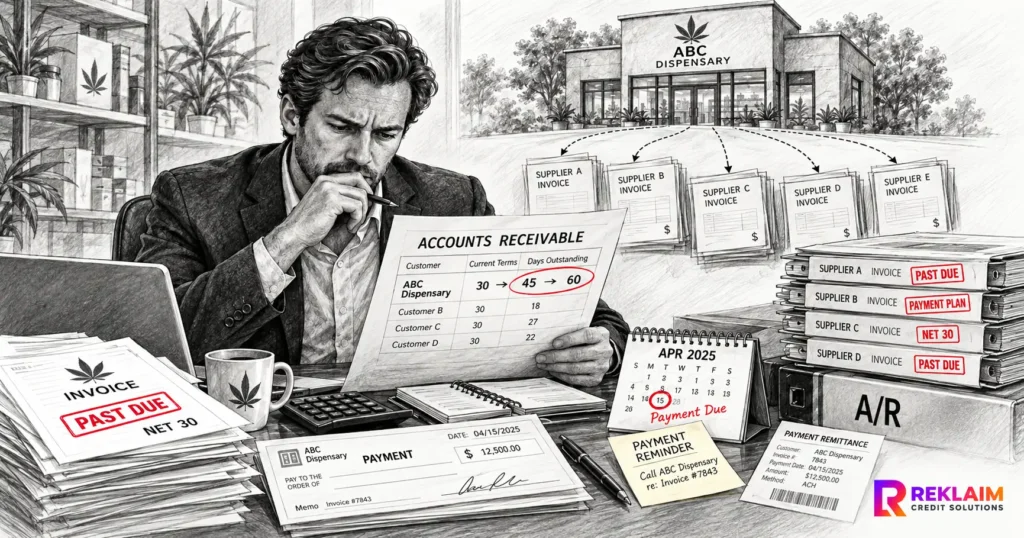
A customer has paid you in about 30 days for the last two years. You know the account, you know the people, and nothing in the relationship has given you much reason to worry. Then the last few payments start coming in closer to day 45.
We pay attention to that kind of change.
Just because one payment comes later than previous payments doesn’t mean that the customer’s financial situation has changed drastically. We wouldn’t suggest holding a customer’s account just because one payment came in late. But if a customer who normally pays in 30 days suddenly starts paying in 45 days, that is different from the history you agreed to when you set the payment term and credit limit.
Credit managers outside cannabis are seeing more of this right now. According to the National Association of Credit Management, payments have been slowing down even though the general index has not shown any contraction in the economy or among credit managers.
Its August Credit Managers Index report also included credit managers saying established customers were stretching from 30 days toward 45, asking for longer terms, and telling suppliers they could not pay until they collected their own receivables.
Cannabis businesses deal with many of the same cash pressures. The difference is that most cannabis suppliers still have far less shared payment information available when one of their customers starts changing the way it pays.
If an account moves from 30 days to 45, and then begins moving toward 60, we want to know more before another large order goes out the door.
A Customer Paying in 45 Days Is Not the Same Account That Paid in 30
There are plenty of innocent reasons a payment comes in late. Inventory may be moving slower than expected, the customer may have made a large tax payment, or somebody in accounts payable may have changed the weekly payment schedule. A retailer may also be waiting to collect its own money before paying vendors.
None of those explanations automatically makes the customer a poor credit risk. What interests us is whether the customer’s normal pattern has changed and whether that change continues.
If a customer has always paid in 45 days, we can account for that when we set the terms and limit. We know the reality we are dealing with. If we see a company that has a history of paying in 30 days for two years, gradually starting to pay in 45, and then 50 and then 60 days, we are seeing things differently today than we used to see when we approved the account.
Commercial credit professionals often describe part of this through Days Beyond Terms, or DBT. A Net 30 invoice paid on day 45 is 15 days beyond terms. Dun & Bradstreet uses payment experiences and days beyond terms in its trade-payment reporting because the way a company pays its suppliers over time says more than whether one invoice happens to be open today.
For us, the useful part is the trend. When the trend changes, we want to understand why.
Is the Customer Slower in Their Payments, or Are They Paying Everyone Slowly?
At this point, your own AR starts running out of answers.
Your aging tells you exactly what the customer owes you and how quickly they have paid your invoices. It cannot tell you whether four other suppliers are seeing the same slowdown.
Those are very different situations.
Suppose a dispensary starts paying you on day 45 instead of day 30 while continuing to pay most other suppliers normally. Maybe there is an issue with your invoices, a dispute that has not reached the right person, or a decision inside the customer’s AP department about which vendors get paid first.
Now suppose the same dispensary has moved you and five other suppliers from around 30 days to 45 or 60 days during the same quarter. We would take that much more seriously because the change is no longer limited to one vendor relationship.
This is one of the limitations we discussed in Who Is Paying Late?. Your aging report is essential, but it only sees your piece of the customer’s payment behavior.
That broader context matters even more when you ship product despite open first invoices on the books.
What We Would Review Before Changing the Account
If a good customer starts paying slower, we would not begin with a credit hold. We would start by reviewing the account again because the information supporting the original decision has changed.
First, we want to understand how much money we actually have at risk.
Take into Account the Entire Exposure, Not Just the Past Due Bill
Let’s say, for instance, that a customer owes $20,000 on their last bill and has another order for $20,000 scheduled to ship next week. The important question is whether the outstanding bill is actually past due.
We need to decide whether we are comfortable having $40,000 outstanding if we release that next order before receiving payment.
This becomes apparent when you compare the two amounts, but organizations tend to keep collection activity separate from approving an order. Finance would consider the overdue amount, while sales would focus on the new order.
When no one checks both at the same time, exposure increases without any intent to increase it.
We would look at what is current, what is past due, which orders are waiting to ship, and what the total balance could become before we reasonably expect the next payment.
We may still approve the order. We just want to know exactly what we are approving.
See Whether Other Suppliers Are Experiencing the Same Change
If broader trade-payment data is available, we would want to know whether the account is slowing down across the market.
A delay in receiving one payment may be negligible. If several suppliers notice payments taking longer than 30 days to reach 45 or 60 days overdue, it tells a different story.
This is also where portfolio monitoring becomes useful. The point is not to treat every slower payment as a default warning. It is to see whether the behavior you are seeing inside your own AR is isolated or part of something larger.
Context gives the credit manager a rationale to either ignore the customer’s account or analyze the exposure further.
Examine Whether Other Changes Occurred at the Same Time
Payment behavior is one part of the account, so we would also look at what changed elsewhere.
Did the credit score move materially? Has a tax lien been filed? Is there a new judgment? Did something change with the cannabis license? Did a new UCC filing or any other public event occur since we last examined the customer?
Although one filing alone does not make a decision, it is important to remember that borrowers borrow money and that disagreements and public events must be evaluated in context.
If payments are slowing, the open balance is growing, and a new tax lien appears during the same period, we now have a different credit picture than we had six months earlier.
Call the Customer Before You Guess
Credit metrics should help you have a better conversation with the customer and not replace it.
If somebody has paid you well for years and begins slipping, we would rather call at day 45 than wait until the account reaches day 90. Ask what changed. Maybe sales slowed. Maybe inventory is sitting longer. Maybe the customer is dealing with a short-term tax problem or waiting on a large receivable of its own.
You may hear something that makes you comfortable leaving the account exactly as it is. You may also learn that the customer needs more time than the current terms allow and that continuing to ship at the existing limit will only make the problem harder for both companies.
Either way, you are making the next decision with more information than you had before the call.
What Should You Change When Payment Behavior Keeps Slowing?
No rule says a customer paying on day 45 automatically loses its credit limit. We would decide what to change, if anything, after looking at the account as a whole.
Customers who explain their reasons for a hardship, still have good payment history, and a solid credit report may not need to change anything on their account. Other customers may deserve credit, though not what they had before if payments started being late.
In such instances, limiting the credit line can slow the growth of exposure while maintaining the good working relationship.
You may also ask the customer to pay off the current debt before shipping additional orders. Thus, the customer can still enjoy the benefits of the product without leaving the debt unpaid.
If this is only a temporary issue and the customer is still open to communication, the best solution is to create a payment plan. If payment dates keep slipping, promises get missed, exposure keeps growing, and the next order adds even more unsecured credit, a hold or a more formal collection escalation becomes easier to justify.
What we would avoid is making any of those decisions based only on the age of one invoice.
The Difference Between $20,000 and $40,000 Is Usually Another Shipment
This is the part we think credit teams need to keep in front of them.
A customer has a debt to you equal to $20,000 and their payments are starting to falter. You observe the development, assess the situation and determine your next steps before the shipment of the subsequent order.
Now take the same customer and keep shipping without reviewing the account. Another $20,000 goes out. The first invoice gets older, the second invoice comes due and the customer now has twice as much money to find before getting current.
The customer’s underlying cash problem may not have changed much, but yours has.
That is why we think in terms of credit exposure rather than simply asking which invoice is late. Once the balance doubles, the choices usually get worse. Something that could have been easily resolved through the setting of limits or partial payments begins to drift towards collections.
The check of the situation allows the business to maneuver with the customer without exposing itself to unnecessary credit risk.
Seeing the Change Early Gives You More Control
At Reklaim Credit Solutions, we’ve built our platform around the fact that one cannabis supplier can only see its own relationship with a customer.
Our contributory network uses de-identified AR and payment data from cannabis suppliers to build a broader view of how counterparties pay across the industry. The customer profile we create includes information on their payments, monitoring updates, and their overall financial standing.
Nonetheless, this customer profile does not mean it will decide whether you proceed with the shipment.
The credit manager, CFO, and AR manager know things the report cannot provide. They have awareness of the relationship with the customer, the significance of the account and the negotiations with the customer.
What we want that person to have is enough information to know whether a customer moving from 30 days to 45 is an isolated issue or whether the same change is happening across several supplier relationships. If a tax lien, judgment, or another meaningful credit event appears at the same time, they should know that too.
Fast forward to a good customer who is paying slowly – this does not mean that there is something wrong; rather, it implies that something has changed.