

What relationships don’t tell you about your customers
Repeatedly, I have heard from cannabis supplier that they “know their customers” and/or “I am friends with them” when we talk about the need for credit information on their customers.
So, I recently asked a prospect a question. If your best friend had problems with the IRS and a federal tax lien was filed against them, would they pick up the phone and tell you about it?
They laughed and said no.
So why would a customer you’ve been shipping $10,000 in product to on Net 30 terms, basically giving them a loan, but who’s always been a pretty good payer, call and tell you the state just filed a tax lien against their business? Or that one supplier filed a lawsuit and another obtained a judgment for $30,000 against them in the past 2 weeks? Or that they’ve started stretching payments to 5 of their other suppliers?
Chances are that they wouldn’t. Not because they’re dishonest or bad people. Financial difficulties are uncomfortable to discuss, particularly when you’re trying to keep a business operating. To many people, it’s personal.
Many cannabis suppliers have managed for years without credit reports or monitoring. They know their customers, visit their stores, know the buyers personally, and have a pretty good sense of who pays and who doesn’t.
I don’t doubt that for a minute. Relationships matter in cannabis, and the people running these companies know their businesses. But a good relationship only tells you what a customer chooses to share.
When There Isn’t Enough Cash to Pay Everyone
I’ve spent much of my career in commercial credit and collections, working with some of the largest companies in corporate America to help manage different parts of their order to cash process. I’ve also helped run a third party collection agency where I’ve watched firsthand how companies struggle to manage their cash when there isn’t enough money to pay everyone. Someone must decide which suppliers get paid this week and which ones have to wait.
Your company might be getting paid today. Fantastic. That doesn’t mean you’ll stay at the top of their list next month. Almost every customer who eventually falls behind was paying their suppliers on time at some point.
For many suppliers, the first indication only comes when an invoice goes past due.
What Credit Information Actually Does
Credit reporting has been used across nearly every major industry for decades because it answers very practical questions. Should we extend credit to this customer? How much? On what terms? And once we’ve approved them, how do we know when their payment behavior starts changing?
Reklaim Credit Solutions is a credit reporting and rating agency developed specifically for the state regulated cannabis industry. For a company extending trade credit, there are 2 primary ways to use that information: evaluating new customers before extending credit and monitoring existing customers so changes in credit risk can be considered before more product ships.
Making the First Credit Decision
Let’s say a new customer place an order and asks for $15,000 of product on Net 30 terms. You pull their credit report from Reklaim and review their predictive credit score, suggested credit limit, payment history reported by other cannabis suppliers, and public records such as tax liens, judgments, lawsuits, and UCC filings.
Maybe the information supports extending the full $15,000. But perhaps you have discovered a recent state tax lien for $35,000 and evidence that the customer has started stretching payments to other suppliers over the past few months. You may decide to approve only $5,000 initially and review the limit in 90 days after establishing some payment history of your own.
You haven’t necessarily lost the sale or turned away a potential long term customer. You’ve made a credit decision that reflects the information available and the risk you’re willing to tolerate.
Every dollar of credit you extend is essentially a loan to your customer. You’ve shipped the product, but you haven’t collected the money. Until that invoice is paid, you’re helping finance your customer’s operations with your own working capital.
Monitoring the Customers You Already Have
Much of a supplier’s credit exposure is tied to existing customers, not the ones placing their first order. For many companies, accounts receivable eventually becomes one of the larger assets on the balance sheet. When that happens, a few slow paying customers can tighten cash flow quickly.
Think about a customer you’ve sold to for 2 years. They order regularly, they’re generally within terms, and your sales team has an excellent relationship with them. Now suppose that same customer starts paying several other suppliers 60 or 90 days late. Maybe a tax lien is filed, a lawsuit appears, or there’s a change in their license status.
None of that necessarily shows up in your own AR aging report. Your customer may still be paying you on time.
Reklaim’s portfolio monitoring identifies these changes as new information becomes available throughout the month and sends email alerts on significant changes in payment behavior, credit scores, license status, and public records, including lawsuits, judgments, tax liens, and UCC filings.
That gives your team a reason to check in with the customer, understand what’s happening, and decide whether any changes to their credit terms or limit are warranted.
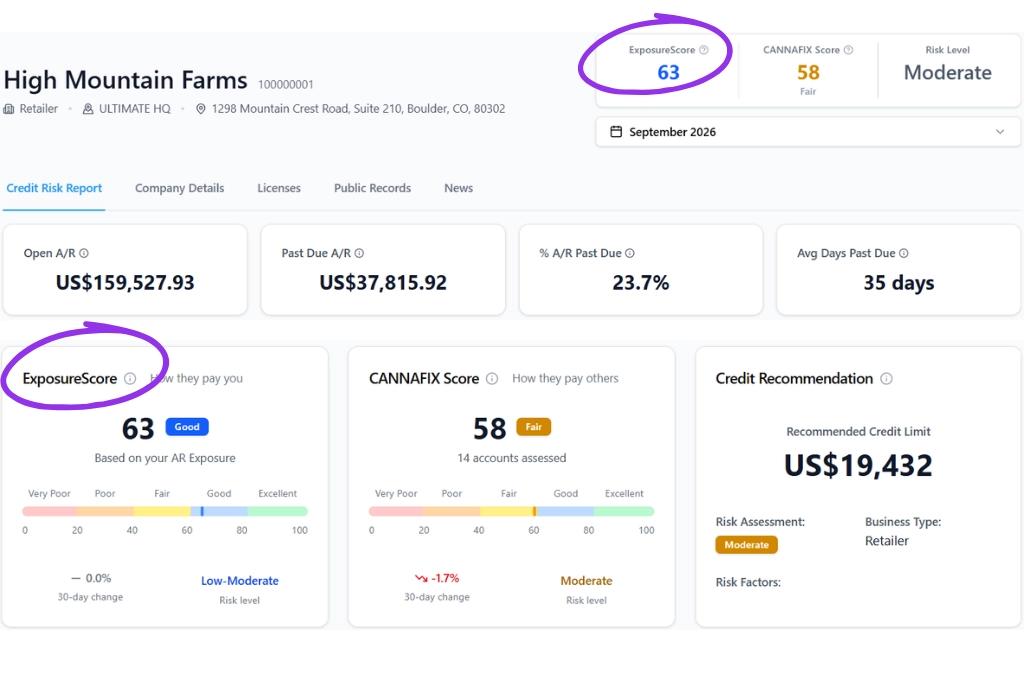
Reklaim also provides 2 predictive credit scores on your customers each month:
- Reklaim ExposureScore: A predictive credit score based on your own AR data, showing how that customer is paying you.
- Reklaim CANNAFIX Score: A weighted average predictive credit score combining all available trade lines on the customer, showing how they are paying participating suppliers across the industry.
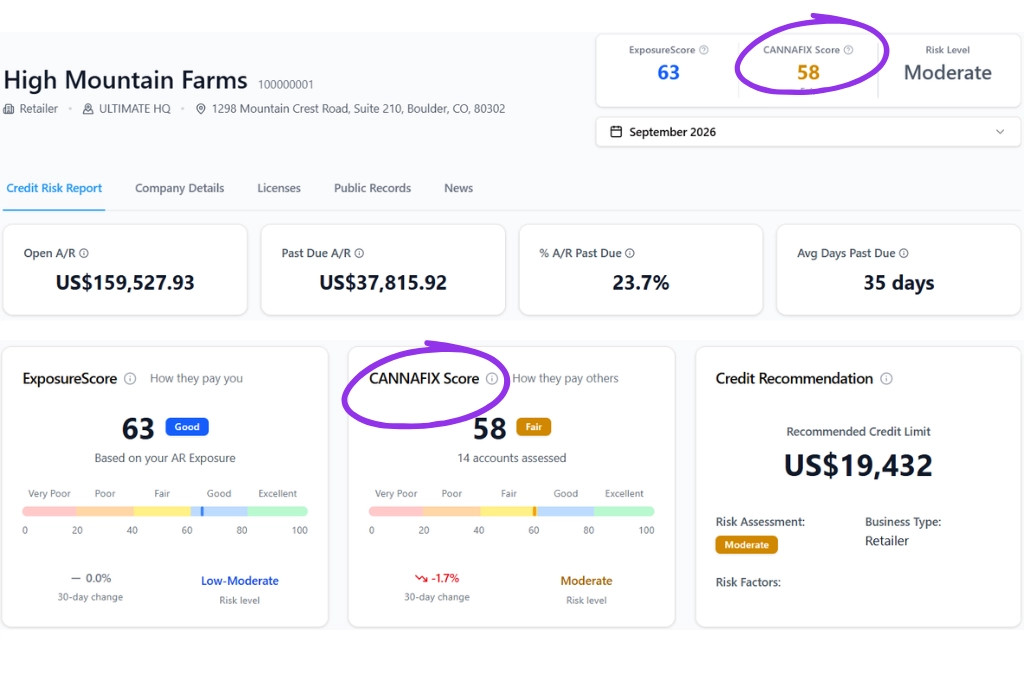
A customer might be paying you within 30 days while several other suppliers are experiencing significant delays. Or a customer who is temporarily behind with you might still have a strong payment record everywhere else.
A Suggested Credit Limit for Every Customer
Many cannabis suppliers don’t set formal credit limits for every customer. That’s understandable. It’s hard to set a limit without shared payment data to base it on. Others have limits, but the outstanding amount gradually grows beyond what was intended. A customer starts with $10,000 in credit, pays well, and the sales team keeps shipping more product. Before long, the balance is $25,000 or $30,000.
That may be perfectly reasonable. But has anyone reviewed whether it’s justified?
Reklaim provides full credit reports with suggested credit limits you can compare with each customer’s current AR balance. If a customer owes you $25,000 and their suggested limit is $10,000, that doesn’t automatically mean you stop shipping. It means the account deserves a closer look.
You might reduce future shipments, shorten payment terms, request a partial payment before the next order, or simply review the customer’s payment history and financial circumstances.
The opposite is also true. A customer whose suggested limit is well above what you’re extending may be an opportunity to increase sales.
Nobody selling into the cannabis industry can eliminate credit risk. If you required COD from everyone, you’d protect your cash but give up a considerable amount of business.
One customer might qualify for $25,000 on Net 30. Another might be better suited for $5,000 on Net 15. A third may need to remain COD until their payment history improves.
The credit decision doesn’t always have to be yes or no.
The Math Behind One Better Credit Decision
You ship a $10,000 order to a customer who ultimately defaults, and you write off the entire receivable. At a 10% profit margin, you’d need another $100,000 in sales to replace that lost profit.
Now suppose a credit report or monitoring alert flags a problem before that order ships. You hold the order until the customer reduces their balance, or you shorten the terms. You may still make the sale without taking the same unsecured risk.
One avoided write-off can be worth considerably more than the annual cost of credit reporting and monitoring.
Why Reklaim Credit Solutions Exists
Unpaid accounts receivable across the cannabis industry have been widely reported to exceed $4 billion. Yet cannabis suppliers haven’t had the shared trade payment information and credit analysis tools that companies in most other industries use to evaluate their customers.
Traditional credit reporting agencies such as Dun & Bradstreet and Experian may report on and score cannabis companies, but their models weren’t developed around extensive cannabis specific trade payment data.
Reklaim is a contributory cannabis credit reporting network. Cannabis suppliers contribute their AR aging data, which is deidentified and used to develop predictive credit scores, credit reports, suggested credit limits, and portfolio monitoring.
Contributors retain ownership of their data, and their customer lists aren’t shared with other participants.
Credit reporting networks depend on companies sharing their payment experiences. The more suppliers who participate, the more customers can be evaluated using actual cannabis payment experience. As the network grows and more payment history becomes available, our predictive credit scoring models have more information to learn from and improve their ability to identify customers whose payment behavior may be deteriorating.
I started by asking whether your best friend would tell you about a tax lien. I’d like to end with a different question.
If a customer you’ve done business with for years was suddenly struggling to pay 5 other suppliers, wouldn’t you want to know before shipping them another $10,000 in product?
Relationships and experience will always play a major role in commercial credit decisions. But even your best customers may be dealing with financial problems they aren’t sharing with you.
Reklaim Credit Solutions gives cannabis suppliers another source of information before deciding how much credit to extend, whether to increase a limit, or whether to keep shipping.