
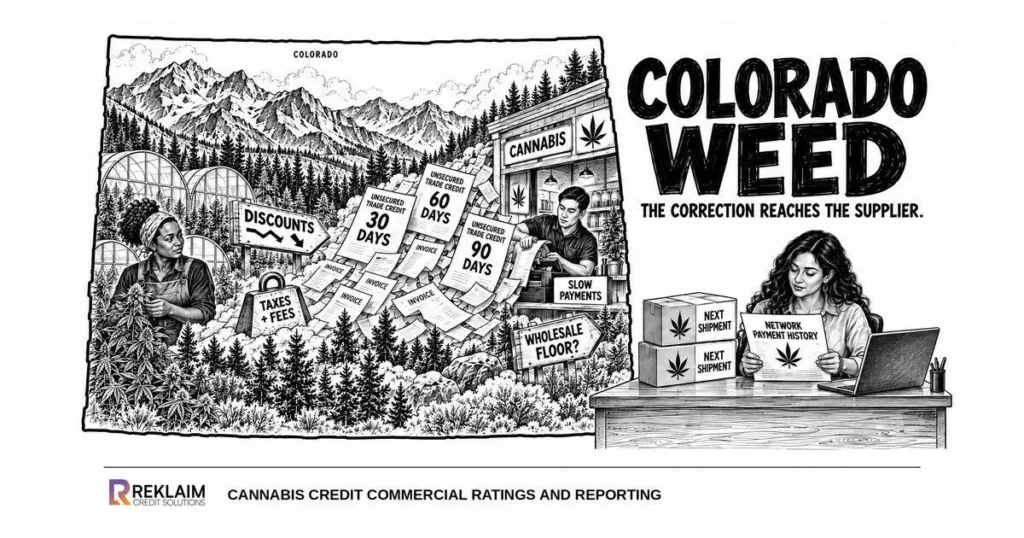
The state that wrote the roadmap, then followed it off the cliff
We’ve covered New York, Massachusetts, Oregon, California and Illinois. Now Colorado cannabis market, where all of this started, and where it’s been going on long enough to know how it ends.
In April, Chuck Smith, founder of Dixie Brands who now runs the Colorado Leads trade group, told Westword where he thought the market stood: “we thought we were at the bottom, but then it keeps feeling like we haven’t hit bottom yet.”
That was month 148 of legal sales.
This morning a Denver dispensary is advertising $39 ounces. Another has $25 shake ounces and a penny eighth for first-time customers. In March, Westword found eighths at $8. Colorado’s regulated stores, medical and adult-use combined, sold $2.23 billion of cannabis in 2021. In 2025 they sold $1.32 billion, down 41%, and the first seven months of 2026 are running about 4% behind the same months of 2025.
Everything we’ve written about in five other states, the oversupply, the price collapse, the discounting, the slow pay, the receivers, Colorado did first. It also has something none of them have yet: four more years of history after the crash.
The place is a 12-year experiment with no control group.
It is the control group.
Why Did Colorado’s Cannabis Market Become Oversupplied So Early?
Colorado was the first state to commission a serious study of how much weed its people smoke, compare it to how much weed its licensees grew, and publish the answer. Oregon and California got around to it later. Colorado did it in 2014, six months into legal sales, before anyone had a full crop to count.
The 2017 market study, done for the state by the University of Colorado’s business school and the Marijuana Policy Group, concluded that Colorado’s illegal market “has been fully absorbed into the regulated market.” That was the headline. The number underneath it was stranger.
The tracking system recorded 301.7 metric tons of flower equivalent moving through the regulated market, against modeled resident and visitor consumption of 208.6 tons. The legal market was selling, by my math, 45% more than the state’s own economists thought anyone was consuming. The researchers couldn’t fully reconcile the gap. Either Coloradans were smoking a great deal more than they told the survey, or the market was producing more than its customers could use.
Two years later the answer came in.
The 2019 update was blunter. Licensed growers produced about 553 metric tons of flower equivalent. Stores sold 357.5. Estimated consumption was somewhere between 223 and 275. The study blamed inventory, processing losses and conservative consumption estimates for part of the gap.
Even allowing for all of that, Colorado was growing roughly two pounds for every one its economists thought it consumed, and it had the receipts.
It didn’t need the study to know any of this.
The first crash had already happened. The state’s wholesale benchmark for a pound of flower was $2,007 in January 2015. By the end of 2018 it was $759. Jim Parco, who ran Mesa Organics in Pueblo, told a local station in 2018 that customers had been paying $300 an ounce and “Now I’m selling $60 ounces all day long.” His diagnosis: “We have too many stores.”
Nobody in Oregon or California was listening. Both were about to run the same experiment on a bigger scale.
Then came 2020. The state’s own 2020 market update called it the first year “in which prices reached and sustained higher levels than in previous years.” Sales hit $2.19 billion, then $2.23 billion in 2021. Flower prices rose 20%. The regulator put out a release saying Colorado “saw the most marijuana sales ever.” By September 2021 there were 1.71 million plants in the ground.
The report said 2020 was the first year prices held. They held for one more. Then the pandemic went away.
How Did Colorado Become the Roadmap for Legal Cannabis Markets?
Andrew Freedman, the state’s first marijuana czar, called it “version 1.0” and said the quiet part early: it was okay to make a bad decision, “because you’re truly guessing.” He also said this, in 2017, which should have been printed on the wall of every state capitol that followed: “This is an agricultural commodity, so grows that can get really big are going to start taking over.”
Colorado’s choices became everyone’s defaults.
Unlimited licenses, with local opt-out. Oregon and Michigan took both.
A requirement that stores grow 70% of what they sold, which lasted nine months before the Legislature let it die (a Denver edibles maker called it “vertical protectionism”), after which Colorado became one of the friendliest big-chain markets in the country; by one economist’s 2024 count, the average Colorado cannabis business held 9.6 licenses, against 1.24 in Washington. Washington watched that and went the other direction, splitting growers from retailers and capping stores.
Metrc, whose predecessor Colorado hired to track medical marijuana in 2011, became the track-and-trace system in 20 states and the system switch Illinois blamed for muddying its sales numbers last year.
A 15% excise on the first wholesale transfer, calculated on the contract price or, for transfers between affiliates, the state’s own median price, so the tax falls as the market falls. Later states adjusted the pieces and kept the shape.
They all came to look. Massachusetts senators toured Colorado seed to sale in 2016. Illinois’s Rep. Kelly Cassidy came back from Colorado in 2019 with a lesson about local taxes, and Illinois built its market on license caps, which readers of the last article know did not protect it.
A New York state senator cited Colorado’s lower tax rate in 2024 while his chamber was trying to undo its own potency tax. John Hickenlooper called legalization “reckless” on a debate stage in 2014 and co-signed a letter to the Attorney General three years later calling Colorado “a model for other states and nations.”
He was right both times. That’s the problem.
Why Are Colorado Cannabis Sales and Prices Still Falling?
The pattern we found in every state started here, and Colorado has the longest series.
The state’s own data puts the average gram of adult-use flower at $14.05 in 2014 and $5.34 by 2017. It bottomed at $3.99 in April 2019, bounced to $4.80 in the pandemic, and set an all-time low of $3.18 in September 2024, which the regulator’s annual report describes as down more than 76% from the 2021 highs. Headset’s September 2026 numbers have the packaged eighth at $15.14, the fourth cheapest of the dozen markets it tracks, behind Oregon, Arizona and Michigan. Illinois, you’ll recall, was $25.99.
The basket went with it.
Headset had the average Colorado basket at $63.89 in April 2021. By mid-2023 it was $46.59, and Headset stopped reporting a Colorado basket figure soon after. The average item went from $21.47 in July 2021 to $14.30 last month, down a third. Discounts went from 7.5% of sales to 12.6% over two years and sit around 16% today. Units sold fell 7.3% in 2025. More stores, more discounting, fewer items, fewer dollars. Pre-rolls are the fastest-growing category, up 16.5% in September, same story as Illinois.
So which is it: are Coloradans spending about the same and walking out with more, or spending less? Headset’s numbers say less. The basket fell 27% between 2021 and 2023 while the average item fell about 15%, which puts the typical trip at roughly three items in 2021 and about two and a half by 2023, cheaper ones, and in bigger packages: Headset’s 2026 deep dive notes that shoppers have moved up the size ladder to 14-gram and 28-gram formats where the per-gram price is a fraction of an eighth’s.
Then look at the state level. In 2025 Colorado sold 7.3% fewer units and 5.8% fewer dollars. Illinois is still in the phase where customers buy more items for fewer dollars. Colorado is past it. Its customers buy fewer items, in bigger bags, for less money, and the market has been that way for about two years.
Lower prices stopped buying volume in Colorado somewhere around 2023. After that, they just bought less revenue.
Headset’s analysts wrote in 2023 that “legacy markets such as Colorado face more challenging market conditions and struggle to grow,” which is the polite way of saying what Toby Ripsom, who co-founded the now-closed Veritas Fine Cannabis, said in June: “It’s coming back to earth and just being the business that it should be.”
Colorado also did something to its own medical market that no other state in this series has tried.
In 2021 the Legislature cut the daily medical concentrate purchase limit from 40 grams to 8, with exceptions a doctor has to sign for, required real-time tracking of medical purchases by patient, and made doctors add a mental-health review. A patient advocate warned it “will effectively kill medical marijuana in Colorado.”
Medical sales fell 37% within a year. Cheap adult-use flower would have pulled patients across the counter anyway; the law made sure of it. The registry, 117,000 patients at its 2014 peak, is about 50,000 today. Medical was the steadiest, least price-sensitive customer in the state. The state regulated it down to a rounding error.
Twelve years of data, and the line kept finding the same direction.
How Did Legalization in Other States Change Colorado Cannabis Tourism?
Colorado invented the border town. Then it found out what the other side of the border feels like.
The state’s first market study, in 2014, estimated that visitors were 44% of recreational sales in the Denver area and about 90% in some mountain resort counties.
Trinidad, 13 miles from New Mexico, built an economy on it: roughly 25 dispensaries for about 8,000 residents, one store for every 320 people, and shop owners telling reporters that 75% to 95% of their customers came from out of state. Las Animas County’s stores sold $70.8 million of adult-use cannabis in 2020, roughly $5,000 for every man, woman and child in the county. Josh Bleem of CannaCo put it plainly in 2021: “The border model was a great model.”
Past tense was the right tense.
New Mexico opened adult-use sales on April 1, 2022. Las Animas County’s cannabis tax revenue fell by a third. Trinidad’s finance director was telling the council by 2024 that some dispensaries “aren’t reporting on a timely basis.” Westword counted around 20 dispensaries in late 2023; the state’s October 2026 roster lists 14 retail licenses in town. The money, as Westword put it, “isn’t as good as it was.”
Pueblo was supposed to be the Napa Valley of cannabis. In 2017 the county had more than 200 licensed growers, extractors and retailers by the Wall Street Journal’s count; this year the Journal went back and found “a place full of failed businesses.”
County cannabis tax revenue fell from $7.1 million in 2021 to $4.8 million in 2023, and the city of Pueblo zeroed out its own cultivation excise in January 2024 to keep anyone growing, then voted two months later to bring it back. Anthony Russo, a Pueblo cultivator, in 2024: “There’s farms as far as the eye can see that are defunct.” “I can tell you most of the people I was born in this industry with are gone.”
Meanwhile Dinosaur, Colorado, population 315, five minutes from the Utah line, had four dispensaries at last count and a town treasurer who told a reporter “There’s money running out of our ears.” Utah has medical only.
The border model still works, as long as you’re on the right side of it!
Legal adult-use sales have spread to 20 states, and the 2024 industry jobs report, written in part by Beau Whitney, says that has “reduced Colorado’s cannatourism trade to a fraction of its former self.” Governor Polis said the same thing with less precision in 2024, “there’s less tourism, of course, and we’re a little bit less special,” before promising Colorado would double down.
Colorado built New Buffalo. Then it became Illinois.
How Has Colorado Regulated Intoxicating Hemp?
One thing Colorado did before anyone else, and did about as well as it can be done: in 2023 it became one of the first states to push “intoxicating hemp” out of general retail.
Senate Bill 23-271 capped the THC in hemp products sold outside the cannabis system at 1.75 milligrams a serving with a 15-to-1 CBD ratio, which rules out anything built to get you high, and the Attorney General has been suing and fining the companies that ignored the line under the state’s consumer protection law.
Illinois arrived at a similar place this year, three years later, with a tighter line and considerably more drama.
The difference is that Colorado’s cannabis operators showed up to keep the line where it is. A 2026 bill to let 10-milligram hemp drinks into bars and liquor stores, and 3-milligram ones into grocery stores, died in committee in April, 9 to 0, after cannabis operators testified against it. The sponsor, Senator Julie Gonzales, said “What is lacking is political will.” The cannabis side’s answer, from Adam Foster at the hearing: “all intoxicating THC products should be regulated the same under Colorado law.”
Colorado closed the gas-station door in 2023. It didn’t help the price of a pound. It did keep the problem on one side of the counter. And by keeping drinks out of age gated retailers, bars, restaurants, events and clubs, it has kept a great marketing tool for dispensaries on the sidelines.
How Do Colorado Cannabis Taxes Affect Operators?
Colorado’s stack is simpler than Illinois’s and lower than California’s, that has not made it affordable.
The state takes a 15% excise on the first wholesale transfer, calculated on the contract price or on the state’s own median price for transfers between affiliates, plus a 15% retail marijuana sales tax at the register, plus whatever the city and county add. Adult-use is exempt from the ordinary 2.9% state sales tax; medical pays it instead of the 15%.
In Denver, the register adds about 26% to the shelf price. Truman Bradley, who ran the industry’s main lobby until it dissolved last year, called cannabis “the highest-taxed industry in the entire state.”
The excise is tied to the state’s median wholesale price, so the state’s take fell with the market.
Marijuana tax and fee receipts went from $423 million in 2021 to $236 million in 2025, down 44%. Springfield’s answer to the same problem, you’ll recall, was to call rate changes premature. Colorado’s was to raise fees.
In August 2024 the regulator roughly doubled license fees by emergency rule on the way to a two-year license. Chris Kaiser of Bubba’s Kush said it was “tying up more money and locking in revenue for businesses that are closer to shutting down.” Bubba’s Kush has since shut down.
The Legislature has started to notice, slowly.
It cut local governments’ share of the state retail tax from 10% to 3.5% last year and eliminated it this July, which rearranges the state’s take without lowering anyone’s bill, and a 2026 bill to replace the 15% excise with a flat dollar a pound died in committee in April. Governor Polis, in 2024, called the industry “not just the first but, in an ongoing basis, the best and most innovative in the entire country.”
Westword ran the numbers next to the quote: sales down 20% one year and 14.5% the next, jobs down 30%, cultivation permits down 21%.
The state is sharing in the compression. The operator is absorbing it. Same as everywhere, just with a longer track record.
Why Is the Colorado Cannabis Market Consolidating?
Here’s the number that explains Colorado better than any other. The state ended 2025 with 688 adult-use store licenses, more than it had in 2021, and the count has only slipped a little since. As of June it had 449 adult-use cultivation licenses, down from 795, nearly half gone. Retail survived the correction. Cultivation didn’t. The industry fixed its oversupply the way industries do when nobody manages it: the growers went out of business.
The chains went with them, or went somewhere else.
Curaleaf announced its exit from Colorado in January 2023; its CEO said price compression and weak enforcement against the illegal market “prevent us from generating an acceptable return on our investments,” and Boris Jordan, its chairman, said something truer: “The biggest problem in this industry is that you’re not getting paid for what you do.”
Terrapin sold its Colorado stores in 2024 to focus on Pennsylvania.
Native Roots, once tied for the most stores in the state at 21, sold 15 of them to Verdant in July and shut its north Denver grow in October, 141 jobs.
LivWell’s parent shut its Denver grow in May, 132 jobs, and sold 17 stores.
Green Dragon closed its 92,000-square-foot Denver grow in 2025 because, in its parent CEO’s words, buying wholesale was cheaper than growing.
The Cannabist Company, which bought The Green Solution in 2020, filed for creditor protection in March, shut its Denver production facility in September, 50 jobs, and agreed to sell its eight Colorado stores to Vireo.
And Schwazze, the Denver company that bought Star Buds and Emerald Fields and 24 stores’ worth of Colorado’s independent retail, was taken by its own lenders. Vireo bought $91 million of Schwazze’s defaulted notes for about $62 million in stock, then the noteholders put Schwazze’s collateral up at a public auction and won it with a credit bid: 24 Colorado stores and a manufacturing plant, no cash in the bid itself. Vireo counted 56 Colorado stores in August and has a CEO who told investors in March, “We will never be done in Colorado.” Its Colorado retail revenue in the second quarter, on a pro forma basis, was $44.8 million, down 15% from a year earlier.
None of this is villainy.
Vireo is doing what a well-capitalized operator does in a market where capital is the only thing that’s scarce. The independents that sold did the math and the math said sell. And there is a case, which I’d make, that what Vireo is building is good news for everyone who sells into Colorado retail.
Avis Bulbulyan of Siva, quoted when the Native Roots deal was announced: “It’s way too fragmented right now, and people are barely holding on.” A brand that was selling to a dozen struggling independents, each with its own buyer, its own accounts-payable clerk and its own reasons for paying late, now sells to one counterparty with 56 doors, a public balance sheet, quarterly filings and a CEO on record that Colorado is a market it intends to keep. John Mazarakis, that CEO, put the logic to investors in March: “As you’re getting over $200 million in revenue in a single market, clearly the synergies are enormous.”
Scale buying is sounds like bad news for a supplier’s price. It is usually good news for a supplier’s collections, and in Colorado right now collections are the bigger problem.
A consolidated retail tier that pays on terms would do more to stabilize the brands on Colorado’s shelves, and the distribution that gets them there, than anything pending in the Legislature.
The other side of the coin is concentration. When one customer is a third of your book, its terms are your terms, and its credit is your credit. Underwrite it like any other customer. Just be glad there’s something to underwrite.
The state’s job count tells the rest of the story: 38,337 cannabis jobs in 2022, second in the country. 20,009 this year, eighth in the country.
Half the jobs, in four years, in the state that invented the industry.
Colorado didn’t consolidate. It liquidated, slowly, to the people who could still borrow. This is a pattern I believe we will see across state lines.
How Is Colorado’s Cannabis Downturn Affecting Trade Credit?
Here’s where the pressure turns into credit, and in Colorado it has had 12 years to turn.
On February 24 of this year, C2CC, the company behind the Bonanza brand, sued The Cannabist Company and 17 of its Colorado stores in Denver District Court over 68 unpaid invoices totaling $382,962.70, due net 30, run up between November and February. Corey Keller, Bonanza’s co-founder, was gracious about it: “There are no hard feelings, this is strictly a business matter.”
One month later Cannabist filed for creditor protection with $219 million of secured debt ahead of him. The company’s own filing says the senior noteholders are expected to suffer “a significant deficiency.” Unsecured suppliers line up behind them.
That’s just the one that made the papers.
Westword’s reporting this spring found the founder of Bubba’s Kush, which, again, has since closed, “still owed over $50,000 by two stores.” Jason MacLean, a longtime Colorado grower now growing in New Jersey: “Being a small business, if you don’t get these dispensaries to pay, then you’re screwed.” Payment on delivery, he said, is not the norm in Colorado, and a store that goes 90 days over is where the damage starts for a small grower that has sold its whole harvest.
Jon Spadafora, Veritas’s CEO, explained the chain reaction when his company closed its grow: fewer customers “makes it take longer for our bills to get paid,” which meant Veritas paid its own suppliers later. “I’m past the part of thinking it can’t get worse.”
It got worse. Veritas is gone.
Silverpeak, seven stores, told a Denver judge in April it was insolvent and at least $13 million in debt; its own lawyer said the company “was undercapitalized from inception and has consistently operated without sufficient working capital.” A receiver is selling it.
The Herbal Cure, 15 years in Wash Park, is facing a foreclosure auction this month on a $2.6 million loan over what its owners say started as a $2,100 late fee.
Maggie’s Farm closed five stores in late February 2024 and left a security contractor chasing a $358,000 judgment with garnishments and contempt warrants.
Now, what the state has done about any of this.
In 2023, after what it called “reports of licensees not paying invoices for regulated marijuana ordered and received,” the Marijuana Enforcement Division issued a bulletin. It said contracts between licensees are enforceable in Colorado and that the courts are available. It reserved the right to investigate when nonpayment pointed to some other rule violation, and to count it against a licensee already in trouble.
That was nearly the entire remedy.
No delinquent list, as in New York. No 60-day cap, as in Massachusetts. Nothing in the licensing statute, as in Illinois. No administrative remedy of any kind for an ordinary unpaid invoice. Three years on, that bulletin is still the state’s only policy on licensees paying each other.
Then, this April, MED discovered a nonpayment problem it actually cared about.
Dominique Mendiola, who runs the division, put the count at more than 200 licenses that had failed to pay the state’s own fees on time in six months. The division’s bulletin said the missed payments had “created a significant resource burden” and might “warrant consideration of broader fee increases.” Missing a fee payment is now a Level I violation, the same tier as selling to a minor, with fines up to $100,000 and revocation on the table.
This came 20 months after it roughly doubled those fees. Christian Sederberg, a cannabis lawyer, offered the explanation the division didn’t: “The slow payments reflect the hard economic realities they’re in.”
So: in Colorado, not paying your bills can cost you your license, provided the bill is your license fee.
Are Colorado Cannabis Wholesale Prices Finally Finding a Floor?
Now the part some recent chatter has been about.
For the first time since 2024, the state’s wholesale benchmark for a pound of flower went up. The rate for the fourth quarter is $601, from $574 in the third. (The benchmark is a median of reported transfers from the prior three months, used to set the excise tax. It lags the market and it isn’t what any particular grower got paid last week. It’s also the only public wholesale price series Colorado has).
Licensed cultivators fell more than 14% in the year to June. Roughly 320 cultivation jobs left Denver between May and October, between LivWell, Cannabist and Native Roots. The plant count on June 30 was 60% below its 2021 peak.
And one company is betting on it.
On October 6, Spherex, a Colorado vape and concentrate maker, agreed to buy two of Cannabist’s grows out of the wind-down, a Denver-area indoor and a Trinidad outdoor, and said why: declining cultivation capacity had produced “supply constraints that created production backups and delayed orders.” In April its then-CEO Ryan Hunter had said the closures were “a significant supply source for cannabis that’s all being taken offline,” and John Wickens, who brokers cannabis real estate, told the same reporter the market was “past the bottom.”
Westword’s April piece added the detail that fits, from Nick Johnson, a cannabis photographer who sees a lot of products: “There is a lot of low and mid-tier cannabis, and very little top-shelf making it into dispensaries right now.”
Against all that: the new rate is still 7.4% below a year ago. The state’s rate for trim didn’t move and its rate for extraction bud went down, which argues against a biomass shortage. Headset has Colorado item prices flat. And the $39 ounce is on the menu this morning, so reports of the cheap ounce’s death are, for now, premature.
The defensible read is that Colorado’s growers fixed the supply problem the hard way, by leaving, and the ones still standing may be about to get paid more for a pound.
Good for them, and about time. It is also the moment a retailer that has spent two years buying flower at the cheapest prices in Colorado’s history and selling $80 ounces finds out what its margin looks like if the pound keeps climbing. Higher input costs tie up more cash before sell-through. In a state with no payment rule, that cash comes from somewhere, and in our experience the first place it comes from is the supplier’s invoice.
A floor under wholesale prices is a floor under the grower. For the retailer, it’s a ceiling.
What Does Dixie Brands Reveal About Cannabis Credit Risk and Capital Structure?
Before the general lesson, one company’s version of it.
Dixie Brands started in Denver in 2010 with a THC soda and a handful of employees, co-founded by Tripp Keber and the same Chuck Smith who opened this article.
Dixie became the first cannabis brand people outside the industry could name with great consistent products that were popular in CO and other states. By 2014 it had 45 employees and plans for a $5 million production plant; at its peak it reportedly had about 100. And it was built the way the smart money said to build: own the brand and the recipes, license the manufacturing to a state-licensed operator in each market, sell them the ingredients and packaging, collect the fees.
With wind in its sails, in November 2018 Dixie went public in Canada by reverse takeover on the back of a $25 million raise.
Its 2018 revenue was $5.8 million. Its loss was $20.3 million.
In 2019 revenue nearly doubled to $11.1 million while gross margin fell eleven points, operating cash burn hit $14.4 million, year-end cash went from $18.4 million to $551,000, and the auditors flagged going concern.
In 2020 it merged with the owner of Mary’s Medicinals at an implied Dixie valuation of about $43 million and became BellRock Brands.
In July 2021 BellRock missed its audited financials; Canadian regulators issued a cease-trade order and the exchange suspended the stock. It never filed audited numbers again. A $4 million secured note from April 2021 was carrying a 35% default rate by 2023. The company sold its Denver building in 2022 to pay down debt.
In March 2024 a Denver judge appointed a receiver over nine BellRock entities on a $5.5 million default. Management’s own snapshot at the time showed about $30 million of debt, roughly half of it unsecured, which is where the suppliers sit. The back of the line.
Then the part that matters to anyone who ships product on terms.
In September 2025 the receiver reported that the nine companies had less than $90,000 in the bank between them, couldn’t buy raw materials, had stopped paying noncritical vendors and were still trying to collect from their own delinquent customers. In the receiver’s words: “Facilities have been shuttered due to the inability to pay rent.”
On November 24, 2025, after eight qualified bids, the court approved the sale of substantially all of the assets, Dixie and Mary’s included, to an entity formed by KEY Investment Partners for $2 million in cash. The order says the buyer is NOT a successor and assumed none of the liabilities. The claims attach only to the $2 million.
Jordan Youkilis of Key Investment Partners said, “MM Brands acquired the BellRock portfolio out of receivership because of the enduring value and consumer trust Dixie and Mary’s Medicinals have built over more than a decade. Buying the assets cleanly allowed us to capture that brand equity without the constraints of the historical capital structure, giving MM Brands the flexibility and runway to reinvest in product, distribution, and brand-building rather than being pressured by legacy debt and equity overhang. With the industry moving toward greater federal clarity, this was the right way to put these brands on a stronger footing for the next phase of growth.”
We’ll visit the the historical capital structures that continue to hamper cannabis operators in more detail in another piece. But, as I have written about, this is a necessary evolution of the industry.
The new owners relaunched both brands in January and it’s footprint is now eight markets, down from a peak of twelve plus Canada. Colorado is not one of those eight, yet.
Add it up. At least $35 million of identified financing went in through 2021, by a conservative count. The accounting losses in three years alone were $48 million. A brand everyone in Colorado knew sold for $2 million, and the unsecured creditors are waiting on their share of it which will be near zero.
The brand survived, as quality brands do. The company didn’t, and the people who sold to it on terms learned that a recognizable label on the shelf is not a receivable you can collect.
To be clear, nobody at Dixie did anything the rest of the industry wasn’t doing. That’s the point.
Now the general lesson, which is what the research keeps pointing at.
In every state we’ve covered there are too many products and too much supply for today’s legal consumer base, and not enough capital to carry the extra operators while that base grows.
It will grow.
More states, hemp pushed back into the licensed channel, medical access widening, Schedule III somewhere down the road. But growth comes in years and payroll comes in weeks, and the gap gets filled by somebody’s working capital until it doesn’t.
Colorado shows what the correction looks like when the state doesn’t manage it.
Four years and counting. Nearly half the growers. Half the jobs. The biggest independent chain sold to its bondholders. A regulator that enforces its own invoices and not yours. And at the end of it, a wholesale benchmark that has climbed all the way back to 30% of where it started.
It also shows the order of operations, which is the useful part.
Growers go first, because they’re the ones first carrying the inventory and extending the terms.
Brands and manufacturers go next, because their receivable sits with the retailer.
Retailers go last, and on the way out they pay their bills last. The supplier who reads this and thinks “my market isn’t Colorado yet” is right.
YET being the key word.
Going out of business is going to be the outcome for a lot of operators in a lot of states, through no fault of their own, because the arithmetic of the regulatory structure and taxes paired with the legal consumer base doesn’t support everyone who got a license.
The operators who make it through will be the ones who stop treating that as an insult and start treating it as a forecast.
What Can Colorado Cannabis Operators Control Now?
Policy moves slowly. Colorado’s hasn’t moved on payment in three years. Receivables don’t wait.
Every sale on terms is a credit decision. A credit limit set when the pound was $1,700 was set for a business that doesn’t exist anymore, and so was one set when the pound was $574. Before you ship more, look at how the customer is paying, how much is overdue, and how much of your book that customer represents.
Assume consolidation and plan for it.
When a customer gets bought, the old entity’s invoices don’t always come along. When a customer gets taken by its lenders, whether your invoice comes along depends on the transaction documents, and you weren’t in the room when they were drafted. Vireo’s purchase adjustments included trade payables, smart of Vireo and great for the trade payables that made the list.
AR aging often shows a slowdown before a receiver, a foreclosure notice or a WARN letter does. The hard part is seeing past your own ledger. A dispensary can be current with you while falling behind with three other suppliers.
That credit intelligence blind spot is one of the reasons we built Reklaim Credit Solutions.
No supplier can see how a customer is paying everyone else. By combining de-identified AR aging data from across the industry, we can see how that customer is paying the suppliers across the network, and every operator that contributes helps itself by widening the picture. That allows us to provide independent commercial credit scores, suggested credit limits, credit reports and, equally important, continuous monitoring based on what is happening across the market, not just what one customer is doing with one supplier.
How suppliers use this information is important. But it starts with having the information available. Until now, suppliers have had to assemble it themselves, one phone call at a time.
A supplier that sees stress early can shorten terms, cut exposure or require payment before the next delivery.
One that learns about it from a receiver’s notice has a loss.
Is there a viable path?
Again, Yes!
Colorado is further down that path than any state we’ve covered.
The growers that are left have a wholesale floor forming under them. The retail count has held up far better than cultivation. The hemp line is drawn. The medical and adult-use rules have been through 12 years of corrections. The state’s own forecasters expect the retail sales tax take to stabilize in the back half of this fiscal year and consumption and prices to rise modestly after that.
Chuck Smith is probably right that the bottom is close, even if he’s been right about that before.
The path runs through fewer operators, bigger ones, and a supply base sized to the customers who exist rather than the ones the 2014 study promised. That’s not a plan anyone chose. It’s what happens when nobody chooses.
Colorado wrote the roadmap. It just never promised that the road went to a nice neighborhood.
The operators who understand that, in every state we’ve covered, are the ones who’ll still be here when their market gets to year twelve.
Sources
Colorado Department of Revenue, Marijuana Sales Reports (annual 2014 to 2025; monthly through July 2026) and Marijuana Tax Reports
Colorado Department of Revenue, Average Market Rate for Unprocessed Retail Marijuana, current and prior rates 2014 to Q4 2026; AMR press releases June 18 and September 22, 2026
Colorado Marijuana Enforcement Division (MED) dashboard (CU Boulder Business Research Division), licenses and cultivated plants through June 2026; MED licensed facilities workbooks, October 1, 2026; MED 2025 Regulatory and Enforcement Update, February 19, 2026
MED and Colorado DOR, 2017 Regulated Marijuana Market Update (CU Boulder Business Research Division and Marijuana Policy Group), August 2018; 2019 Regulated Marijuana Market Update fact sheet; 2020 Regulated Marijuana Market Update and release, December 23, 2021; 2014 market size and demand study, July 2014
MED Industry Bulletin 23-01, Contracts Between Regulated Marijuana Businesses Are Enforceable in Colorado, 2023; MED industry bulletin on delinquent licensing fees, April 3, 2026, as reported by CRB Monitor News, April 14, 2026
Colorado Legislative Council Staff, September 2026 economic and revenue forecast (marijuana section), as reported by The Marijuana Herald, September 22, 2026
Colorado Department of Public Health and Environment, Medical Marijuana Registry monthly reports, March 2026
Westword, Thomas Mitchell, “Are Colorado’s Biggest Marijuana Chains Burning Out?” and Monika Swiderski, “Smoke Alarm,” April 2026; Scott Lentz, “Colorado Weed Prices Reach a Sad New Low,” March 11, 2026; “Major Colorado Cannabis Retailer Sued Over Six-Figure Bill,” February 26, 2026; “Colorado Marijuana Prices Reach New Record Low as 2025 Ends,” January 2026; Jake Holschuh on growers and payment, 2024; Scott Lentz on Veritas, 2024; marijuana business owners and fee increases, August 2024; Trinidad coverage, 2021
BusinessDen, Justin Wingerter, Silverpeak receivership, April 10, 2026, and Altmore v. Schwazze, May 20, 2025; Max Scheinblum, The Herbal Cure foreclosure, October 2, 2026, and “Pot sales continue fall, but at a slower pace,” June 22, 2026
Colorado Sun, Tamara Chuang, Trinidad and New Mexico, April 21, 2021; Colorado Sun on border communities, August 2022; High Country News, Jonathan Thompson, February 1, 2024
KRDO, Pueblo County producers, Sean Rice, April 22, 2024, and Mesa Organics, August 7, 2018; The Wall Street Journal on Pueblo, March 2025; KFF Health News via KUNC, Dinosaur, October 1, 2023
5280, November 2, 2022 (Veritas); 9News, Colorado marijuana downturn, late 2022; Cannabis Business Times, Colorado operators and price compression, March 2023, and Curaleaf exit, January 26, 2023; Cannabis Business Executive, Boris Jordan interview, February 2023
Headset, Colorado market page, September 2026 (snapshot October 3, 2026); “Colorado 2026 Market Deep Dive,” August 2026; Cy Scott IgniteIt Colorado post, July 7, 2026; “Navigating the Colorado Cannabis Market: Takeaways From Our Denver Data Night,” August 23, 2023; Cannabis Market Overview, May 2021 and July 2023; “Cannabis Prices in 2026,” October 2026
MJBizDaily, “Colorado cannabis sales drop in 2025, again,” February 13, 2026; Colorado retail chain purchase, Margaret Jackson, March 10, 2026; Native Roots grow closure, August 6, 2026; Vireo and PharmaCann Colorado stores, December 17, 2025; Maggie’s Farm closures, March 8, 2024
Vangst and Whitney Economics, Jobs Reports 2022 through 2026; Whitney Economics, U.S. cannabis retail forecast revision, April 9, 2025
Vireo Growth, Q4 2025 earnings call, March 17, 2026; Q2 2026 results release, August 11, 2026; Schwazze transaction closing release and CSE Form 10, March 23, 2026; New Cannabis Ventures, October 14, 2025; Schwazze Form 8-K, October 14, 2025
The Cannabist Company, Initial Factum, Ontario Superior Court (CCAA), returnable March 24, 2026; FTI Consulting monitor’s reports; Vireo agreement to acquire Cannabist assets, July 20, 2026; WARN notices, Denver, July 14 and August 3, 2026 (Cannabist, Native Roots) and March 20, 2026 (PharmaCann)
Spherex, acquisition of two Colorado cultivation facilities from The Cannabist Company, press release, October 6, 2026; Bisnow, Denver cannabis growers closing, April 1, 2026
Weedmaps and Leafly Denver and Colorado Springs dispensary deal listings, accessed October 28, 2026
Colorado General Assembly: Amendment 64 (2012); Proposition AA (2013); SB 40 (2016); HB19-1090; HB21-1317; SB23-271; HB25-1209; SB26-164 (withdrawn); Reason, Colorado and Washington rules, July and October 2013
Westword, Andrew Freedman interviews, 2016 and 2017; KUNC, “What states can learn from Colorado’s marijuana regulations,” November 1, 2016; Governing, July 26, 2017; Reason, Hickenlooper, October 7, 2014 and July 1, 2019; Westword, Polis and industry numbers, April 2024
NPR Illinois, January 29, 2019 (Rep. Kelly Cassidy); Boston 25, January 13, 2016; Reuters, New York potency tax, January 16, 2024; Detroit Metro Times, Michigan oversaturation, 2023
KOAA, medical marijuana sales decline, April 20, 2022; High Times, HB21-1317, June 28, 2021; Harris Sliwoski, Colorado intoxicating hemp enforcement, May 19, 2025; MJBizDaily and Colorado Springs Gazette, SB26-164 pulled, April 29 and May 1, 2026
CRB Monitor News, Maria Brosnan, “Delinquent licensing fees lead to new fines in CO,” April 14, 2026; Marijuana Moment, Colorado tax revenue and tourism, September 24, 2024; Axios Denver, John Frank, Colorado marijuana tax changes, April 20, 2026
Denver Department of Excise and Licenses, marijuana annual reports 2021 and 2024; City of Denver statement on medical license counts, April 23, 2026
Cannabis Benchmarks, U.S. Cannabis Spot Index weekly reports, April 2025 through October 23, 2026; LeafLink, Colorado market profile and 2026 Wholesale Cannabis Pricing Guide release, May 4, 2026
Denver District Court, Berman et al. v. BellRock Brands Inc. et al., case 2024CV30763: Order appointing receiver-manager, March 25, 2024; Receiver’s initial status report, May 24, 2024; Receiver’s fourth status report, September 19, 2025; Order approving sale following auction of November 3, 2025, entered November 24, 2025; Dixie Brands audited financial statements 2018 and 2019 and Q3 2019 statements; BellRock Brands CSE listing statement, October 31, 2020; CSE suspension (July 9, 2021) and delisting (June 14, 2024) bulletins; KEY Investment Partners, MM Brands acquisition announcement, January 12, 2026; Joe Bayern, Innovating Cannabis Podcast, May 18, 2026; Fast Company, May 2014
KRDO, Maggie’s Farm judgment and contempt warrants, May 24, 2024; Westword, Herbert Fuego, “How Are Colorado’s Border Town Dispensaries Doing?”, October 26, 2023; Westword, Thomas Mitchell, Mason Tvert interview, January 9, 2024; Pueblo Chieftain, city cultivation excise, February 28, 2024; Metrc partner roster, accessed October 31, 2026; MED Industry Bulletin 26:02 on delinquent fees, April 3, 2026; Colorado SB25-268 and HB26-1409 (local tax distribution); SB26-161 (postponed indefinitely April 28, 2026)