
More cannabis companies sell on terms now than they did a few years ago, but we still hear very different answers when we ask a simple question: who actually owns credit and collections inside the company?
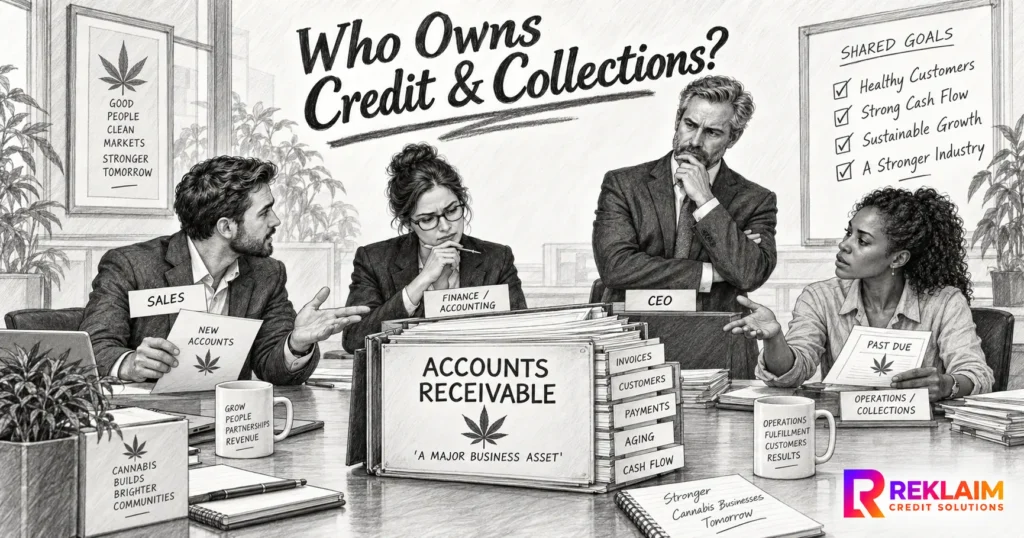
Sometimes, the responsibility of handling credit and collections falls on the shoulders of the Chief Financial Officer (CFO), while there are times accounting oversees aging, which is done while sales keep making sales.
At times, the Chief Executive Officer (CEO) reaches out to clients and authorizes larger credit limits because he or she is not convinced anyone else approving credit has been given that responsibility. In small companies, the situation works fine as long as everyone knows the customers.
Problems arise when business grows faster than its own systems.
You suddenly have more customers buying on Net 30, more dollars sitting in accounts receivable, more exceptions being made for sales, and more past-due invoices that somebody needs to chase. The work gets spread across three or four departments, but no one person is really looking at the whole account from approval through collection.
That is where things begin to get expensive.
The National Cannabis Industry Association has pointed out for years that accounts receivable can become one of the largest assets on the balance sheet once a cannabis company starts extending trade credit. Its guidance on building a formal trade credit policy is worth reading for that reason.
If one of your largest assets is sitting in customers’ hands, somebody should own the decisions around it.
The Job Exists Even If the Title Does Not
We do not believe all companies in the cannabis industry should rush to hire a Credit and Collections Manager tomorrow. A small company with limited customers may employ its CFO, Controller, or Finance Manager and be perfectly alright with it. What matters here is not the title, but having someone to hold responsible.
What matters first is not the title. It is whether somebody is clearly responsible.
The person in this position must know who the credit-qualified customers are, how much credit they have, and why the credit limits are set as they are, as well as which customers are near their limits, who are dragging their feet, and which accounts are no longer the same as they were six months ago.
They must also be allowed to act according to that information.
When sales wants to ship $20,000 to a customer who has already reached its limit, who decides? If a customer has always made payments on the 30th day, but now has started making them on the 45th day, who decides if it matters? If accounting has sent six emails and nobody is responding, who decides when the problem moves from a normal collection issue to a credit hold or outside collection effort?
Those decisions happen whether the company has a formal credit department or not.
In more established B2B industries, this work is a defined profession. The National Association of Credit Management has been training and certifying credit professionals for decades in credit analysis, risk, financial statement analysis, collections, and credit administration.
Cannabis is not somehow exempt from needing the same discipline just because the industry is younger.
Credit Starts Before the Invoice Is Past Due
One reason the function gets fragmented is that people tend to think of collections as something that starts after an invoice goes late.
By then, most of the important credit decisions have already been made.
Someone approved the customer. Someone agreed to the payment terms. Someone decided the credit limit. Someone allowed the next order to ship while the first invoice was still open.
Those are all credit decisions.
We went deeper into that first approval process in Cannabis Credit Application: What to Check Before Offering Net 30 Terms, because the first order is where a lot of exposure begins.
But the credit owner’s job does not end once the account is approved.
Customers that qualified for a $25,000 limit six months ago may qualify for a $50,000 limit today because of their excellent payment history. On the other hand, some customers may still have a $50,000 limit, even if their payment behavior suggests otherwise.
That is why limits need an owner too.
Sales should be part of those conversations because sales usually knows the customer better than anyone. We have never understood the idea that credit and sales should sit on opposite sides of the table. Both groups want profitable business. The only difference is that sales is usually focused on getting the order, while credit has to make sure the order eventually turns into cash.
We wrote about that relationship in Credit & Sales in Cannabis.
The problem is not sales asking for an exception. The problem is when nobody has a consistent way to decide whether the exception makes sense.
Somebody Has to Watch the Account After Approval
This is the part we think gets missed most often.
A customer gets approved, pays well for a year, and gradually becomes the account nobody worries about anymore.
That is understandable. Good customers earn trust.
But they still change.
They open another location. They take on more debt. Their license situation changes. They get hit with a tax issue. Their sales weaken. They start paying another supplier later, while still paying you on time because your product matters more to them.
Your own aging report may not show any of that yet.
That is why portfolio monitoring belongs inside the credit process. Somebody needs to be looking at what has changed, not just which invoice has crossed 30 or 60 days.
We are not suggesting that every new UCC filing or tax lien means you stop shipping product. Credit does not work that way. Information creates a reason to review the account.
Someone responsible for credit still has to decide whether the change impacts the customer.
That is a valuable difference because while software may indicate a change, it still won’t take into account any relationships, the size of the next order, or whether the customer is important strategically. At last, it comes down to human control.
Collections Should Not Be Whoever Has Time That Afternoon
The collections side usually becomes visible first because that is when the cash stops arriving.
Some businesses have finance triggering the reminders because it’s monitoring PA. If that doesn’t accomplish anything, then sales is involved since they have a relationship with the customer. If the balance gets large enough, the CFO or CEO gets involved.
Again, none of that is automatically wrong.
The question is whether there is a process behind it.
A customer who has paid you well for three years and suddenly falls behind deserves a different conversation than a customer who has missed three promises and stopped returning calls. One may need a short payment plan. The other may need a credit hold and a much harder escalation.
We covered that distinction in Cannabis Accounts Receivable: When to Use Payment Plans vs. Third-Party Collections.
What we would not do is manage collections only by looking at the oldest invoice.
The oldest invoice is easy to see. The biggest risk is not always as obvious.
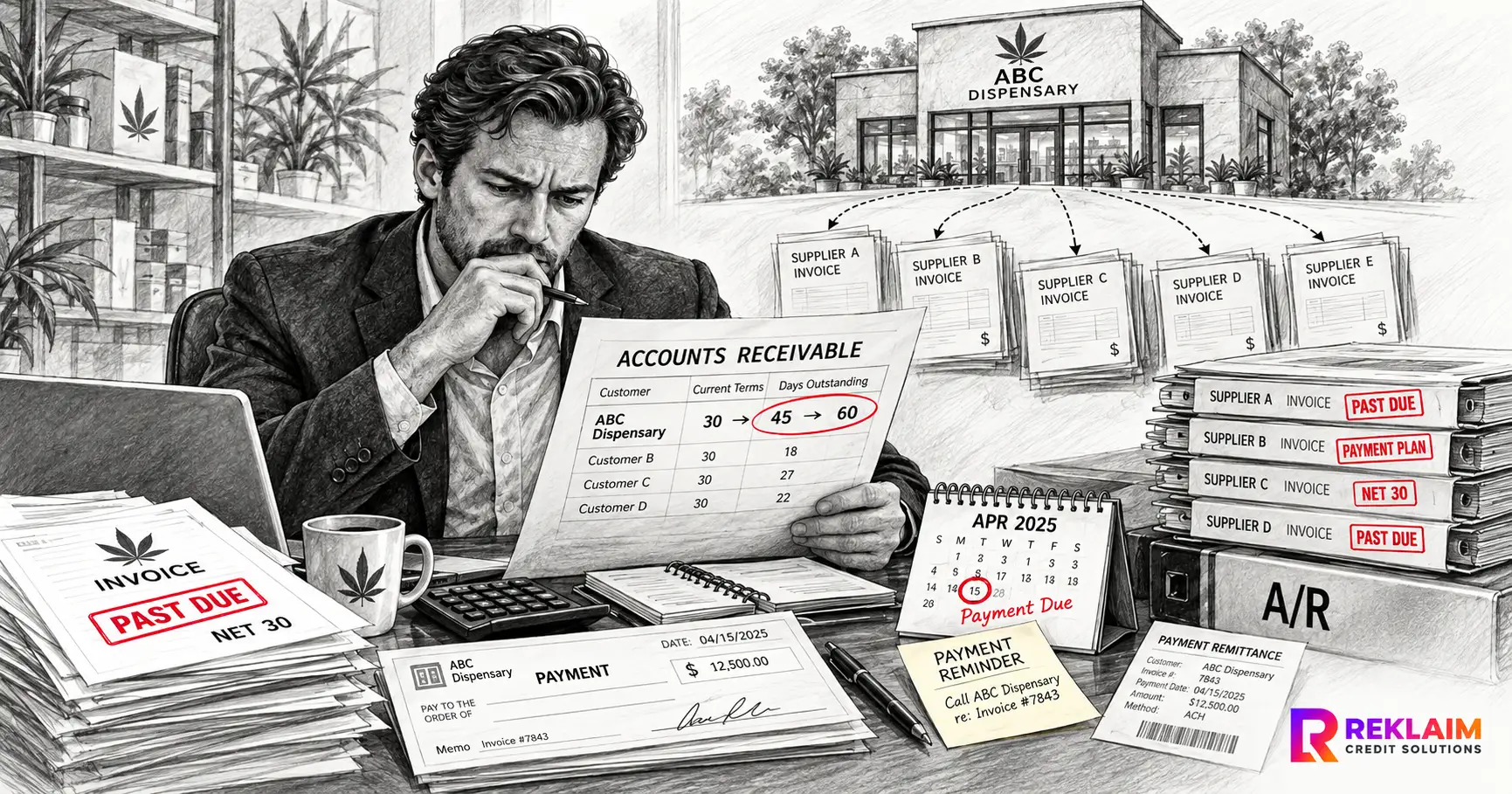
A $4,000 invoice at 75 days past due may get more attention than a $100,000 account that has quietly moved from paying on day 30 to day 45. From a credit standpoint, we would want somebody looking at the second account very closely.
That is also why Who Is Paying Late? focuses on dollars at risk, not just days outstanding.
If nobody owns the whole portfolio, those patterns are easy to miss because every department sees a different piece of the account.
Cannabis Makes the Job Harder
Credit managers in other industries do not always have perfect information either, but cannabis adds some obvious limitations.
Most of the companies you are selling to are privately held. You are not pulling quarterly SEC filings on the dispensary down the street. You may get financial statements if the customer is willing to provide them, but you still have to make many credit decisions with less information than a lender or credit manager would prefer.
That means the person responsible for the account has to put together what is available.
- How has the customer paid you?
- How is it paying the market?
- What does the commercial credit file show?
- Are there tax liens, judgments, or new UCC filings?
- Is the license in good standing?
- Has the account been requesting larger orders while taking longer to pay?
None of those questions answer everything on their own. Together, they give you something to work with.
Cannabis companies have perfected the process whilst the credit ecosystem of this trade is still growing. This explains why personal connections, references and experience play a crucial part in the credit decision-making process.
However, personal connections, references, and experience should not be the only factors influencing decisions.
When Does This Need to Become a Dedicated Role?
There is no clean number where we would say, “Once AR reaches $2 million, go hire a credit manager.”
Every company is different.
We would look at what is happening inside the business instead.
If the company has chargebacks to handle, analysts spend more time than needed making credit decisions, the sales department keeps asking who can approve a credit limit, and no one can tell which customers are a threat, it is time to change how credit decisions are made.
The company may not need to hire a new employee; it may just need to define certain employees’ responsibilities.
As the company grows, this duty may turn into a full-fledged position of Credit Management, Credit Collection Management, or even an accounts receivable manager.
The title can come later. The ownership cannot.
Better Information Does Not Replace the Person Making the Decision
This is where Reklaim fits.
Reklaim Credit Solutions is being built to give the person responsible for cannabis credit and AR better information to work with, including cannabis-specific trade-payment data, predictive credit scores, suggested credit limits, commercial credit reports, public records, license information, and portfolio monitoring.
None of that removes the judgment from the job.
Someone still has to decide whether the customer can use credit of $10,000 or $100,000. At the same time, someone must decide whether to raise the limit, make a collection call, put the next order on hold, or send the account to a collection agency.
The information should help towards ensuring better decision-making in that sense.
It should not pretend to make them for you.
If credit and collections currently belong partly to sales, partly to accounting, partly to finance, and partly to the CEO, we would start with a simpler question before worrying about software or job titles.
Who owns the receivable?
If nobody can answer that clearly, that is probably the first thing to fix.
Frequently Asked Questions
Who should be in charge of credit and collections in a cannabis business?
In smaller businesses, a chief finance officer, controller, financial manager, or AR specialist may handle the role. However, as the number of credit clients and amounts owed become bigger, the organization may need a dedicated credit manager or a credit and collections manager.
Is accounts receivable the same as credit and collections?
Accounts Receivable is not the same as credit and collections. Accounts Receivable includes invoicing, cash application, aging, and direct amounts, while credit and collections begins before that by deciding whether to extend terms and continues through establishing limits and accounting for credits and collections.
When should a cannabis company hire a credit manager?
A cannabis company should hire or designate a credit manager when credit approvals and limit reviews, customer supervision, and collections become too complex for other employees to manage alongside their duties.
What should a credit and collections manager monitor?
At a minimum, we would want that person watching open exposure, payment behavior, aging, limit utilization, past-due concentration, and material changes in the customer’s credit or license profile. The goal is to know what is changing before the next order adds more exposure.