
The biggest legal market in America, and most of the weed still sells elsewhere
We’ve covered New York, Massachusetts and Oregon cannabis markets. Now the big one: the California cannabis market in 2026.
If California were a country, it would be the fourth-largest economy on the planet. The state put its 2025 GDP at $4.25 trillion.
It’s also the biggest legal cannabis market in the country by a country mile.
Licensed retailers sold about $3.9 billion in 2025, according to state data reported by MJBizDaily. Beau Whitney of Whitney Economics and First Citizens Bank estimates U.S. legal cannabis sales at $28.6 billion to $29.6 billion last year. That makes California roughly 13 cents of every legal cannabis dollar spent in America. Michigan, a distant second, did about $3.2 billion.
And yet, by the state’s own commissioned estimate, licensed stores supply only about 38% of what Californians consume.
The fourth-largest economy in the world can’t get its own residents to buy most of their weed legally. You can’t make this up.
The structural issues in the market make even the legal operators tempted to play in the gray (illegal) market. The cultivators, manufacturers, distributors and retailers I talk to in California are smart people doing their best inside a structure that makes doing the right thing expensive and doing the wrong thing easy.
Why Are California Cannabis Sales Shrinking While Volume Rises?
California’s legal market isn’t losing customers so much as it’s losing value. Licensed sales were about $4.4 billion in 2023, $4.2 billion in 2024 and $3.9 billion in 2025.
The first quarter of 2026 came in at about $964 million, below $976.5 million a year earlier and $1.07 billion two years earlier. The second quarter steadied at $1.013 billion, a hair above the same quarter of 2025. One flat quarter after four years of decline is a pause, not a recovery.
At the 2021 peak, taxable sales topped $1.5 billion in a single quarter. Vapes now outsell flower, $350.8 million to $312.8 million in the first quarter. Pre-rolls are catching up as well. I guess with no double albums, people just aren’t rolling their own as much.
The product that built California’s reputation is now runner-up.
California also has more operating dispensaries than any other major adult-use market, 1,182 by Hoodie Analytics’ count of the 15 largest multistate-operator markets, as presented in SSC Advisors’ October 9 weekly update, and fewer dollars running through each one. The average California store does about $3.24 million a year, against more than $10 million in Maryland. Lots of doors, thin traffic.
Through 2024, units sold kept rising while dollars fell, according to a market outlook ERA Economics prepared for the Department of Cannabis Control (DCC). Its inflation-adjusted wholesale price index fell from 102 in 2021 to 49 in 2024. The average wholesale value of a licensed pound went from $1,377 in 2020 to $721 in 2024.
Retail followed. Adjusted for inflation, the average eighth fell 42% between early 2020 and mid-2024, from $38.86 to $22.72. Vape cartridges fell 44%. By November 2025, a California ounce of flower averaged $62.25 at retail, an all-time low.
Hoodie Analytics, which tracks retail flower across package sizes, puts the average California gram at $5.59 as of August 2026, down 10.7% from a year earlier. Different yardstick, same direction.
Now try to factor in all of those 50% off delivery services that populate Weedmaps. Not a pretty picture.
The farm math is just as brutal.
Researchers at UC Berkeley’s Cannabis Research Center, describing Mendocino County after the 2021 price crash, put wholesale prices below $300 a pound against estimated production costs of $250 to $400 a pound. In Humboldt, the county’s growers alliance said prices fell from $350 to $250 a pound in a single year, and that the county has lost about half its farms since 2021.
Unfortunately, as prices fall, most expenses don’t fall with them.
It’s not getting better. Cannabis Benchmarks put late-September outdoor flower at $334 a pound, down 11% since January, and indoor at $983, down 31% this year. Outdoor pounds fetched more than $1,200 in 2021.
Indoor canopy has held flat at about 9.6 million square feet while its price cratered, which Shadd Dales and Anthony Varrell of The Dales Report called “the cultivation equivalent of a bank run in slow motion.” Or, as one Humboldt grower told them, “We used to make a lot; now it costs a lot.”
These issues aren’t new. Way back in early 2022, Beard Bros Media reported that oversupply and rising input costs had sunk California producers’ profit margins by an average of 80% in 2021.
Statewide, active cultivation licenses fell from 8,493 at the end of 2021 to 4,805 at the end of 2024, a 43% drop. Licensed production still rose 11.8% in 2024. Fewer licenses, and fewer farms. Part of that drop is consolidation, growers folding small licenses into bigger ones, which is why ERA cautions that license counts are a rough proxy for exits. Part of it is people walking away. More weed. Lower prices.
Plus, the same illegal growers still at it. Some are small growers who have been at it for a long time, but now there are large commercial unlicensed cultivators as well.
When it costs more to grow a pound than anyone will pay for it, you aren’t running a farm. You’re sitting at a blackjack table in a smoky casino, and you’ve just been dealt a hard 16 against the dealer’s ace.
How Much of California Cannabis Is Still Sold in the Illicit Market?
Price compression (i.e., price rationalization) is only half the problem. The other half is the competition that never has to file a tax return.
ERA estimated that Californians consumed about 3.8 million pounds of cannabis in 2024. About 1.4 million pounds came through licensed channels. The other 2.4 million didn’t. The same study put unlicensed production somewhere between 7 million and 16.3 million pounds a year, with a midpoint of 11.4 million, and the authors say the truth is probably nearer the low end. Much of it likely leaves the state.
Those are model estimates with wide ranges. Even the low end is five times what the licensed market sold.
More than half of California’s cities and counties don’t allow cannabis stores (licensed delivery can still reach them), so legal product travels farther, through more markups, to customers who often have a cheaper unlicensed option on the same block.
In Los Angeles, city officials say there are at least as many unpermitted cannabis stores as permitted ones. Add burner distros, trap delivery services and unlicensed storefronts, and the licensed operator is competing with businesses that skip the excise tax, the local tax, the testing, the tracking, the security requirements and the rent on a compliant building.
To be fair, the state is swinging harder than it used to, although it’s still playing wiffle ball.
California officials reported seizing 377,010 pounds of illegal cannabis in 2025, valued by the state at $609 million, and more than 841,000 pounds since 2022. The DCC says the licensed share of consumption has climbed to about 40%, up from 25% in 2019. That’s progress. It’s also still a minority.
Intoxicating hemp products, for what it’s worth, have largely been shut out of California, so I’ll give it one mention and no more.
How Does California’s Gray Market Affect Cannabis Credit and Cash Flow?
If you talk to virtually any operator in the California market, they’ll tell you a good portion of legal product ends up in consumer hands via untaxed sales. It’s sold to a licensed buyer, on a licensed manifest, and the check clears. What happens after that isn’t on the seller’s invoice.
Would the legal industry collapse without it? Probably not overnight. But a lot of businesses would feel it fast, because of the influx of legal product flowing to consumers via legal channels, plus, the gray/illegal market has one habit the licensed market doesn’t.
It tends to pay CASH.
That matters more than people think.
In a long-running litigation filed by dispensary chain Catalyst, a California court recently found that the state’s track-and-trace system doesn’t automatically flag irregular transactions the way the statute requires. If detection improves and enforcement follows, the burner distro and trap channels should narrow. That sounds like good news, and in the long run I believe it is.
Licensed dispensaries and delivery companies will have less competition even as prices compress further. But the influx of products staying in the state and being sold through licensed channels will likely mean that prices could collapse even further before stabilizing.
And, burner distros buy COD. The licensed buyers who remain buy on terms. So the sale doesn’t disappear. It changes form. COD becomes an invoice on terms, and an invoice on terms is an extension of unsecured trade credit. A loan.
Same top line. Completely different company. Days sales outstanding (DSO) rises, working capital tightens, and credit exposure grows across the supply chain without anyone ever deciding to grow it.
In California, the gray market may be the one customer that reliably pays on time. Think about that.
Read More: The Cannabis COD List: Blunt Tools, Not Surgical Instruments
How Do California Cannabis Taxes Pressure Legal Operators?
California’s state excise tax jumped from 15% to 19% on July 1, 2025. Three months later, after the industry made its case, AB 564 took it back to 15% through June 30, 2028. It passed 39 to 1 in the Senate and 76 to 0 in the Assembly, which tells you how obvious the problem had become.
The state rate is only the start. Six in ten California jurisdictions that allow cannabis sales add a local cannabis tax, and ERA found that local taxes, fees and restrictions can push the effective local rate above 30%. When the state rate was 19%, Los Angeles operators faced a combined stack approaching 40%, by LAist’s count. Los Angeles also raised its annual license renewal fee from $8,486 to $12,617.
Now compare that with anything else on a Los Angeles shelf.
Buy $100 worth of shoes, sunscreen or a phone charger and you pay the 9.75% sales tax.
Buy $100 worth of legal cannabis today and the taxes stack up to roughly 35%: the 15% state excise tax, the same 9.75% sales tax (which California charges on top of the excise) and the city’s 10% business tax on adult-use gross receipts, which the retailer pays and, one way or another, the price reflects. Depending on how the retailer builds that business tax into the price, the all-in number runs higher. Call it three and a half times the tax on the shoes, the sunscreen or the phone charger. Make that make sense.
The city’s business tax alone tells the story. A general retailer in Los Angeles pays $1.27 for every $1,000 in gross receipts. An adult-use cannabis retailer pays $100. That’s about 79x more, for selling a product the state calls legal. And under Proposition CB, approved this year, those cannabis business taxes are payable whether or not a business holds a license. Sounds good on paper, but good luck collecting from the shop that never applied for one.
Then look at what the businesses owe. In Los Angeles, more than 500 of roughly 700 licensed cannabis businesses owed the city about $400 million in taxes, a figure that rose to $417 million by last December, according to the Los Angeles Times. The city’s Office of Finance considered only about $150 million of it collectible. If the city can’t collect its taxes, what happens to the vendors?
In Humboldt, more than three quarters of roughly 1,000 cultivation-permit holders owed county cultivation tax, more than $17 million in total. Humboldt’s answer was to set its cannabis tax to zero.
When more than 500 of 700 businesses in one city are behind on taxes, the problem isn’t the 500.
Since 2018, California has collected nearly $8.4 billion in cannabis taxes, according to the Governor’s office. Retailers collect the excise tax at the register, and the state has liens, audits and license renewals on its side. The brand, the farm and the distributor waiting on an invoice, again, have a phone number.
Guess who gets paid first.
What Cannabis Policy Changes Are California Leaders Debating in 2026?
California votes November 3, and cannabis has become something rare in American politics: a bipartisan punching bag.
At IgniteIt LA this month, Shadd Dales and Anthony Varrell reported that State Treasurer Fiona Ma, the Democratic nominee for lieutenant governor, called the legal market “a complete disaster” and declared the legal business “dead.” Steve Hilton, the Republican nominee for governor, looked at a Sacramento dispensary’s 38% effective tax rate and called it “RIDICULOUS.” In all caps. He isn’t the first to reach for that word. Back in February 2022, Beard Bros Media opened a piece on California’s supply chain by blaming “Ridiculous taxes, labor shortages, and excess regulatory red tape.” Four years later, it still fits.
Same diagnosis, different cures.
Ma wants Prop 64 replaced. Her route: an industry-backed bill passed by two-thirds of the Legislature and signed by the governor, then put to voters, which skips the expensive signature-gathering campaign a brand-new initiative would need. Hilton favors deregulation and enforcement: an “Office of Fun and Freedom” to strip rules he considers pointless, a state audit of cannabis tax flows and an expanded CHP to go after illegal grows.
Dales and Varrell put the stakes in one number. A functioning California market with a 10% illegal share instead of 55% “would be worth $8 billion.” They also make the point every operator already knows: “enforcement without price parity just relocates illicit supply.”
Ten years after Prop 64, nobody running statewide is willing to defend it. That’s either the best news this industry has had in a decade or the setup for another ten years of conference panels. Probably both.
Who Gets Paid When the Company Fails?
Plant-touching cannabis businesses generally can’t use federal bankruptcy, so in California they end up in state-court receivership. A review of public court records identified at least 21 confirmed California cannabis receivership estates. Almost none publicly disclose what trade creditors are owed, let alone what they recovered, if anything.
What is public is sobering.
In the MedMen receivership, the receiver estimated at least $164.5 million in unsecured debt, owed to landlords, service providers and vendors across a multistate estate. Gold Flora entered receivership in March 2025 after defaulting on about $11.5 million in senior notes.
Its last quarterly filing before that showed $273.1 million in liabilities against $209.7 million in assets, including about $21.2 million in accounts payable and $9.6 million in accrued purchases.
StateHouse, which entered receivership in October 2024, had reported $24.3 million in audited trade payables at the end of 2023. In the Element 7 receivership, a single vendor alleged $734,944 for goods ordered and not paid.
HERBL shows how the middle of the supply chain gets squeezed from both sides. As a distributor, it was owed money by its customers and owed money to the brands and manufacturers it bought from. Its receiver confirmed under oath that the company owed manufacturers and brands for product. Individual brands reported balances of more than $160,000 and $130,000. The receiver sold HERBL’s accounts receivable book for $600,000, while the court tentatively ruled on a $9.05 million IRS claim and a proposed $1.39 million distribution to a secured bank.
Many smaller stories read the same. Berkeley Patients Group faced three lawsuits alleging $261,629 in unpaid bills from a cannabis vendor, a security company and a landlord, claims the company denied. Cresco Labs sold its California operations, citing fragmented retail, price compression, illegal competition and lack of scale. Two Santa Rosa manufacturers filed notices for about 109 layoffs this summer.
In a receivership, secured lenders, administrative costs and tax claims generally come before unsecured trade creditors. The brand that stocked the shelf is usually standing at the back of the line when the shelf gets sold.
Receivership is where unpaid cannabis invoices go to die.
Why Is California’s Cannabis Supply Chain So Expensive?
California doesn’t just stack taxes and cultivation licenses. It stacks licensing.
Under the state’s rules, every transfer of cannabis between licensees has to be conducted by a licensed distributor. Cultivators tell me that starts on day one: a nursery can’t legally move a clone to its own grow next door, under the same ownership, unless a licensed distributor carries it.
Separate licensed premises, separate manifest, separate truck. And licenses are issued by activity and by premises, not by company. So I tried to map what it takes to get three common products from a clone to a customer when the work is split across separate licensed businesses, which is how a lot of California still operates.
The counting rule is simple: each licensed business counts once, no matter how many trips it makes, and the high end assumes a different distributor drives each leg.
A one-gram pre-roll starts at a licensed nursery. A distributor moves the clone to a cultivator, who grows and harvests it. A distributor moves the harvest to a processor, who dries, trims and, because state rules treat rolling as processing, can roll it too. A distributor then takes the finished batch, holds it while a licensed lab samples and tests it, and delivers it to the retailer. That’s 11 steps and, in a fragmented chain, as many as 10 separate licensed businesses.
A packaged edible goes further. Add a manufacturer to extract oil from the biomass, a distributor to move that oil, and a second manufacturer to infuse, package and label the gummies before the final distributor, the lab and the retailer get their turn. That’s 13 steps and as many as 12 licensed businesses.
A vape cartridge can go further still, with extraction, refining and filling sometimes happening at different manufacturers. Fourteen steps. As many as 13 licensed businesses.
And not every distributor can finish the job. A transport-only distributor can move product between licensees, but it can’t deliver finished goods to a retailer. That last leg takes a full distribution license.
These are models of a fragmented chain, not statewide averages. A vertically integrated operator or a licensed microbusiness can fold several of these steps into one company. Plenty of California products move through fewer hands. Plenty move through more, once you count the hardware, packaging, security and service vendors who never need a cannabis license at all.
Compare that with a candy bar. The sugar grower sells to a refiner, the refiner to the candy maker, the candy maker to a wholesaler, the wholesaler to a store, and nobody needs a state license to drive the truck. Even alcohol, under its famous three-tier system, has three licensed tiers. A cannabis gummy in California can pass through a dozen licensed businesses.
Every one of those licenses is a cost center, with its own application and renewal fees, compliance staff, security, insurance, track-and-trace entries and margin to protect. Every handoff is another manifest, another trip and another chance for something to go sideways. None of that cost disappears. It gets built into the price of a product that’s already competing with a shop down the street that holds zero licenses.
A dozen licenses, one gummy, and a competitor down the street with none.
Where Does California Cannabis Market Pressure Show Up in Accounts Receivable?
California has no public, audited statewide data on cannabis receivables, aging, write-offs or bad debt. The closest thing is an industry trade association’s estimate, from May 2025, of roughly $777 million in California cannabis accounts receivable. It’s an estimate, but it’s a big one.
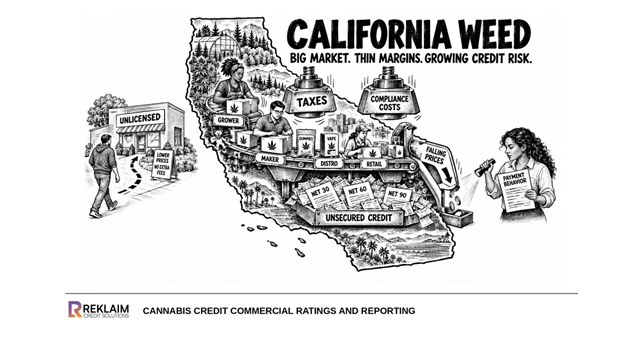
The chain is easy to follow. Falling prices cut revenue per sale. Fees, “cannabis” rent, compliance and financing costs don’t fall with them, and the tax rates certainly don’t. Illegal sellers skip most of that cost stack. The squeeze turns into slower payments, and slower payments roll uphill.
Every tier feels it. The cultivator waits on the manufacturer. The manufacturer waits on the distributor. The distributor waits on the retailer. The retailer is waiting on customers who can buy cheaper down the street with a credit card and on a tax bill that won’t wait at all.
Increasingly, retailers are asking brands to take product on consignment, which means the brand finances the shelf and gets paid only when the product sells.
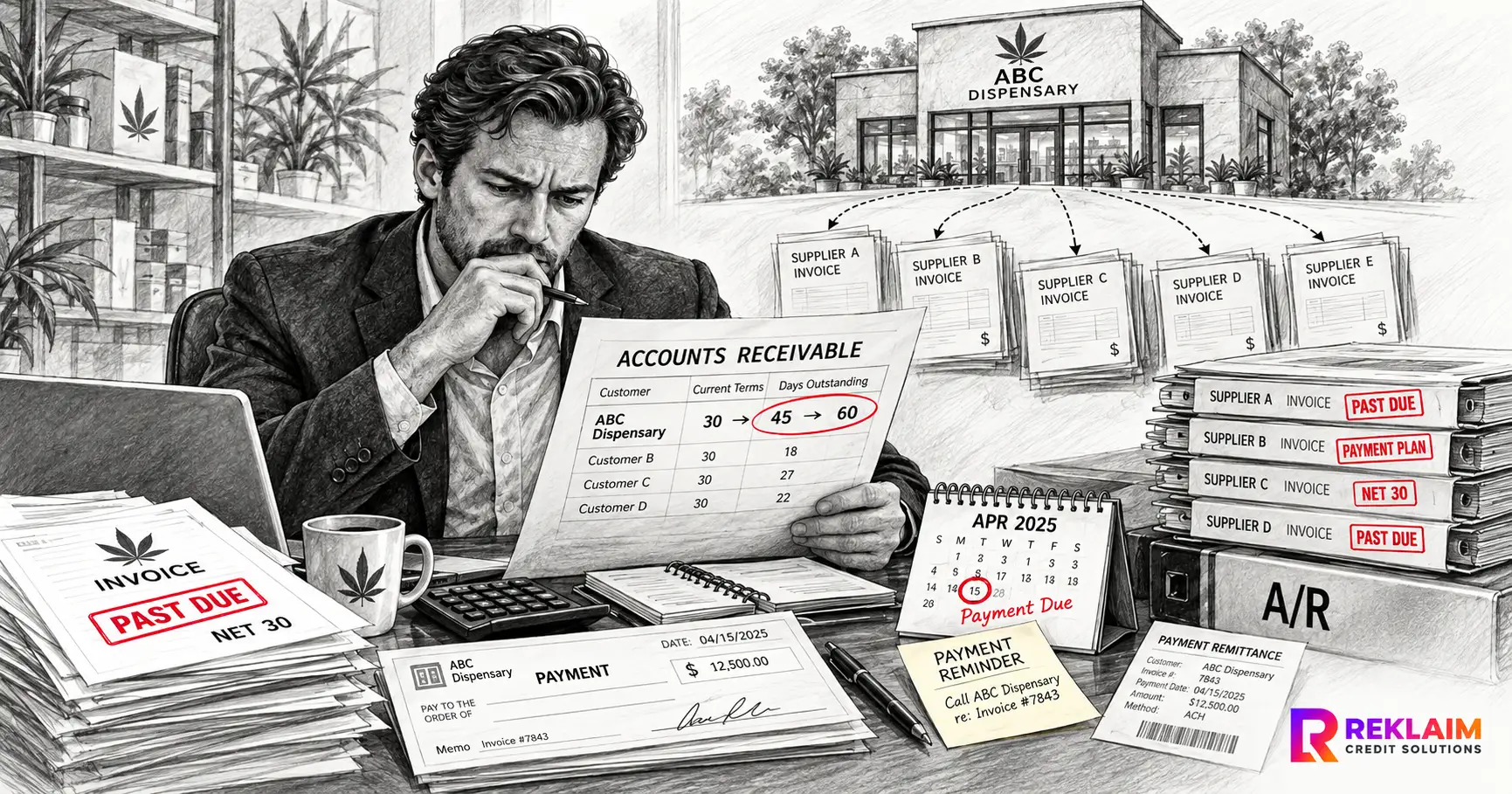
Delinquency rarely appears overnight. A retailer that pays in 30 days, then pays in 45, then 60 is telling its suppliers something. The trouble is that each supplier only hears its own part of the conversation.
Everyone in this chain is somebody’s customer and somebody’s creditor.
Most are both before their gluten-free vegan lunch.
What Can Operators Control Now?
Every sale on terms is a credit decision. A credit limit set a year ago was set for a business that may look entirely different today. Before you ship more, look at how the customer is paying, how much is overdue and how much of your book that customer represents.
Know what happens to your book if the gray market shrinks. A cash customer that disappears and comes back as a net-60 customer is a different risk, even if the revenue line looks exactly the same.
AR aging often shows a slowdown before a lawsuit, a lien or a receivership does. The hard part is seeing past your own ledger. A customer can be current with you while falling behind with three other suppliers.
That blind spot is one of the reasons we built Reklaim Credit Solutions. No supplier can see how a customer is paying everyone else. By combining de-identified AR aging data from across the industry, we can see how that customer is paying the suppliers in our network, and every operator that contributes widens the picture. That allows us to provide commercial credit scores, suggested credit limits, credit reports and continuous monitoring based on what is happening across the market, not just what one customer is doing with one supplier.
We are onboarding subscribers now and ingesting their AR aging data.
A supplier that sees stress early can shorten terms, cut exposure or require payment before the next delivery with empirical data to back up those decisions. One that learns about it from a receiver’s notice has a loss.
Final Thoughts
Californians consumed an estimated 3.8 million pounds of cannabis in 2024. The demand isn’t the problem. The licensed share has grown from roughly a quarter of consumption to about 40%. The excise tax is back to 15% through mid-2028, and enforcement is up.
Wes Hein from Mammoth Distribution suggested to me that “Multivariate problems often require multivariate solutions. We have a lot of work to do in Sacramento and in local jurisdictions.
The industry’s credit problems require comprehensive credit reform combined with attacking the underlying causes of late payment (taxes, illegal market, etc.). But beyond the industry’s structural problems, we also have self-inflicted wounds.
For example, far too many operators conflate discounting with marketing and thus only compete on price. And beyond the operators who can’t pay, we have operators who can pay but simply don’t because of the lack of serious consequences for not doing so. But we have a plant people love, and more of them every day. “Success is ours to lose”.
The operators who make it won’t necessarily be the biggest. They’ll be the ones who know their costs, protect their cash, plan for a market with fewer COD buyers, and stop treating receivables like sales until the money shows up. Selling to fewer retailers that pay is a better business than filling every order that comes in.
Seth Yakatan from Ordo Verde offered this perspective: “Survival in California at retail will separate the good operators from the great ones and there are several great ones. Each is running its own version of the West Coast Offense and I’m sure we will see those same operating systems heading east soon. California is and will be the largest recreational market period, until and if Florida goes recreational.”
California built the biggest legal cannabis market in the country inside the fourth-largest economy in the world. Now it needs the credit discipline to match.
Sources
Office of Governor Gavin Newsom, “California’s economy isn’t just bigger than Texas and Florida, it’s growing faster, too,” July 24, 2026
Office of Governor Gavin Newsom, “California’s legal cannabis market generates $8.4 billion for Californians as state cracks down on illicit operators,” September 2, 2026
Whitney Economics and First Citizens Bank, 2026 State of the U.S. Cannabis Industry Report, as reported by Cannabis Equipment News
CRB Monitor News, “2025 Cannabis Market Review,” January 15, 2026 (Headset data)
MJBizDaily, “California cannabis sales dip slightly again in first quarter of 2026,” May 29, 2026
MJBizDaily, “California cannabis sales recover from earlier slump,” September 2, 2026
CalMatters, “California’s marijuana industry gets a break under new law suspending tax hike,” September 23, 2025
ERA Economics for the California Department of Cannabis Control, California Cannabis Market Outlook 2024 Report, January 2025
California Department of Cannabis Control, Condition and Health of the Cannabis Industry in California, March 3, 2025
Cannabis Business Times, “60% of Cannabis Consumed in California Comes From Unregulated Market as Licensed Production Grows,” March 4, 2025
Cannabis Business Times, “How Much Does a Gram, Ounce of Cannabis Flower Cost in 2026?” January 13, 2026
SSC Advisors, Weekly Update for the period ending October 9, 2026, presenting Hoodie Analytics data (used with permission)
Beard Bros Media, “Supply Chain Issues Across the Board in Cali,” February 7, 2022
The Dales Report (Shadd Dales and Anthony Varrell), newsletter commentary on IgniteIt LA and the California market, October 2026, citing Cannabis Benchmarks data
Marijuana Moment, “California GOP And Democratic Candidates Agree That Marijuana Law Needs An Overhaul,” October 8, 2026
UC Berkeley Cannabis Research Center, “Trends in California’s Cannabis Cultivation Since Legalization,” March 5, 2026
Jefferson Public Radio, “‘An incredible experiment’: Humboldt County ends its cannabis tax,” October 29, 2025
MJBizDaily, “Humboldt County extends deadline to pay marijuana cultivation taxes,” March 28, 2025
Spectrum News 1, “LA ballot measure wants to tax illegal cannabis shops, but enforcement may be difficult,” April 14, 2026
Office of Governor Gavin Newsom, “California tops $1.2 billion in illegal cannabis seizures, up 18x since 2022,” January 27, 2026, and July 8, 2026 enforcement release
Office of Governor Gavin Newsom, “Governor Newsom signs legislation cutting taxes on cannabis,” September 22, 2025; Cannabis Business Times, September 22, 2025
City of Los Angeles Department of Cannabis Regulation, “California Cannabis Taxes,” September 24, 2025
California Department of Cannabis Control, Medicinal and Adult-Use Cannabis Regulations (July 2026), including 4 CCR §15000 and §15000.1(d)
City of Los Angeles Office of Finance, Cannabis Tax Rate Table; Tax Compliance Guide: Cannabis Industries (Proposition CB, revised July 16, 2026); Industry-Based Tax Compliance Guide: Retail Sales, September 23, 2025
CBS Los Angeles, “Sales tax in Los Angeles County increases to 9.75%,” April 2025 (Measure A)
Public Health Institute, “The State of Local Cannabis Policy in California Cities and Counties: 2025 Scorecards,” February 5, 2026
LAist, “LA’s legal cannabis owners say multi-million dollar program left ‘complete debt and devastation,'” July 30, 2025
Los Angeles Times, “L.A. marijuana businesses will pay higher fees as industry struggles,” August 5, 2025
Los Angeles Times, “L.A. cannabis businesses owe $400 million. The city may get only $30 million,” March 4, 2026
Los Angeles Superior Court receivership filings and receiver reports for MM CAN USA (MedMen), Gold Flora, Element 7 and related estates; San Diego Superior Court filings for StateHouse Holdings
Gold Flora Corporation SEC filings, including Form 10-Q for the quarter ended September 30, 2024, and Exhibit 99.1, March 31, 2025
MJBizDaily, “Debt and default force marijuana operator Gold Flora into receivership filing,” April 1, 2025
StateHouse Holdings audited financial statements, December 31, 2023
Superior Court of California, County of Santa Barbara, East West Bank v. HERBL Inc., tentative ruling, May 4, 2026, and receiver declarations
Berkeleyside, “Berkeley cannabis dispensary faces 3 lawsuits claiming it hasn’t paid its bills,” January 9, 2025
MJBizDaily, “Cresco Labs is latest cannabis MSO to exit California market,” July 22, 2025
MJBizDaily, “Mass layoffs at two California cannabis manufacturers,” July 24, 2026
Perishable Agricultural Commodities Act, 7 U.S.C. 499e(c)