
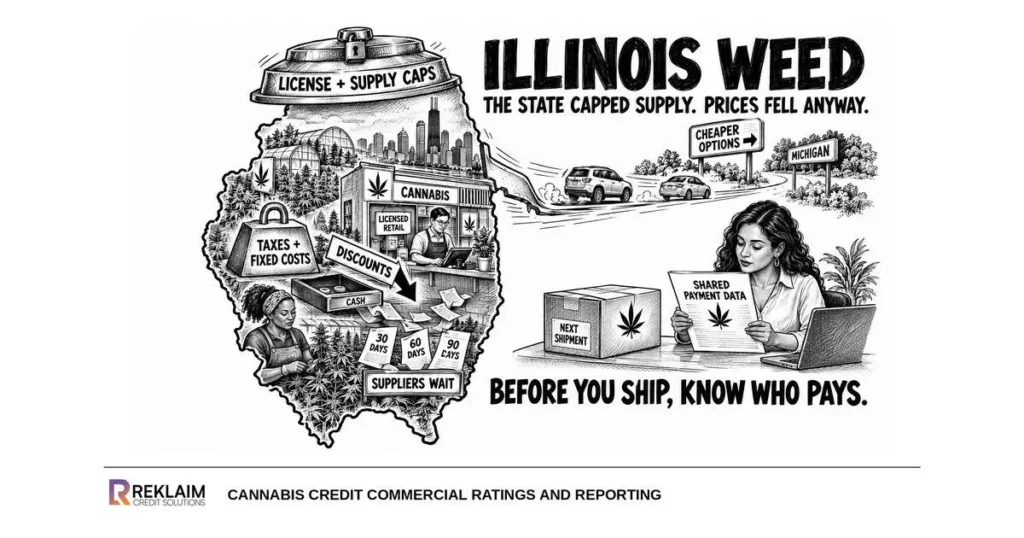
The state that capped everything, and prices fell anyway
We’ve covered New York, Massachusetts, Oregon and California. Now Illinois, where the story arguably starts in a different state.
New Buffalo Township, Michigan, has about 2,500 residents and, as of this spring, 29 dispensaries.
On paper, that makes no sense at all.
It sits about 70 miles from the Loop, one exit past the Indiana line. BDSA estimates its stores sold about $231 million of cannabis in 2025 and $72 million in the first quarter of 2026, roughly $28,000 per store per day that quarter against a Michigan statewide average near $10,000.
Crain’s Detroit walked New Buffalo’s parking lots over two days in June 2025 and counted plates. Of hundreds of cars, “only six had Michigan license plates.”
The rest drove in from Indiana and Illinois, Flock cameras be damned.
The same Cresco eighth, LA Kush Cake, that sold for $28.80 at Sunnyside in Wrigleyville this March sold for $14.25 at Vibe in New Buffalo. Same brand. Same strain. Same company. Different grow, half the price, one invisible state line away.
That’s the Illinois cannabis market in one parking lot.
Why Did Illinois Cannabis Prices Fall Despite Supply Caps?
Illinois is the fifth-largest economy in the country, at about $1.23 trillion in 2025, and Chicago is the third-largest metro. Its licensed cannabis market did about $1.7 billion in 2025 including medical, roughly $1.5 billion of it adult-use, which puts it about sixth among the states, and the state has collected about $2.5 billion in state dispensary taxes since 2020.
It also did what every critic of the oversupplied markets said to do. It allows only 30 cultivation centers and has licensed 21. It issued 88 craft grower licenses and started each one at 5,000 square feet of canopy, with anything more subject to state approval. It capped retail at 500 licenses and 10 stores per owner. It made dispensaries buy only from Illinois licensees, kept any one supplier at no more than 40% of a store’s inventory, and let the market open with some of the highest prices in the country.
Guess what.
How Much Have Illinois Cannabis Prices Fallen Since 2020?
Prices fell anyway. The state’s own data puts the average retail gram of flower at $17.50 in April 2020 and $5.72 in November 2025. The Chicago Tribune put the ounce at more than $400 at launch and about $167 by early 2026. Sales dollars fell in 2025 and are running behind again in 2026, while the number of items sold keeps climbing. Starting to sound familiar?
I’ve been in this industry since 2014. We’ve all watched oversupply wreck Oregon and California. Illinois is the control group: capped supply but the same ugly result. Which tells you the problem was never only the number of licenses.
Did Illinois Actually Have a Cannabis Supply Shortage?
Beau Whitney of Whitney Economics, whom we quoted in the Oregon piece, put a number on that for me. His 2025 supply analysis has Illinois with total demand, legal and illegal combined, of about 1.9 million pounds of cultivated output a year, against authorized capacity of about 2.1 million pounds.
With legal participation hovering around 50%, that leaves roughly 1.2 million pounds of excess capacity in a market everyone describes as supply-constrained. In his words: “The excess supply and pricing compression is mainly driven by tax policy more so than simply cheaper prices in other states.”
You can cap supply. You can’t cap the interstate.
Why Is Illinois Selling More Cannabis but Collecting Fewer Dollars?
Illinois adult-use sales peaked at $1.72 billion in 2024. They fell to $1.51 billion in 2025, down 12.5%, while the number of items sold rose 6.5% to 52 million. Through August 2026, sales were $933 million, down about 12% from the same months of 2025, on roughly 10% more items. July 2026 set the all-time record for items sold, more than 5 million in a month.
More weed, less money? The basket says yes.
Headset had the average Illinois basket at $153 in the first weeks of January 2020, when people were buying anything with a label on it. By the end of 2021 it was about $92. By the middle of 2023 it was about $70, and that is the last Illinois basket figure I could find from Headset.
Divide the state’s own adult-use dollars by its own item counts and the average item went from about $46 in 2020 to about $35 in 2024 and about $25 so far in 2026 (the Metrc change is part of that last step).
Whitney adds a caution on the item counts: shoppers are shifting to formats they see as better value, and pre-rolls alone picked up 4.6 points of revenue share between 2021 and 2025, so more items don’t mean more flower. The customer walks out with more in the bag and less on the receipt.
Part of that decline is accounting.
Why Did the Metric Change Affect Illinois Cannabis Sales Reporting?
The state switched its track-and-trace system to Metrc in July 2025, and the new system records final checkout prices AFTER discounts. The old one, in the state’s words, “collected some pre-discount prices.”
Headset’s model estimates that about 64% of discount value was missed in the old reporting. The switch wasn’t free for operators either: inventory migration, retraining, new tags on everything. The state paid for the tags. Operators were forced to pay for the staff time. So the state’s fiscal 2026 figure of $1.52 billion in total dispensary sales, medical included, down 22% from fiscal 2025, overstates the drop. The reported direction for 2025 doesn’t change, but the slope does.
Then read how the state itself describes the year.
The 2026 annual report says fiscal 2026 data “reflects final purchase price, including all discounts and promotions offered by the industry,” and the Cannabis Regulation Oversight Officer, Erin Johnson, cheerily summed it up as a “record number of sales last year, with the best prices yet for Illinois consumers.”
Put that next to the Headset estimate and a fair supposition is that a good part of the reported decline never happened at the register. The state may simply have started counting the discounts it was missing before.
The cleanest test is July and August, the months that have been fully on the new system in both years. July and August 2026 came in at $248.7 million, about 8% ahead of July and August 2025. Fewer dollars per item, more items, and on a like-for-like basis the top line may have stopped falling. Headset’s September estimate points the same way: Illinois sales up 10.8% from a year earlier on 14.2% more units. Oregon and California were flat over the same stretch.
How Much Is Cannabis Discounting Affecting Operator Margins?
The discounts themselves are the story. Cresco, one of the state’s largest operators, reported that sales discounts ate 24.6% of its gross revenue in 2024, 29.6% in 2025 and 31.8% in the second quarter of 2026. That’s companywide, but Illinois is its home market. When a third of your sticker price is promotion, the sticker price is a suggestion. For a supplier, the question is how much of that discount reaches its own invoice, and how much of that invoice gets collected.
The biggest operators in the state now name Illinois when they explain softer numbers. Cresco: “increased competition, price compression, and price discounting in the Illinois, Florida, and Pennsylvania markets.” Green Thumb, on a dip in retail revenue: “primarily due to price compression in existing markets, including Illinois,” with comparable-store sales off 7.1%. Verano, on its 2024 results: “expected declines in Illinois and New Jersey due to increased retail competition.” Ascend’s CEO this March: “Price compression remains a significant headwind, particularly in Illinois.” Curaleaf this May: strength elsewhere “was offset by challenges in Nevada and Illinois.”
As many of you know, I prefer “price rationalization” to “price compression” but tomatoes, tomahtoes.
These are the best-capitalized companies in cannabis, in a state built to protect them. If they’re bleeding margin here, imagine the craft grower with 14,000 square feet and equipment, construction and working capital loans.
Illinois was supposed to be the market where the math worked. One problem though: the customer’s math moved to Michigan.
Thank you, come again.
Why Is Cannabis So Much Cheaper in Michigan Than Illinois?
Headset’s September numbers: the average Illinois eighth sells for $25.99. Michigan’s sells for $14.32. Missouri’s for $24.93. The average across the dozen markets Headset tracks is $20.23. Illinois sits well above that average, and both of its neighbors with legal sales undercut it. Rick Bashkoff of Lit Alerts, which aggregates dispensary menus rather than register data, saw the same thing from the shelf side in his third-quarter 2025 Midwest survey: “Illinois has held the highest average price point for some time now,” while Michigan “consistently offers the lowest prices across all product sizes.”
The gap isn’t a mystery, and the register makes it worse. Michigan charges a 10% excise at checkout and then 6% sales tax on top of that. In Chicago, the stack on flower is a 10% state excise (25% on flower above 35% THC), 10.25% general sales tax, 3% city cannabis tax and 3% Cook County cannabis tax: 26.25% at the low end, 41.25% at the high end. For comparison, a pair of sneakers on Michigan Avenue carries 10.25%. An eighth of strong flower carries 4 times that.
Run that Cresco eighth through both registers.
In New Buffalo, $14.25 on the shelf becomes about $16.62 out the door, with $2.37 going to Michigan. At Sunnyside Wrigleyville, $28.80 becomes about $36.36 if the strain tests under 35% THC and about $40.68 if it tests over. The tax alone on a strong-flower eighth in Chicago, $11.88, buys most of the eighth in New Buffalo. Same brand, up to 2.5x the money.
Scale it to an ounce and it gets worse. Michigan’s statewide average ounce, by the state regulator’s count, fell to $60.33 in August, about $70 after tax. The Illinois ounce is around $167 on the shelf, which is $211 to $236 after tax in Chicago. For the price of one Chicago ounce, a customer can buy three in Michigan. Snacks for the ensuing munchies are extra.
(To be fair, those are simple sums on menu prices, and Michigan’s new wholesale tax is already baked into its shelf price. BUT, the gap doesn’t move.)
Michigan did just raise taxes. A 24% wholesale tax took effect January 1, 2026, and Michigan’s sales fell in January and February from a year earlier, with early estimates putting the February drop as high as 14.8%. Lawmakers from both parties filed a repeal bill in March.
But here’s the thing: Michigan’s average ounce still fell to $60.33 in August. The wholesale tax hurt Michigan operators. It didn’t make Michigan expensive. New Buffalo, with its 2,500 residents, did $72 million in the first quarter with the tax in place. Whitney saw it coming in April 2025: “Unless Illinois develops a regionally competitive tax policy, tax revenues derived from sales to out-of-state residents could be at risk. This is not simply a hypothetical. Illinois has already experienced this as a result of retail openings in New Buffalo, Michigan.”
Missouri took the other flank. In 2022, before Missouri opened adult-use sales, it was projected that out-of-state shoppers were more than 30% of Illinois sales, many of them crossing the river from St. Louis.
In 2023 that share was about 25%. Through August 2026 it was 19.7%. For three years Illinois sold expensive weed to Missourians. Now Michigan sells cheap weed to Illinoisans. Where you sit in the state decides which story you’re in. New Buffalo is a Chicago problem. Along the Mississippi, the cheaper option is Missouri. In the middle of the state, until next month, it’s the gas station. And on the other borders the arrow still points in.
By Hoodie Analytics’ estimates, the Illinois dispensaries with the highest sales include Sunnyside in South Beloit on the Wisconsin line, Nature’s Treatment in Milan across from Iowa and Thrive in Metropolis across from Kentucky. Illinois still exports its prices to the neighbors that haven’t legalized. It imports them from the one that has.
Illinois law says legally purchased cannabis can’t cross state lines, in either direction. The law does not appear to be slowing traffic on I-94.
Douglas Kelly of the Cannabis Equity Illinois Coalition put it plainly to the Tribune: “People are going to places that are cheaper to buy their product, whether it’s the hemp shop on the corner, or Michigan.”
The customer didn’t leave the market. The customer left the state.
Read More: Cannabis Payment Behavior: What to Do When a Customer Starts Paying Slower
How Has Intoxicating Hemp Competed With Illinois Cannabis?
Which brings us to the hemp shop on the corner.
For most of the legal market’s life, “intoxicating hemp” sold in Illinois gas stations, smoke shops and convenience stores without paying a dime of cannabis tax. The State Police described those products as “widely available” in the fiscal year that just ended. A Pritzker-backed bill to rein them in died in January 2025. Nobody has an exact number, but Whitney’s April 2025 report put Illinois hemp cannabinoid retail sales at roughly $870 million a year. That’s more than half the size of the licensed market, sold at the gas station, with no cannabis tax on any of it.
What Changes on November 12, 2026?
The state finally moved. SB 3222, signed June 12, 2026, banned sales to anyone under 21 immediately. On November 12, intoxicating hemp gets reclassified as cannabis. Outside a licensed dispensary, the only hemp products that remain legal are non-smokable, non-synthetic products with no more than 0.4 milligrams of total THC per container, which rules out any drink, gummy or vape built to get you high. The Department of Revenue said on October 14 that enforcement starts November 12 regardless of the federal delay to December.
That includes the THC seltzers at the grocery store, the liquor store and local bar. That’s unfortunate. I personally believe that lower dose THC drinks sold in age-gated environments are the best marketing available for the regulated THC industry.
Whitney believes that the total potential THC beverage market size in Illinois is $600m annually, of which 62.7% is supported off-premises, while $112m in sales could run through restaurants and bars.
That beverage business paid sales tax, employed distributors and bartenders, and was built to sell with dinner, not out of a parking lot. In three weeks it goes away, and the tax it carried goes with it. As Whitney put it, the state “is not only taking a hit on lower tax revenues on the MJ side, but also on the hemp side.”
The law carves out nothing for beverages, and the Department of Revenue’s October bulletin says anything over the threshold needs a cannabis license to be sold at all. Chicago breweries that built a second business on 5-milligram cans are waiting to find out whether they survive the year.
Mayor Johnson had previously vetoed Chicago’s own hemp ban in February with a warning: “when you make something illegal, you inevitably create a black market.” He’s not wrong about the risk. Tiffany Chappell Ingram of the Cannabis Business Association of Illinois said the same thing from the other side: the ban will only work to the extent it is enforced.
Hemp didn’t cause Illinois’s price problem. But for years it sat under the licensed market’s prices, and it did so outside the cannabis tax system entirely. Time will tell how the impending ban will impact pricing and purchasing behavior.
How High Are Illinois Cannabis Taxes in 2026?
Illinois taxes cannabis by potency. Flower at or below 35% THC carries a 10% purchaser excise tax. Infused products carry 20%. Flower and other non-infused products above 35% THC carry 25%. Add the 6.25% state sales tax, up to 3% for the municipality and up to 3% for the county (3.75% in unincorporated areas), plus a 7% privilege tax on the grower’s gross receipts that gets built into the wholesale price. Chicago’s stack on strong flower is north of 40%.
Not great for an industry that has taught consumers to chase potency over quality.
Whitney’s April 2025 report on Illinois taxation, prepared before SB 3222, puts the average effective rate an Illinois consumer pays at roughly 36.25% once the 7% cultivation tax is counted, and calls the structure “one of the more complex and highest rates in the country.” His finding on what that buys the state: “As a result, Illinois legal cannabis consumer participation is low. At 50.6%, Illinois has one of the lowest legal participation rates in the country when compared to other mature, adult-use markets.” His table puts Michigan at 85% and Missouri at 75%. Half of Illinois demand, by his estimate, is being met somewhere other than an Illinois dispensary.
The mechanism is not complicated. Whitney’s work across six states finds consumers will pay a premium of 10% to 15% over the untaxed alternative to buy legally, and that “once that differential between legal and illicit pricing exceeds 15%, the pace of consumer conversions into the legal market slows.” Illinois is running at more than twice that premium. He also puts his finger on the register problem: “When a consumer does not know how much they will end up paying for their cannabis products until they are at the register, they are not as willing to purchase as much or participate in the legal, regulated marketplace.”
The state collected $422.6 million in dispensary taxes in fiscal 2026, down from $438.2 million the year before, plus $31.8 million in cultivation privilege tax from growers, down from $33.9 million. It’s only the second annual decline since legalization, and the first since fiscal 2023.
Tax revenue fell far less than reported sales did, one more sign that the old sales reporting was inflated and the tax reporting wasn’t.
The operators in the industry have been asking for relief for years. The state’s answer in the 2026 annual report is that rate changes would be “premature” while the market is still adding stores. The “significant changes to cannabis tax policy” the report mentions for fiscal 2027 are the ones already passed in SB 3222, led by the medical excise exemption, and the agencies want to see how those play out before recommending anything else. Translation: don’t expect the agencies to recommend an adult-use rate cut until they have a full year of data.
Could Lower Cannabis Taxes Increase Illinois Tax Revenue?
Whitney already ran the numbers they’re waiting on.
His model, which he says has been applied in Oregon, Michigan, New York, Massachusetts and Washington, finds a 5-point cut in the Illinois rate would add about $143.6 million in state cannabis tax revenue through 2030 and a 7-point cut about $189.2 million, with legal participation up about 16.8 points, because enough shoppers come back from Michigan, the gas station and the guy down the street to more than cover the lower rate.
His recommendation: “Reduce cannabis taxation statewide by a minimum of 5%, with 7% strongly recommended.” A tax cut that raises revenue is the kind of thing legislators say they want. It’s been sitting on their desks since April 2025. Whitney’s view of why it’s still sitting there: “Solutions exist to solve the operator issues while increasing legal participation and tax revenues, but the legislators are not willing to accept the fact that their policies are failing.”
The tax is a percentage of price, so the state’s take falls as prices fall. The operator’s rent, payroll, security and compliance costs do not. The state is sharing in the compression. The operator is fully absorbing it.
Governments, state and local, take about 29 cents of every strong-flower dollar a Chicago customer hands over. The mother plant that started the cultivation many, many months ago, is at the back of that line.
How Concentrated Is the Illinois Cannabis Market?
Illinois was designed as a limited-license market, and limited-license markets concentrate. The Parabola Center’s analysis of Headset data found that incumbent operators’ brands account for nearly 79 cents of every retail dollar in the state, whether the product sells in their own stores or an independent’s. The top four firms held 47% of sales at the end of 2025, up from 45% a year earlier. The number of parent companies selling product fell from 91 to 79 in a single year.
Concentration isn’t the whole story on the shelf, though.
Rick Bashkoff’s team at Lit Alerts tracks which brands are climbing the sales rankings in each state every month, and its July 2026 Illinois report found “three distinct brands gaining serious traction against legacy MSO brands,” with names like Daze Off, Aeriz, IC Collective, OGeez! and Nature’s Heritage moving up across flower, pre-rolls, edibles and concentrates alongside a few MSO-owned labels.
His read: “Illinois remains one of the most competitive cannabis markets in the nation,” and “brands that diversify across multiple categories are capturing disproportionate market momentum.” The big companies have most of the dollars. The momentum is spread more evenly than the market-share chart suggests.
Which tells you there is room in this market, and in the others we’ve covered, for both: the bigger, well-capitalized operators and the smaller ones delivering products consumers also want.
The craft grower program was designed to be a counterweight against big operator concentration.
Eighty-eight licenses went out in 2021 and 2022. As of early this year, by the Tribune’s count, 29 were operating. Industry estimates put the cost of getting a craft grow from application to first sale at $5 million to $10 million.
Reese Xavier of HT23 Growers in Chicago Heights said it on camera in 2024: “one of the things I learned quickly was limited access to capital. That is one of the largest barriers to becoming operational.”
Financing is scarce, and until June a craft grower started at 5,000 square feet of canopy, which is the state asking you to run a hobby farm, but, with a compliance department. Lisbeth Vargas Jaimes of the Illinois Independent Craft Growers Association said it in 2023: “we’re being set up to fail.”
SB 3222 lets a craft grower go straight to 14,000 square feet without the old staged approvals, and the state paused renewal fees for two years. That helps the ones that are open. Most of the rest still haven’t opened, and money (or lack thereof) is the usual reason.
Are More Illinois Dispensaries Splitting the Same Revenue?
Retail is the same story one tier down. As of September, the state had issued 288 adult-use dispensary licenses, including 178 social equity lottery stores that have opened. Hoodie Analytics’ public dashboard put the count of open stores in the high 260s this year, up about 8% from a year earlier.
More stores, more items, fewer dollars. Whitney measured the same squeeze a year earlier: 37.1% more retailers in 2024 on 2.5% more sales, so average revenue per store fell 25.2%. Another 68 conditional licensees are still trying to open, years after winning a lottery that was itself tied up in court.
The state has put about $55 million of forgivable loans on the table across three rounds to keep them going. Many are buying product from the same vertically integrated companies they compete with at the register. The 40% rule stops one supplier from filling a store’s inventory. It doesn’t guarantee an independent brand a spot in it.
Scott Weiner closed his Okay Cannabis store in Wheeling in the spring of 2025. His verdict to the Tribune: “You just can’t fight the big boys.” And: “For the new social equity guys coming in, sadly there’s no path to success.”
There’s one more advantage the original licensees had that rarely gets mentioned.
Until this year, only the legacy medical dispensaries, nearly all of them owned by the biggest operators, could serve the state’s medical patients, who pay a fraction of the tax an adult-use customer pays.
SB 3222 lets eligible adult-use stores apply to add a medical license for a $5,000 fee, and on September 10 the state issued the first 37. It’s the first time a social equity store has been allowed to compete for the steadiest customers in the market.
To be clear, the big boys are NOT villains here. Cresco, Green Thumb and Verano are Chicago companies that literally took the risk and built the market.
Sorry, not sorry, but credit where credit is due. They employ thousands of people across their footprints and are getting medicine to patients and are feeling the same compression as everyone else. The structure did this.
A capped market with a tax stack that tops 40% on strong flower in Chicago and a cheaper state next door was always going to reward scale and punish everyone without it.
Illinois built a market for a dozen winners. Then it put 500 licenses on the table.
How Is Illinois Cannabis Market Pressure Affecting Trade Credit?
Here’s where the pressure turns into credit.
Why Are Cannabis Suppliers Cutting Credit Exposure?
When Illinois retailers started struggling, their suppliers did what any lender does. Cresco’s CFO, Sharon Schuler, August 2025: “Wholesale revenue was flat as we stayed disciplined in our AR strategy, prioritizing creditworthy accounts and foregoing sales that carried repayment risk.” The company’s receivables, she added, were “down 23% since the start of the year.” Those are companywide numbers. Its president named the state: “we are also seeing it in states like Illinois, where you had some increased activity, whether it’s due to financial struggles of some major outlets in the state… our decision to not sell to those customers may have impacted revenue, but we think it’s the right thing to do.”
Verano’s CEO said the same month that Illinois and New Jersey were “2 of the biggest markets where we have cut back.” A year earlier, Cresco had credited “increased collections in the Illinois market” for lower bad-debt expense, which tells you Illinois receivables were already big enough to move a multistate company’s numbers.
The retailer’s perspective? Picture a social equity dispensary that won a lottery, waited out a lawsuit, borrowed from the state to open, and is now discounting 30% to compete with Michigan that just got its terms pulled by its biggest supplier. It isn’t a bad actor. It’s an unsecured borrower, and its supplier just did what any lender does when the numbers stop working. Stop the bleed.
The supplier isn’t the villain either.
The product was delivered, the invoice is due on the terms both sides agreed to, and every additional shipment on terms is more of the supplier’s own cash sitting in someone else’s register. And in Illinois like other states, the party holding that receivable isn’t always the brand on the package. Plenty of brands run through a licensed infuser or cultivator that invoices the store, which means the brand learns about a slow payer secondhand.
In Illinois, this distress showed up in the real estate as well.
WGLT reported in December that PharmaCann was closing its Dwight cultivation facility on January 13, 2026 and laying off 82 workers, citing the state’s monthly mass-layoff report. Its landlord had already cut its base rent across nine leases in several states from $2.8 million a month to $2.6 million. The landlord took the building back in December and signed a new tenant in March, which is the one encouraging line in this paragraph.
4Front’s Illinois assets, three stores, two grows and two manufacturing plants, went into receivership last year, in proceedings filed in Massachusetts and Illinois.
The Cannabist Company’s Aurora equipment was put up for auction in August.
Ayr announced in March 2025 that it was selling its four Illinois stores because, in its president’s words, it lacked the scale to compete here.
A Chicago cannabis lender disclosed in August that one of its Illinois loans had been restructured to 0% cash interest, a 7.5% default rate and 13.75% paid in kind, which means none of the interest is being paid in cash. All of it is being added to the loan.
What I couldn’t find is a published list of who owes whom, or a single company that breaks out its Illinois receivables. The trouble in Illinois is being worked out in rent cuts, credit cutoffs and quiet exits.
Quiet doesn’t mean small and quiet has yet to translate to better margins.
Can Late Cannabis Payments Put an Illinois Dispensary License at Risk?
Then Illinois did something no other state in this series has done quite this way.
Buried in SB 3222, the same omnibus that dealt with hemp and craft canopy, are two new grounds for disciplining a dispensary license. Section 15-145 of the Cannabis Regulation and Tax Act now lets the state deny, suspend, revoke, fine or put on probation a dispensing organization for, in the statute’s words, “engaging in a pattern of nonpayment or late payment for goods or services to a cannabis business establishment,” and for “engaging in predatory financial practices or financial collusion, including, but not limited to, bid-rigging and market allocation schemes.”
The same law says that anyone collecting more than 10% of a dispensary’s monthly gross revenue, half its annual net profit or $250,000 a year is now treated as a principal officer. In Illinois, a principal officer is anyone the state considers an owner or controller of the license, and every one of them has to be disclosed, vetted and approved by IDFPR. In plain English: if you’re taking that much money out of a dispensary, the state now wants your name, your background check and its sign-off, whether or not you’re on the license. AND management and consulting contracts now count toward the ten-store cap (ordinary accounting and IT vendors are excluded).
The state’s own summary of the bill says it “increases transparency around cannabis business ownership,” which is a polite way of putting it. Short of a state waiver, that drags the arrangements that have quietly transferred control of struggling social equity stores to their lenders and operators into the open.
Read the first one again. Not paying your grower now sits on the same list as diverting product, failing a state audit and lying on your license application.
That’s a bigger deal than it sounds.
New York put nonpayment in its regulations and built an unpopular COD list around it for retailers that don’t pay within 30 days of delivery. Massachusetts capped terms at 60 days starting in 2028.
What Counts as a “Pattern” of Late Payment?
Illinois wrote the offense into the statute itself, named a pattern of late payment as the trigger, and added financial collusion for good measure. A retailer that habitually pays late now has a regulatory problem, not just a collections problem.
BUT…what the statute doesn’t say is how it works.
It doesn’t define a pattern. It doesn’t say who reports one, what a supplier has to show, or how a retailer disputes a claim beyond the state’s general complaint process. Those details will come from the regulator, through rules or through the first cases it brings. It reaches dispensary licenses only, so a grower that stiffs a vendor is not covered.
The provision took effect on June 12, 2026, the day the bill was signed, and it is a deterrent with no published enforcement case that I could find as of this writing, which is still more than any Illinois supplier had last year.
A grower whose invoices are months past due now has somewhere to send them besides a collections agency. A license complaint is not a collections strategy, though. A retailer that loses its license isn’t paying anybody any faster. Suppliers need a clear way to document a pattern and a regulator that answers while the account is still open.
A law that punishes nonpayment is only as good as the record of who paid. Illinois now needs that record.
Where Does Illinois Cannabis Market Pressure Show Up in Accounts Receivable?
I found no public statewide data on cannabis receivables, aging, delinquent invoices or write-offs in Illinois. The state paused its monthly wholesale sales reporting after the Metrc switch and, as of this writing, hasn’t restarted it. The only hard credit numbers I’ve found in the public record are a few multistate line items in SEC filings.
The chain is the same one we’ve traced in four states, with Illinois’s own special twist. Falling prices cut revenue per sale. The tax falls with the price, but the rent, payroll and compliance costs don’t fall at all. The shopper has a cheaper option 70 miles away and, until next month, at the gas station. The squeeze turns into discounting, discounting turns into slower payments, and slower payments roll uphill from the dispensary to the grower, and from the grower to the packaging company, the lab and the trucking firm that already did the work.
Delinquency rarely appears overnight. A retailer on 30-day terms that pays in 30 days, then 45, then 60 is telling its suppliers something. The trouble is that each supplier only hears its own part of the conversation.
In Illinois, the state just made that conversation a licensing matter. Maybe. But somebody still has to keep the minutes.
What Can Illinois Cannabis Operators Control Now?
Policy moves slowly. Receivables don’t wait. Yes, same line, different state.
Every sale on terms is a credit decision. A credit limit set when the eighth was $35 was set for a business that doesn’t exist anymore.
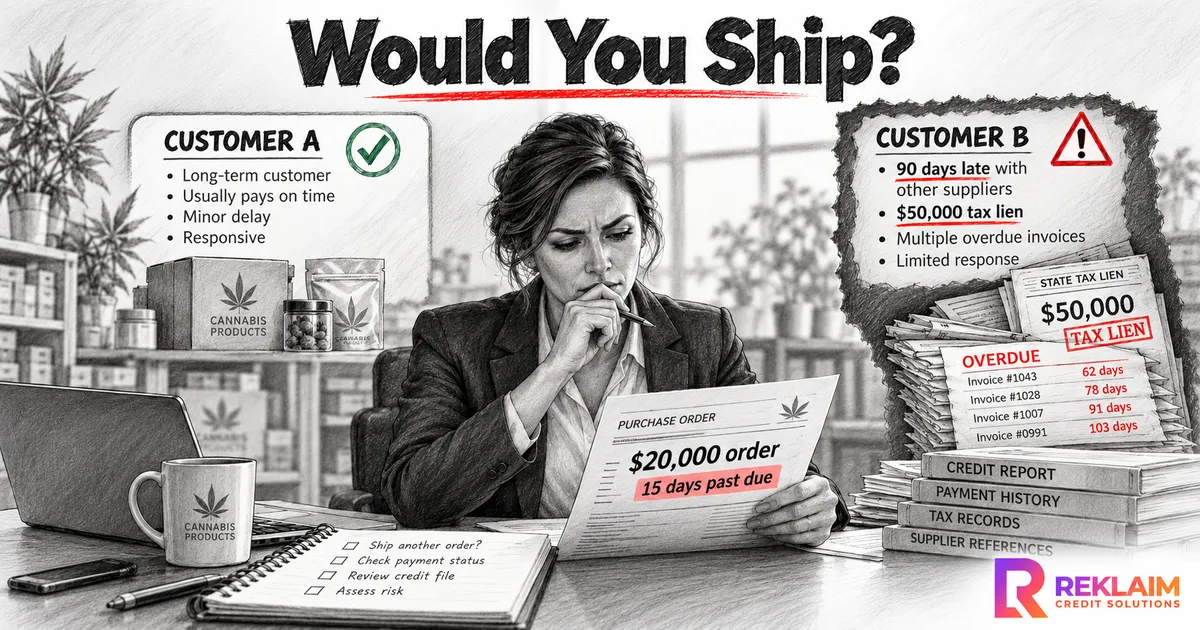
Before you ship more, look at how the customer is paying, how much is overdue, and how much of your book that customer represents.
Try to estimate what happens to your book when hemp goes away. Some of that demand may come back to dispensaries, but, some of it may come back to the ones that have been paying you late. A customer that gets healthier is still a customer that owes you.
AR aging often shows a slowdown before a license action, a rent cut or a receiver does. The hard part is seeing past your own ledger. A dispensary can be current with you while falling behind with three other suppliers.
That blind spot is one of the reasons we built Reklaim Credit Solutions. As Sam Fensterstock, CRO, continuously reminds us, “No supplier can see how a customer is paying everyone else.”
By combining de-identified AR aging data from across the industry, we can see how that customer is paying the suppliers across the network, and every operator that contributes helps itself by widening the picture. That allows us to provide independent commercial credit scores, suggested credit limits, credit reports and, equally important, continuous monitoring based on what is happening across the market, not just what one customer is doing with one supplier.
A supplier that sees stress early can shorten terms, cut exposure or require payment before the next delivery.
One that learns about it from a license complaint has a loss.
Is there a viable path?
Yes. Illinois just sold more items in a month than it ever has, and on a like-for-like basis its sales may have stopped falling.
Hemp is about to lose the gas station and head shops, and some of that demand will very likely walk into a dispensary.
Craft growers finally got a canopy they can run a business on.
Social equity stores can finally serve medical patients.
The state has made a pattern of nonpayment grounds for losing a license. Those are five things no other state in this series has going for it at the same time.
The tax stack still tops 40% on strong flower in Chicago, and Michigan is still 70 miles away. Until Springfield deals with that, the operators who make it will be the ones who know their costs, price for the market they’re in rather than the one they were promised, protect their cash and stop treating receivables like sales until the money shows up.
Selling to fewer retailers that pay is a better business than filling every order that comes in.
Illinois capped the supply, capped the licenses and capped the canopy. It never capped what a customer will drive for a deal. The operators who understand that are the ones who’ll still be here if the border ever evens out.
Sources
Illinois Department of Financial and Professional Regulation (IDFPR), Adult Use Cannabis Monthly Sales Figures, updated September 2, 2026
IDFPR, “Adult-Use Cannabis Sales Figures Released, January to August 2026,” September 21, 2026
State of Illinois, 2026 Annual Cannabis Report (compiled by the Cannabis Regulation Oversight Office), pp. 8, 18, 25, 43 and 56, and IDFPR/CROO release, “Illinois Releases 2026 Annual Cannabis Report Highlighting Continued Growth,” October 7, 2026
IDFPR, FY2025 Annual Cannabis Report
IDFPR, SB 3222 fact sheet, June 23, 2026, and medical expansion release, September 10, 2026
Office of Governor JB Pritzker, SB 3222 signing release, June 12, 2026
Illinois Department of Agriculture, Informational Bulletin IB-2026-06, SB 3222 updates; Craft Grower Operational Extension notice, January 2026
Illinois Department of Revenue, cannabis tax FAQs and Cannabis Taxes page; Informational Bulletin FY 2027-04 on Hemp Act enforcement, October 14, 2026
Commission on Government Forecasting and Accountability, Monthly Briefing, June 2026
Illinois Cannabis Regulation Oversight Office, “Learn how cannabis tax dollars are spent”; ICJIA, R3 Cohort 4 release, June 23, 2026
Cannabis Regulation and Tax Act, 410 ILCS 705/15-36, 15-37, 15-70, 15-145, 20-5 and 30-30; 8 Ill. Adm. Code 1300.195
New York Office of Cannabis Management, Delinquent Payment Reporting Guidance and FAQs, revised October 19, 2026; 9 NYCRR 124.2(k)
Michigan Department of Treasury, Administrative Rule R 205.141 (sales tax applied to marijuana excise-inclusive price)
SB 3222 Enrolled (104th General Assembly, P.A. 104-0463), Section 15-36(c-2) (principal officer thresholds), Section 15-145(a)(30) and (31) (new grounds for discipline) and Section 999 (effective dates)
Illinois State Police section of the 2026 Annual Cannabis Report, p. 62 (hemp availability, seizures)
Chicago Tribune, “Illinois cannabis sales revenue falls as hemp and other states cut into prices for the struggling industry,” February 16, 2026
MJBizDaily, Illinois sales and CROO price data, MJBizDaily Staff, February 19, 2026
Headset, Illinois market data and “Cannabis Prices in 2026,” September 2026; Headset, “Getting closer to the truth: why we updated Illinois cannabis sales,” November 25, 2025
BDSA, “Michigan Border Stores and The Cross-State Cannabis Boom,” Leah Spokojny, April 3, 2026
Crain’s Detroit Business, Dustin Walsh, New Buffalo dispensaries, June 25, 2025
Axios Chicago, “Chicagoans still find bargain weed in New Buffalo,” March 11, 2026, and November 12, 2024
WBEZ, Michael Puente, New Buffalo dispensaries, September 3, 2025
MJBizDaily, “New 24% wholesale tax continues to punish Michigan cannabis,” March 10, 2026
Detroit Metro Times, “Michigan lawmakers seek to repeal 24% cannabis wholesale tax as sales slump,” Steve Neavling, March 3, 2026
MITechNews, Michigan ounce prices and border-store sales (CRA and BDSA data), Mike Brennan, September 21, 2026
Cannabis Business Times, Tony Lange, Illinois sales and the Missouri border, March 21, 2023; Cannabis Business Times, Michigan February 2026 sales (CRA data), March 17, 2026
Farmdoc Daily (University of Illinois), “The Emerging Cannabis Market in Illinois: Prices, Taxes, and Supply Constraints,” December 28, 2023
Civic Federation, “How Will Illinois Tax Recreational Cannabis,” December 13, 2019; CBS Chicago, Cook County cannabis tax, January 16, 2020
Chicago Sun-Times/WBEZ, “Illinois cannabis consumption rising, state tax revenues drop,” Isabela Nieto, October 12, 2026; Chicago Sun-Times, David Struett, February 11, 2025
Chicago Reporter, “What Illinois got wrong about legal weed,” Sara Cooper, February 5, 2026
Parabola Center, “The Illusion of Competition: Market Concentration in Illinois Cannabis,” Hedy Yang, June 2026
Whitney Economics, “Cannabis Taxation in Illinois,” Beau R. Whitney, April 2025 (public-facing edition dated April 15, 2025); Beau Whitney, Illinois supply analysis and correspondence with the author, October 2026
WBEZ, Illinois Independent Craft Growers Association, January 17, 2023; Green Market Report, craft grower build-out costs, October 19, 2023
Illinois Department of Commerce and Economic Opportunity, Social Equity Direct Forgivable Loan Round III release, April 20, 2026
MJBizDaily, “Illinois to regulate hemp THC like cannabis, but future of drinks unclear,” June 17, 2026; Axios Chicago, Justin Kaufmann, June 17, 2026; Block Club Chicago, August 24, 2026
WTTW, Chicago hemp ordinance vote and veto, January 21 and February 13, 2026; Pritzker signing coverage, June 12, 2026
Cresco Labs, quarterly MD&A filings (Forms 6-K, Exhibit 99.2), Q2 2024 through Q2 2026; FY2025 Form 40-F MD&A, March 5, 2026; Q2 2025 earnings call transcript, August 7, 2025; Q2 2026 earnings call transcript
Green Thumb Industries, Q3 2025 and Q2 2026 results releases; FY2025 Form 10-K
Verano Holdings, FY2024 and FY2025 results releases; Q2 2025 earnings call, August 8, 2025
Ascend Wellness Holdings, Q4 2025 earnings call, March 12, 2026; FY2025 Form 10-K
Curaleaf Holdings, Q1 2026 earnings call, May 5, 2026
Innovative Industrial Properties, Form 8-K, January 30, 2025; Q4 2025, Q1 2026 and Q2 2026 results releases; WGLT, “Cannabis plant in Livingston County set to close,” Eric Stock, December 4, 2025
MJBizDaily, “4Front files for receivership,” May 23, 2025; “Ayr Wellness is selling 4 marijuana stores in Illinois,” March 2025
Heritage Global, auction announcement for The Cannabist Company equipment, July 28, 2026 (auction scheduled August 13 to 14); NewLake Capital investor presentation, August 6, 2026
Chicago Atlantic Real Estate Finance, Form 10-Q for the quarter ended June 30, 2026
Office of Governor JB Pritzker, Illinois GDP release citing U.S. Bureau of Economic Analysis, April 10, 2026; U.S. Census Bureau, Chicago metro population
Shanken News Daily/Impact Databank (Headset data), 2025 state cannabis sales rankings, April 21, 2026
Headset, Cannabis Market Overview, January 2022 (December 2021 basket), March 2022, April 2023 and July 2023 (June 2023 basket); Mugglehead, “Weed shoppers are spending an average of $153 in Illinois,” Nick Laba, January 22, 2020, citing Headset; Headset Illinois market page, September 2026 snapshot
Lit Alerts, “Average Pricing for Common Flower Package Size in the Midwest, Q3 2025,” Rick Bashkoff, October 14, 2025; Lit Alerts, “The Challenger Brands of Illinois, July 2026,” Rick Bashkoff, July 20, 2026 (retail estimated sales, April 21 to July 19, 2026)
Hoodie Analytics, Illinois Cannabis Market public dashboard, February 2026 and September 2026 snapshots, accessed October 25, 2026
HT23 Growers, Facebook video, Reese Xavier, September 25, 2024