
The state that might have gotten the register right but also may have left the back of the house to fend for itself
We’ve covered New York, Massachusetts, Oregon, California, Illinois and Colorado. Now Missouri cannabis market, the first state in this series where prices came down and the business, at least the part you can see from the sales floor, did not come down with them.
Missouri’s first legal medical sales took place on October 17, 2020, with eighths that Brightfield Group’s Alyssa Jank put at $50 to $60. Jack Cardetti, the spokesman for the state trade association, said in an October 22 St. Louis Public Radio report what he expected to happen next: “This is essentially the highest prices will ever be.”
In six other states, that sentence would have been the setup. In Missouri it was a forecast, and, not so oddly, a conservative one.
Six years later, Headset puts the average Missouri eighth at $24.93 at the register, after discounts and before tax.
Leafly menus checked this week listed a Flora Farms eighth at $20 and an Illicit eighth on the premium shelf at $38 at the Rock Hill store in St. Louis County (that was a Greenlight until April)
The 2020 price came down by more than half. Annual sales went from about $210 million of medical-only product in 2021 to $1.52 billion of medical and rec in 2025. The documented receivership since adult-use sales began hit a grower and manufacturer, not a store. The consultants the state hired to study the market concluded last month, in the health department’s words, that Missouri doesn’t need additional licenses, at least for now.
If this series has a happy chapter, this should be it.
And, it mostly is.
The catch is that the happiness is unevenly distributed, and the part of the market that absorbed the pain is again the part that ships product on credit.
Why Has Missouri’s Cannabis Market Performed Better Than Other Mature Markets?
Missouri’s laws set the floors: 60 cultivation licenses, 86 manufacturing licenses and 192 dispensaries, 24 in each of the state’s eight congressional districts. The health department received about 2,260 applications and awarded the floors in each of the three main categories. That was it until the appeals started.
Review the public record and the scoring looks like a mess. The state hired a Nevada contractor to do the scoring and by the end of February 2020 the Administrative Hearing Commission had 845 appeals on its docket. In March of this year, a state appellate court ordered 13 more licenses issued to a single applicant after finding that a flaw in the process “infected the entire scoring process”. Six years later and the 2020 scoring fight is still producing licenses.
Then Missouri did something no other state in this series did as fast.
When rec/adult use passed in November 2022, every medical licensee in good standing was allowed to convert to a “comprehensive” license that could sell to anyone 21 and over. On February 3, 2023, the state approved 335 conversions, 207 dispensaries, 72 manufacturers and 56 cultivators, and 196 of those dispensaries were cleared to serve adult-use customers that day.
No new round. No lottery for the main licenses. Colorado and Illinois converted their medical operators too, but neither flipped close to 200 stores on a single day. No 21-month gap between legalization and the first store, the gap New York inadvertently turned into a gray market.
The campaign manager for the amendment defended the design to the Riverfront Times by pointing out that the petition set a floor on licenses, not a ceiling. The constitution lets the health department ease the limits to meet demand and keep the market competitive.
It has not decided to.
Two years into adult use it commissioned a study to find out whether it should, and the study came back in October saying, in effect, not now.
The result is a retail footprint that looks nothing like the rest of this series.
Missouri had 222 comprehensive dispensaries approved to operate as of July, for 6.3 million people.
Colorado has 687 adult-use store licenses for 6.0 million.
Oregon had 769 licensed retailers in December for 4.3 million.
Oklahoma, next door, had 1,453 licensed dispensaries as of January 2 for 4.1 million.
The counts come from different dates and different definitions, but the gap survives all of them: roughly 3.5 Missouri stores per 100,000 residents, against about 11 in Colorado and 18 in Oregon.
The average Missouri dispensary did $6.87 million in sales in 2025. Colorado’s $1.32 billion, spread across its 687 adult-use store licenses, comes to under $2 million a license before you count the medical stores.
John Mueller, who runs one of the state’s larger chains, said it plainly to the Missouri Independent last year: “Limited licenses is the whole key to any market.” Nothing in the numbers since has contradicted him.
Mitch Meyers of BeLeaf said the other half in 2023, when prices were spiking: “You’re not going to see prices double overnight because there are 200 dispensaries and we all have to be competitive.” Both have held up so far.
Two hundred doors is few enough to keep the lights on and should be enough to keep anyone from getting too comfortable.
Seth Yakatan, Ordo Verde added: “Missouri is perhaps the most efficient market in the United States for cannabis, period. Set up correctly, with a great amount of local and government support, it might be the best model for the creation of companies which can survive and generate Actual Cash Flow. Get there, and KC and St. Lou will SHOW YOU.” (emphasis his).
Why Have Missouri Cannabis Prices Held Up Better Than Other States?
Missouri had its first price compression before adult use arrived. BDSA tracked retail prices falling about 35% between January and October 2022 as more licensed growers came online. By the end of 2022, the state was on the same path as everyone else.
Then nearly 200 stores opened to the general public on a Friday in February, and the medical supply base got hit with a demand shock wave it had not planned for.
LeafLink’s wholesale price for bulk flower went from $1,455 a pound in the last week of January 2023 to $2,175 in the last week of February and about $3,000 by April. Bulk flower availability on the platform fell nearly 79%. The health department said cultivators were using only 37% of their permitted flowering canopy. LeafLink’s Ben Burstein told MJBizDaily that Missouri was “one of the only markets in the country where you can actually say that demand is exceeding supply.”
Retailers were dancing on their roofs like Tevye.
Retail prices rose about 10%. Mueller asked how much higher they’d go: “I just don’t see much more than that.” Guess what, he was right.
A medical price collapse rescued by an adult-use demand shock landing on a capped supply base is not something Missouri planned. It got lucky, and the luck gave the retail tier two years of pricing room that nobody else in this series ever had.
By September 2023, Headset had the average Missouri item price at $33.22, 57% above the average of the rest of the markets it tracked, with a discount rate since launch of 10% against 20% elsewhere. Headset’s language at the time: “The market has resisted major pricing compression, allowing retailers and brands to retain margin and fuel expansion.”
Three years later, in September 2026, the same Headset series had the average item at $26.44.
That’s a decline of about 20% over three years.
For comparison, the Massachusetts gram went from $14.17 at its 2018 launch to $3.81 in August 2026, down 73%, and Colorado’s followed the same arc to about $3 by 2024.
Over the same three years as Missouri’s 20%, the Massachusetts gram fell about 36%, from $5.89 to $3.78. An all-product item price against a flower gram is not an apples to apples comparison, but, I think that the shape is clear enough.
Headset’s September state pages put Missouri’s $24.93 eighth with the limited-license East Coast states, $29.69 in New Jersey and $33.63 in New York, rather than with Oregon at $12.74, Michigan at $14.32 or Colorado at $15.14. Headset’s own summary of its price table is the thesis of this entire series in one sentence:
“State lines move cannabis prices more than any other variable.”
Lit Alerts, which scrapes menu prices rather than register receipts, published a Missouri Retail Price Index on October 27. From April through September 2026, the listed price of an eighth went from $29.80 to $30.16, up 1.2%. Rick Bashkoff wrote that “Missouri’s eighth index proved virtually immune to compression.”
The full ounce went the other way, from $143.48 to $139.66, which took it to $4.99 a gram: “Bulk consumers are demanding value, forcing retailers into competitive price-matching on full ounces.”
The menu says $30.16 and the register says $24.93. Different samples, so don’t call the gap a measurement. The measurement is Headset’s: the statewide discount rate rose from 9% in May 2023 to 16% in May 2024, with St. Louis at 20%. So, while the menu price has held, the discount has been doing the work.
It’s a milder version of the instinct that produced penny-eighth promotions in Denver, but it’s the same instinct.
Baskets tell the rest of the story.
Headset’s May 2024 report had the average Missouri basket at $61.63, down 10.7% from a year earlier, with Kansas City at $64.20 and St. Louis at $50.38. Hoodie Analytics put the average visit at about $65 in September 2025. I couldn’t find a published 2026 Missouri basket, but Headset has September 2026 units up 13% over the prior September with dollars up 7.6%, and it said in June, of the May numbers, that the pattern looked like “a shift toward value-driven purchasing and possibly more frequent, smaller transactions.”
Missouri’s customers are buying more items, and the market is taking in about 5% less per item. That’s the Massachusetts pattern, three years late and at a fraction of the speed. Colorado’s basket went from $63.89 to $46.59 over its decline. Missouri’s was in the low $60s the last two times anyone measured it.
How Do Missouri’s Borders Support Cannabis Sales?
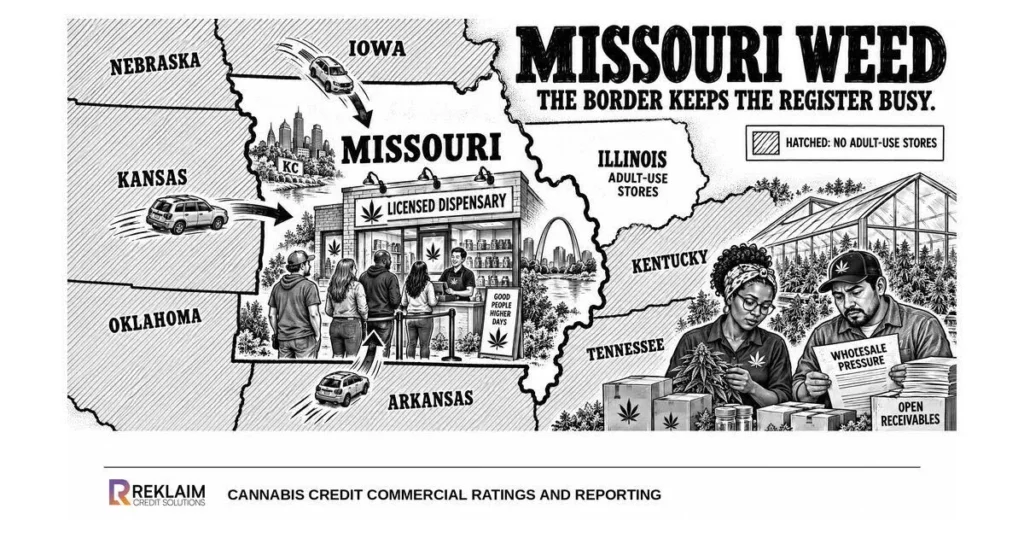
Headset noted something in its 2024 report that explains a great deal: “Missouri, along with Tennessee, shares a border with eight other U.S. states.” Of the eight, exactly one, Illinois, has adult-use stores. Oklahoma, Arkansas and Kentucky run medical programs. Kansas, Iowa, Nebraska and Tennessee have little or nothing a Missouri dispensary would recognize as competition.
In Illinois I wrote about New Buffalo, Michigan, where the township’s 36 dispensaries serve about 2,500 residents and a parking lot full of Illinois plates.
Missouri is the New Buffalo on Illinois’s other border, except it’s an entire state. After adult-use sales began in February 2023, Collinsville, Illinois, across the river from St. Louis, reported its cannabis tax receipts down by more than a third in a year. Sauget’s monthly cannabis tax went from more than $55,000 to about $23,000.
Illinois’s reported out-of-state adult-use sales fell about 15% in 2023, and officials blamed Missouri. In a February 2023 menu comparison, Illinois News Joint found an eighth at $30 in Missouri and $50 in Illinois. A University of Illinois professor summed up the decision: “a lot of the products are going to be the same, and it’s cheaper in Missouri.”
Kansas is the bigger story, because Kansas has no dispensaries at all. Kansas City’s metro area sits on both sides of the state line, and only one side has a dispensary. Nearly 2,200 Kansans held Missouri medical cards as of October 2024, and recreational buyers don’t need a card.
The state’s October market study reports 2025 sales by congressional district, and the Kansas City district did $294 million, the most in the state, at $10.5 million per store, roughly 2x the per-store figure in the St. Louis districts.
The same study surveyed consumers on how much they spend each month. Kansas City district residents reported the lowest spending in Missouri, $108 a month. The stores with the highest sales in the state sit in the district whose own residents say they spend the least. The report doesn’t say where the difference comes from. Does it have to?
Three of the five highest-grossing dispensaries in Missouri on Hoodie’s list have “Stateline” in their names, two on the Kansas line and one on the Arkansas line.
Missouri’s border runs mostly one way, in, and will until one of its seven neighbors changes its mind.
Kansas had an adult-use bill filed in February with 19 Democratic sponsors; it died. As of this writing, Kansas has a governor’s race still uncalled, with the Democrat who campaigned on legalizing leading by about 7,500 votes, a legislature Republicans still control, and no citizen initiative to go around it. Iowa elected a governor on the same platform by a wider margin, into the same kind of legislature. The governor’s office wants it now. But the legislative votes still aren’t there.
Every Missouri dispensary within a tank of gas of the state line is a business whose customers could be legislated away in a single session in Topeka, Little Rock or Nashville. Nobody expects that this year.
How High Are Missouri Cannabis Taxes in 2026?
Missouri taxes adult-use cannabis at 6% and medical at 4%, with local governments allowed to add up to 3% on adult-use sales. The general sales tax applies on top.
Where state and local sales taxes run 8%, and the city takes its 3%, the adult-use checkout rate is about 17%. Chicago stacks to about 41.5% on flower above 35% THC and about 26.5% below it. Colorado charges a 15% retail marijuana sales tax plus local, with a separate 15% excise at the first wholesale transfer. California charges 15% plus sales tax plus whatever the city wants. Even Massachusetts, the cheapest menu in the East, runs up to 20%.
Why Does Missouri Capture 93% of Reported Cannabis Spending?
Last summer the health department hired Cannabis Public Policy Consulting to tell it whether the market needed more licenses.
Before the contract was awarded, the firm’s Mackenzie Slade told the Missouri Independent that “Missouri is pretty famously the model to follow.” The firm then spent a year studying the model and, on October 15, reported that it works.
The study surveyed 1,200 Missouri adults who had used cannabis in the previous month, in March and April of this year, and matched the answers against 35 months of state tracking data. The headline conclusion: licensed stores and delivery accounted for about 93% of what those consumers reported spending, $149.95 of a $161.81 monthly average, and a large majority in every one of the eight congressional districts.
Cali’s own commissioned estimate had licensed stores at about 38% of consumption. That’s a different measure, consumption rather than reported spending, but the distance between 38 and 93 is not a measurement problem. Missouri’s regulated market, the report concluded, “is effectively meeting demand and has successfully transitioned into a mature, competitive marketplace.”
Of the small group that bought from an illegal seller, 62% said: “It’s cheaper.” Almost nobody said there was no store nearby. The report’s conclusion: illegal-market participation in Missouri “is not principally an access issue.”
On hemp-derived products, the study found use “relatively limited” and said it was “unlikely that there is robust competition” with licensed products. Price figured in the purchase decision for 66% of consumers and was the single most important factor for 30%.
Then the recommendation. “Future policy decisions should focus less on expanding consumer participation and more on maintaining competition, improving market efficiency, and ensuring that cannabis supply continues to align with evolving consumer demand.”
Translation: no new licenses now. Keep an eye on the growers.
That last part is important, and I’ll come back to it.
How Is the Missouri Cannabis Market Performing in 2026?
On the state’s calendar-year reports, Missouri’s licensed stores sold $1.34 billion in 2023, $1.46 billion in 2024 and $1.52 billion in 2025. Growth slowed from about 9% to about 4%. But it still grew.
July 2026 was the best month the state has had, $139.19 million, after May had set the record at $135.07 million.
The first half of 2026 ran 2.3% ahead of the first half of 2025. September came in at $128.48 million by Headset’s count, about 8% ahead of the prior September. November 2025 was the only month last year in which total sales fell below the year before. Andrew Mullins described the pattern two years ago and it still holds: “around $120 million every month all the way through.”
Medical is the soft spot. The state had 205,897 registered patients in November 2022. By December 2023, after ten months of adult-use sales, it had 106,627. By November 2025 the count had climbed back to about 128,000, which makes sense at a 4% state tax and a six-ounce allowance every 30 days. Medical dollars keep sliding regardless: $14.7 million in December 2025, under $10 million by June. The medical tier that built the market was about 9% of first-half 2026 sales and 7% in July.
The mix is shifting the way it shifted everywhere else, only slower.
Flower was about 48% of Missouri sales in Headset’s first adult-use report in 2023. In September 2026 it was about 40%, $51 million of $128 million. Vapes were $35 million, up 13% from a year earlier. Pre-rolls were $20 million, up 20% in dollars and 25% in units, with infused pre-rolls growing 33%.
Lit Alerts estimates that units of the 2-gram vape rose about 70% in six months. I’ll say what I said about California: people aren’t rolling their own as much. Quality, convenience and price are driving these sales.
The market study, for all its optimism, buried a line on page 49 that the press releases all seemed to skip. The increase in active retail licenses, it said, happened while sales growth slowed, which “suggests that market growth may have been increasingly characterized by a larger number of businesses competing for sales rather than by proportional increases in consumer demand.” Active retail licenses went from 201 in 2023 to 220 in 2025.
The cultivation tables tell a louder version of the same story.
Are Missouri Cannabis Cultivators and Manufacturers Facing Oversupply?
Missouri capped dispensary doors. It capped the grows too.
65 cultivation licenses with 30,000 square feet of indoor flowering canopy each. The difference is what was behind the cap. In April 2023, the health department said growers were using 37% of the combined allowance, counting 17 licensees that hadn’t started growing yet. The stores were full. The grows were 63% empty, and filling them took money and an inspection, not a new license.
So they filled them. Cultivators moved 131 million grams through the tracking system in 2022, 400 million in 2023 and 727 million in 2024. Flower sales at the cultivation tier went from $172 million to $420 million to $463 million.
Then 2025. Volume fell to 454 million grams, and cultivation flower sales fell to $338 million, down 27%, in a year when retail sales grew. Manufacturing held at about $708 million. The state study calls this “early signs of increasing competitive pressure.” The growers, taken together, would call it a 27% revenue cut in the best year the stores ever had.
The wholesale price tells the same story, with a caveat.
LeafLink had Missouri bulk flower at about $3,000 a pound at the April 2023 peak and $2,066 on average for the year, one of only three states where the price went up. Apex Trading had it at $1,690 in September 2025, and LeafLink’s 2026 pricing guide, built on 2025 transactions, put the Missouri pound at $1,822.
The caveat is that LeafLink’s Missouri sample thinned after it raised fees in May 2025 and dozens of operators left (Howie Keum of Local Cannabis: “It felt like it was a cash grab, and people took it personally”; LeafLink called the 1,500% to 2,000% figures “categorically false”), so the numbers come from two providers and different periods. Call the decline 18% from the 2023 average or 44% from the spike.
Either way the pound went down, the retail eighth held, and the state’s own table says the cultivation tier absorbed the difference.
The manufacturers found out the same way. Tammy Puyear, EmmaLeaf’s director of sales and marketing, told Greenway in November 2025: “We can’t produce liters and liters of distillate and expect to sell them as quickly as we might have a year ago.” There was “too much of it in the market at the moment.” EmmaLeaf was sitting on finished product it couldn’t sell fast enough to cover the biomass behind it. It cut headcount and shifted to toll processing for other people’s brands.
The receivership arrived in March. Navarro Farms, a grower and manufacturer in Vandalia with a 16,000-square-foot canopy, a 40,000-square-foot facility and about 35 employees, went to a court-appointed receiver on March 20. The sale notice set a minimum bid of $4.5 million for the cultivation and manufacturing package, and left the owners’ separate dispensary license out of it. The store stayed out of the sale. The grow went to the receiver.
That is pretty much the whole article in one notice.
This is the credit point Missouri’s numbers hide. Every published payment dispute I found in Missouri has a cultivator or manufacturer as the party accused of not paying: a testing lab chasing a producer for $102,425 in invoices and then $12,240 more, and the $20 million claim against Delta Extraction we’ll get to. I did not find one published collection suit by a Missouri grower or brand against a Missouri dispensary. That is not evidence that retailers pay on time. I’m guessing that nobody with only 220 doors to sell into wants to be the one who sued a buyer, and that in Missouri the stress shows up as price and terms before it shows up as days past due.
How Concentrated Is Missouri’s Cannabis Retail Market?
The MO constitution says no single entity may own more than 10% of the dispensary licenses in the state, rounded down, which at today’s count comes to 22. The adult-use amendment dropped the medical program’s words about “substantially common control, ownership, or management”; the medical section still has them, and whether they reach comprehensive licenses is disputed.
The health department stopped collecting common-control affidavits for comprehensive licenses when the amendment passed. A legal owner, an operating manager and a shared purchasing desk are three different relationships, and the cap speaks to only one of them.
In April, two Missouri producers that also own dispensaries filed a proposed class action in Jackson County. The short version of what they allege: one group of affiliated companies, operating under five store names, runs the buying for 61 of the state’s 224 dispensary licenses, about 27%, and purchases something like 40% of the wholesale cannabis sold in Missouri. The 27% is a license count from the petition, not a finding. The 40% is the plaintiffs’ estimate, with no public math behind it.
The terms they describe are simple enough. The group’s buyers told suppliers what they would pay: first about half of the suggested retail price, later 60% to 65% below it. At least one order arrived marked “FILL or KILL,” meaning take the price or lose the order. Pricing and selection for the group’s stores, the plaintiffs say, were set at quarterly meetings they call “kiss the ring” meetings.
A supplier that wanted shelf space in those stores, they say, had to buy the group’s own products and sell them in the supplier’s dispensaries, and suppliers who refused were cut off across the group. The complaint also quotes an investor presentation forecasting that an acquisition “may lead other retailers in the state to consider selling as fear sets in with our soon to be even more dominate position” (sic).
Plaintiffs’ counsel: “Missouri’s cultivators and manufacturers have been suffering under this scheme for too long.” The Missouri Independent, working from corporate filings, found an offering memorandum seeking up to $150 million for ten licenses in which a manager chosen by the lead company would make “all decisions,” pricing and product selection included, and the stores would have to sign supply agreements with the rest of the network. That is the closest thing on the record to a written description of trading shelf space inside a group. The next-largest operator in the state, the Independent reported in May, owns 16 dispensaries.
The lead defendant called the claims “baseless and without merit” and said the company “operates in full compliance with all applicable Missouri state laws and regulations.” In May, the health department said it had reviewed the questioned license applications and had “no upcoming legal action” planned.
What the industry says behind closed doors is broader than the complaint: that a handful of vertically integrated operators control most of the state’s shelf space, trade placement with one another, and keep everyone else off. Proving that is something else.
Greenway Magazine, reviewing MariMed’s exit last October, described “increasing reciprocity demands from vertically integrated dispensaries” and wrote that “for operators without retail outlets of their own, access to shelf space has become increasingly limited as vertically integrated companies favor their in-house brands.”
Two weeks later it published the EmmaLeaf account. After EmmaLeaf’s infused pre-rolls outsold a dispensary group’s house brand, Puyear said, the group raised the retail price on them, and when retail partners moved to “reorganize store shelves to prioritize in-house products,” EmmaLeaf and other independents were displaced “from more than a dozen dispensaries.”
Nobody on the Missouri record describes a slotting fee or an explicit shelf-for-shelf trade between the big chains. In Michigan in 2022, MJBizDaily found chains with more than six stores selling three- and six-month placements for about $3,000 to as much as $25,000, and C3 Industries’ Vishal Rungta, whose company now operates in Missouri and which the publication said did not charge such fees, put it plainly: “Retailers know they have leverage.”
The data points the same direction.
In Hoodie’s September flower rankings, all five of Missouri’s top brands belong to companies with retail operations. Headset shows the biggest chain’s house brand on the menus of 112 Missouri stores in its retailer sample, roughly half the state, which cuts both ways: the largest retailer isn’t locked out of its competitors’ shelves, and that is also what reciprocal stocking would look like. What’s distinctive in Missouri is the allegation that one network does it across 61 doors with a single buying desk.
Which brings us back to the state’s own study, which found “no evidence of excessive market concentration” in any tier, then explained in its methods section that it had measured concentration by sales across individual licenses, not by who owns or runs them, “because usable license ownership data and profit distribution data were not available.” Missouri already collects ownership filings; the recommendation was to turn them into a dataset someone could analyze. Amy Moore, who runs the cannabis division, said future studies will include it.
So, Missouri has a 10% ownership cap, a lawsuit alleging a 27% buying network, and a regulator that hasn’t yet built the instrument to measure the claim. For a supplier the distinction matters less than it sounds. If 61 doors buy through one desk, those are not 61 customers. They may be 61 legal debtors and one negotiation, and a dispute with that desk is likely a dispute with all of them.
The rest of the shelf is consolidating the ordinary way, at prices that keep licenses moving rather than closing.
In June 2025 Vireo Growth closed its acquisition of Proper Brands, 11 operating dispensaries plus a cultivation and manufacturing facility, for stock valued at about $102 million at the contract’s reference price, under a formula built on 4.175 times $31 million of pro forma 2024 EBITDA. That’s a vertically integrated business, so it won’t tell you what a Missouri store earns on its own. It does tell you what a buyer with a public balance sheet thought a Missouri chain was worth.
Curio Wellness, out of Maryland, agreed in October 2025 to buy four stores in the southeast corner of the state, pending approval.
BeLeaf’s SWADE arm took over operations of BesaMe’s five western Missouri stores.
MariMed went the other way and left Missouri in October 2025. CEO Jon Levine said its brands “performed well in the select stores where they were available,” but that reaching scale “would have required significant resources we believe are better utilized in our core markets.” Curaleaf said in January it would “exit Missouri as a sub-scale presence in the state did not justify continued investment.” Two national companies, two exits, one lesson: without your own doors in Missouri, scale is hard to come by.
Vireo now shows up in the third straight state in this series. In Colorado, it bought Schwazze’s stores out of a lender auction. In Missouri, it merged with a going concern at a negotiated multiple. For the brands on Proper’s shelves, a public company with 11 doors is a steadier counterparty than most, and Vireo has so far left Proper running under its own name.
One more thing about the shelf. Lit Alerts’ October brand report found that Missouri’s leaderboard “remains heavily anchored by entrenched, native operators who established early brand affinity during the medical era.” Read the names. The top flower brand is Flora Farms, which owns stores. The top vape is Illicit, which shares a parent with the From The Earth stores. The top concentrate is Vibe, whose operator owns stores.
Native, yes. Independent, no. The national multistate operators that lead Illinois have little or no retail presence in Missouri, and the ones that tried have left. The state built a market where the brands are local, the doors are scarce, and the companies that own the doors own most of the brands on the shelf.
Whoever owns the doors owns the brands’ access to the customer, which makes the ownership question a supplier question before it is an antitrust one. To be very clear, brands without their own Missouri stores do break through: Jeeter in pre-rolls, Grön and Wyld in edibles. They break through on the terms the doors set.
Is Missouri’s Cannabis Microbusiness Program Working?
Missouri’s answer to the ownership question was the microbusiness program, at least 144 small licenses in three rounds, awarded by lottery to applicants who qualify by income and net worth, neighborhood, disability or a cannabis-related criminal record.
The licenses are split between tiny dispensaries and “wholesale” facilities, limited to 250 flowering plants at a time, that may grow and manufacture but may sell only within the microbusiness tier.
With those structural limitations, it has not gone well.
Of 105 licenses issued in the first two rounds, 34 had been revoked by April 2025, 32 of them because the state found the qualifying owners on paper didn’t own and run the business in practice; by May of this year the tally was 106 issued, 38 revoked and one surrendered. Out-of-state consulting groups had filed hundreds of applications in the names of eligible applicants whose lack of control, in Amy Moore’s words, “does not meet even the most generous interpretation of owning and operating a business.”
According to the record, one Michigan cannabis real estate broker was the designated contact on 104 of the 1,048 Round 1 dispensary applications.
As of mid-August, 21 microbusinesses were operating: 5 dispensaries and 16 wholesalers. Microbusiness wholesale sales for all of 2025 were $343,837, across three licensees, in a $1.51 billion market. The division told the Missouri Independent it knew of no microbusiness that had received a bank loan.
The people who did get open sound like this. Sam Vosburg of Ozark Mountain Gypsy, whose team put about $500,000 of its own money in: “Our electric bills are crazy, and we’re not making any money.” Jimi Poe, who owns the first microdispensary, in Platte City: “I’m not going to succeed if I can’t get wholesalers to succeed.” The third lottery drew 888 applications for about 77 licenses on September 9, under new rules that check ownership before issuance. The first of those licenses, some of them replacements for revoked ones, are due in December.
Missouri’s equity tier is a sealed ecosystem with no access to the other 222 doors that matter.
A program sold as a way to spread ownership was built so it couldn’t get product onto the shelves that matter and people and money chased those licenses regardless.
What Did the Delta Extraction Recall Reveal About Cannabis Credit Risk?
If you want to know how a payment failure travels through a tightly integrated supply chain, Missouri ran the experiment in 2023.
On August 2 of that year the state suspended Delta Extraction, and on August 14 recalled about 62,000 products made with its distillate.
Delta had been accused of blending a small amount of Missouri-grown THC with a much larger quantity of THC-A oil imported as hemp from out of state and selling the result, as compliant distillate, to roughly 100 other Missouri manufacturers. The recall list carried some of the best-known brand names in the state, many of which said they had no idea what was in the oil they’d bought from a licensed supplier.
CLOVR, then the state’s largest manufacturer, said about $2 million of oil was stuck in its facility. Mullins wrote to the state that releasing the holds would “head off financial ruin for dozens of Missouri small businesses.” The state revoked Delta’s license in December 2023, and the Administrative Hearing Commission upheld it in February 2025, citing a “corporate culture of lax compliance with regulatory requirements.”
Then the waiter dropped off the check.
In June 2024 an extraction contractor sued Delta in Franklin County for more than $13 million for about 1,100 liters of distillate it said it was never paid for, plus $5 million in lost revenue from five months of seized equipment, nearly $20 million in all. Its attorney’s argument to the Missouri Independent is the one every unpaid supplier in this industry has made: “It doesn’t matter what the state says or if it was within compliance or not,” Delta “still contracted with SND to produce a product.” Case.net lists a default judgment in August 2025. What it was for, and whether a dollar of it was collected, isn’t in the public index that I could find.
Delta has been told as a compliance story. But, it’s also the largest unpaid trade bill in Missouri cannabis that we could find and a cautionary tale for operators everywhere, and it landed on a supplier, not a retailer. A manufacturer’s product was pulled, its revenue stopped, and the people it owed were the ones who had shipped on terms.
That’s the direction credit risk runs in every cannabis market.
Downhill, toward whoever is furthest from the register.
How Will Missouri’s 2026 Hemp Law Affect the Cannabis Market?
Colorado drew its hemp line in 2023. Illinois just drew its own and will take intoxicating hemp out of gas stations. Missouri is doing the same, with one carve-out.
House Bill 2641, the Intoxicating Cannabinoid Control Act, passed with a combined 151 to 28 across the two chambers and was signed on April 23. Its core restrictions take effect November 12.
Under the new law, any finished hemp product with more than 0.4 milligrams of total THC per container, THCA included, is treated as marijuana. It can be grown, made, tested, moved and sold only by Article XIV licensees, which is to say only by licensed dispensaries, microbusinesses and their suppliers.
Not liquor stores, as Minnesota allows and Colorado considered and dropped this spring.
Not grocery.
Unlicensed online sales end.
Selling outside the system carries a $5,000 fine per unit and a Class D felony.
The Attorney General has primary enforcement authority, and the AG, Catherine Hanaway, didn’t wait for the effective date. She sent cease-and-desist letters to 33 unlicensed shops in March under the consumer protection law she already had. On November 4, eight days before the law takes hold, she announced suits against four retailers in state court, in Aurora, Des Peres, Independence and Rock Port, alleging they sold products that tested as marijuana while marketing them as federally legal hemp and, in some cases, presenting themselves as licensed dispensaries. The state wants civil penalties and permanent injunctions, and asked the courts to declare three of the four locations “drug-den” public nuisances.
Hanaway’s statement: “The days of drug pushers masquerading as licensed dispensaries are over.” Because Congress pushed most of the federal hemp redefinition to December 11, the state is letting qualifying hemp beverages stay on shelves until then, 21 and over only; the bill’s sponsor said that if the drinks rules change in Washington, “this is something we will have to look at in January.” The same day, a federal judge dismissed all three counts of the hemp trade association’s challenge to the law, on grounds that included standing, ripeness and federal preemption, and denied its injunction request as moot.
So the fence goes up on schedule. How much demand walks through the dispensary door is a guess, but would guess it will be small. The state study found hemp-derived use in Missouri “relatively limited,” THCA aside: 15% of consumers had used THCA in the past month, 6% delta-8. Missouri’s hemp market never got to Illinois’s size, and I suspect that the dispensaries were already cheaper than the gas station.
Whatever comes over comes to the licensed doors and the growers and manufacturers who supply them, in formats, drinks and low-dose edibles, that Missouri’s manufacturers already know how to make.
That’s a small help to the tier that needs it. It is not a rescue.
What Could Change Next in Missouri Cannabis Regulation?
Three things are on the calendar.
The ownership rule. Missouri already collects ownership filings; the proposal published November 2 would broaden annual reporting to everyone with any interest in a license and put a deadline on it, with final rules expected in 2027. If it holds, the state will have an ownership dataset it can analyze rather than a filing cabinet. It still won’t show a management agreement or a shared buying desk. The consumer case has a scheduling conference set for January 14. One way or another, the state is going to find out what the 10% cap means in current practice.
Phase 2 of the market study, an economic impact and industry stability report built on a survey of the businesses themselves, is due by the end of the year. Phase 1 heard from consumers and found a healthy market. Phase 2 surveys the licensees, growers and manufacturers.
I suspect that we will not see the same rosy outlook.
The license question. Phase 1 said no new licenses now, but it also recommended the state stop allocating dispensaries by congressional district and move to a demand-driven distribution, and it laid out the alternatives, from keeping the current structure to a statewide expansion aimed at lowering prices, though the district allocation sits in the constitution the regulator’s cannot change alone.
The 2020 scoring appeals are still generating court-ordered licenses, 13 in March alone. The third microbusiness round adds roughly 77 small ones in December, some of them replacements. Missouri’s cap holds, and it is also softer than it looks.
And Kansas. Kansas did not legalize in 2026, and its new governor, if the count holds, has said she’ll try. Unlikely with the backing of the legislative body which has thus far rejected the concept.
Which Parts of Missouri’s Cannabis Market Structure Could Change?
Every wall in this article was built by somebody. It’s worth asking who, because that tells you which ones hold.
The tax is stone, as these things go. The 6% sits in the constitution, the Supreme Court just read the local 3% narrowly, and moving either one takes a statewide vote. It’s the wall nobody mentions, and it’s the one that keeps a Missouri eighth cheaper than an Illinois eighth at the register even when the menu prices are nearly the same.
The license cap is stone with a door in it. The floors are constitutional. The ceiling is whatever the health department says it is, and a department under a different governor can say something different without asking a voter. The 2020 appeals keep producing licenses on their own. The third and final micro round adds doors in December.
The hemp fence was poured this year and holds, pending whatever Congress does with drinks in December. As I’ve written about before, I believe that selling low dose THC drinks at traditional commercial age gated establishments and retailers is the best marketing for the regulated cannabis industry.
The 93% isn’t a wall. It’s what the other walls produce, and it goes where they go.
The border is sticks. It’s the one wall Missouri didn’t build and can’t fix. The Kansas City district did $294 million last year and the northwest district $245 million, about 36% of the state between them, in the two districts facing Kansas, Iowa and Nebraska. Not all of that is out-of-state money. But, the per-store gap, $10.5 million in Kansas City against about $5 million in the St. Louis districts, indicates that a good share of it is.
Trinidad, Colorado, learned what happens when the other side opens. Raton, New Mexico, is about 20 miles away, and that was enough. Kansas City doesn’t have a Raton. It has the same metro on both sides of State Line Road.
Kansas, if it moves, moves slowly. My guess at the calendar: a bill in 2027, a program in 2028, a store in 2029 if everything goes just exactly perfect, and Minnesota just showed how long a lottery-built market takes to find its volume.
Missouri would meet it with a six-year head start, the lowest tax on the map, local brands and 220 stores already built. That’s a strong position. It’s a different one from the position this article describes, where a third of the state’s sales sit on borders with nothing on the other side.
What Can Missouri Cannabis Operators Control Now?
Missouri has no rule about payment between licensees. No cash-on-delivery requirement, no credit-term limit, no delinquent list, nothing in the regulations about what happens when a buyer doesn’t pay. New York built a COD regime which no one operating there seems happy about, Massachusetts has one coming and Illinois made a pattern of nonpayment a license problem, all because the problem had already arrived.
Missouri hasn’t had the problem at scale, so a Missouri receivable is governed by your contract, the commercial code and a courthouse, and by whatever leverage you had when you signed. The constitution at least says a cannabis contract is enforceable in Missouri courts despite federal law, which is more than some states offer.
In a 222-door state, that leverage runs one direction. So the credit questions in Missouri are different from the ones in Colorado.
Count doors, not customers. Set exposure limits by ownership group, not by license. If you don’t know whether two stores share an owner or a buying desk, the state’s files may not tell you either, yet, so ask.
Count borders too. A customer who drives in from Olathe is a customer the Kansas legislature can take back.
A price demand is a credit event. A buyer who can move your wholesale price from 50% of retail to 65% off can move your payment date too. The first doesn’t prove the second is coming, but it’s a reason to look. Treat a sudden change in terms the way you’d treat a sudden change in payment behavior.
When a customer is acquired, your invoice may or may not come along. Vireo’s acquisition accounting picked up $25.3 million of Proper’s payables and accrued liabilities, which is what buying a going concern in a stock acquisition looks like. A distressed sale is a different document, and you won’t be in the room when it’s drafted and you’ll likely be at the end of the line when the dust settles.
AR aging still catches the slowdown before the headline does, and Missouri’s headlines are hopefully going to stay good for a while.
A dispensary can be paying you on time while stretching the grower down the road, and in a market where every supplier is trying to stay on the same limited shelves, nobody is going to tell you.
That is one of the reasons we built Reklaim Credit Solutions. No supplier can see how a customer is paying everyone else. By combining de-identified AR aging data from across the industry, we can see how that customer is paying the suppliers across the network, and every operator that contributes helps itself by widening the picture.
That allows Reklaim to provide independent commercial credit scores, suggested credit limits, credit reports and, equally important, continuous monitoring based on what is happening across the market, not just what one customer is doing with one supplier.
In Missouri, the monitoring may matter more than the score. The scores will look fine until they don’t.
The aging might move first.
Is there a viable path?
Yes, and Missouri is on it, which is a sentence I haven’t been able to write about any other state in this series.
The retail tier is the healthiest we’ve looked at. Prices are a fifth off where they were three years ago, not three quarters.
Ninety-three cents of every cannabis dollar consumers say they spend runs through a licensed register.
The tax is low enough that the traffic runs toward Missouri, not away from it.
The hemp question is mostly settled, in the licensees’ favor, with the first federal challenge dismissed and the Attorney General already in court against the holdouts.
The state has studied itself and decided not to flood the zone.
Jack Cardetti was right in 2020. Prices mostly fell, and the stores did fine.
The growers and manufacturers are living in an altered universe.
Flower revenue at the cultivation tier fell 27% last year. The wholesale pound is down somewhere between a fifth and nearly half, depending on where you start counting. Their buyers are consolidating faster than the regulator can count them, and their leverage is whatever’s left after the biggest buying desks have set the price. They are the tier that had room to grow, in a market where the tier that didn’t had the better year.
Every state in this series has eventually had to learn that there were too many sellers for the customers who existed.
Missouri learned the retail half of that lesson in advance, by accident of legal drafting, and it is the better for it. It is now learning the wholesale half the ordinary way, as it happens, with the pain concentrated upstream where the sales reports don’t look.
The operators who will still be here when the state finishes counting its owners are the ones who already know how many doors they sell to, what each of those doors owes them, and how fast the number is moving.
Missouri built the best storefront in this series. The back of the house is on its own.
Sources
Missouri Department of Health and Senior Services, Division of Cannabis Regulation, Missouri Cannabis Market Study: Phase 1 Report (Cannabis Public Policy Consulting), October 15, 2026, and release bulletin; Tables 1 through 28 (license counts as of July 22, 2026; retail, cultivation, manufacturing, microbusiness and delivery sales 2022 to 2025; consumer survey March 16 to April 3, 2026)
DHSS Division of Cannabis Regulation, monthly sales releases and program reports, 2023 through September 2026; comprehensive license approvals, February 3, 2023; microbusiness license revocations, March 27, 2024 and April 14, 2025; Round 3 lottery, September 9, 2026; FY2026 tax transfer release, June 18, 2026; proposed amendments to 19 CSR 100-1.070 and 1.100, Missouri Register, November 2, 2026
Missouri Constitution, Article XIV, Sections 1 and 2 (Amendments 2 and 3); Missouri Supreme Court, Robust Missouri Dispensary 3 LLC v. St. Louis County et al., SC100898, July 22, 2025; Missouri Court of Appeals, Southern District, Hippos LLC v. DHSS, March 10, 2026, readopted and reissued October 2, 2026; Administrative Hearing Commission, Delta Extraction, Case No. 23-0608, February 18, 2025; Franklin County Circuit Court, SND Equipment Leasing v. Delta Extraction et al., filed June 7, 2024, default judgment entered August 20, 2025 (Case.net index); Jackson County Circuit Court, case 2616-CV14550, filed April 28, 2026, and the related consumer action in the Western District of Missouri
House Bill 2641, Intoxicating Cannabinoid Control Act (Section 195.900 RSMo), signed April 23, 2026, effective November 12, 2026; Executive Order 24-10, August 1, 2024; MoHemp Trade Association et al. v. Kehoe et al., W.D. Mo. No. 2:26-cv-04170, filed July 16, 2026, dismissal announced by the Attorney General November 4, 2026; Missouri Attorney General’s Office, statewide action against four retailers (Puffers Choice LLC, CBD Kratom, Herb Depot, Token THC Dispensary), November 4, 2026, as reported by KY3
Headset, Missouri market page, September 2026 data (snapshot October 3, 2026); state market pages for New Jersey, New York, California, Oregon, Michigan and Colorado, same snapshot; “Cannabis Prices in 2026: Average Prices by Category and State,” October 2026; “Geographical Insights into Missouri’s Thriving Cannabis Market,” May 29, 2024; “Missouri’s Growing Adult Use Market,” October 17, 2023; Headset commentary as reported by MJBizDaily, June 10, 2026
Lit Alerts, Rick Bashkoff, “Missouri Retail Price Index: October 2026,” October 27, 2026, and “The Challenger Brands of Missouri, October 2026,” October 19, 2026
Hoodie Analytics (Kris Walker) as reported by the Missouri Independent and KCUR, “Missouri cannabis sales remain steady as new products emerge,” September 5 and 6, 2025; Hoodie Analytics Missouri market page, September 2026
BDSA, Missouri market insights as reported by Greenway Magazine, February 1 and March 29, 2023; “Missouri Debrief,” spring 2023
LeafLink data as reported by Cannabis Business Times (early 2023), MJBizDaily, April 17, 2023, the Missouri Independent and St. Louis Argus, spring 2023, and mg Magazine, April 3, 2024 (2023 state wholesale averages); LeafLink 2024 Wholesale Cannabis Pricing Guide; Greenway Magazine, “Missouri cannabis operators exit LeafLink amid price hikes,” May 21, 2025, and LeafLink’s response, May 22, 2025
Apex Trading, Missouri Wholesale Cannabis Market Snapshot, September 2025, as reported by Greenway Magazine, October 20, 2025
Missouri Independent (Rebecca Rivas), including republications by KCUR, KBIA, The Pitch, Marijuana Moment, News Tribune and Arkansas Advocate: market study coverage, October 20 and 27, 2026; retail network lawsuit and ownership investigation, April 28 to May 18, 2026; microbusiness program, November 10, 2025 and August 20, 2026; study contract bids and award, April 28 and July 1, 2025; Hippos ruling, March 18, 2026; hemp law and lawsuit coverage, 2024 to 2026; unspent tax revenue, March 20, 2026
Greenway Magazine: “Market compression has independent manufacturers taking stock” (EmmaLeaf), November 11, 2025; MariMed exit analysis, October 29, 2025; 2025 and monthly sales reports, January 2026 through August 7, 2026 (July record); BeLeaf and BesaMe, April 2, 2025; Delta Extraction AHC decision, February 20, 2025
MJBizDaily: “Widespread product recall upends Missouri’s cannabis industry,” September 22, 2023; retail network lawsuit, April 29, 2026; record May sales, June 10, 2026; 2025 annual sales, February 12, 2026; HB 2641 coverage, 2026; MMJDaily, Vireo Growth and Proper Brands, June 2025, and “Inside the lawsuit,” May 5, 2026
Marijuana Moment: Delta Extraction $20 million suit, July 2024; microbusiness harvests, November 11, 2025; market study and ownership, October 2026; Reason, May 21, 2026
St. Louis Public Radio: medical launch prices, October 22, 2020; Metro East sales after Missouri legalization, February 7, 2024; tax stacking ruling, July 22, 2025; lab shopping rules, August 23, 2023. KCUR: one month of adult use, March 5, 2023; Kansans with Missouri medical cards, December 10, 2024. KCTV5, March 22, 2023. Springfield News-Leader, April 30, 2023. Kansas City Star and AP via KY3, August 6, 2021. Riverfront Times, August 31, 2022
Cannabis Business Times, “Missouri Now 5th Largest Adult-Use Cannabis Market in Nation,” early 2025; Missouri Business Alert, March 18, 2026; Missouri Lawyers Media, July 23, 2025; Nutritional Outlook, July 20, 2026; News Tribune, August 30, 2026; Missouri State Auditor, Marijuana Program Funds audit, February 18, 2026; Arkansas Democrat-Gazette, October 1, 2026
Curio Wellness, acquisition of four Missouri dispensaries, release, October 22, 2025; MariMed, Missouri exit release, October 28, 2025; Vireo Growth, Proper Brands closing release, June 5, 2025, and subsequent SEC filings (acquisition accounting); Curaleaf Holdings, preliminary fourth quarter 2025 results and Missouri exit, January 2026; Public Notice of Receivership Sale, Navarro Farms MO LLC and Navarro Farms Vandalia LLC (NMBL Strategies, receiver appointed March 20, 2026), DailyDAC, June 16, 2026
Dispensary menus via Leafly, Greenlight Rock Hill, Greenlight Springfield and Key Cannabis KC North, accessed November 1, 2026; Joint Commerce Missouri price index, October 31, 2026
Marijuana Herald, state tax rate table, March 2025; Oklahoma OMMA license counts, January 2, 2026; Colorado MED 2025 store counts, March 23, 2026; Harris Sliwoski, Oregon retailer counts, December 29, 2025; Illinois News Joint, February 13, 2023