
The market that broke the one rule every other state obeyed, and what happens when it stops.
We’ve covered New York, Massachusetts, Oregon, California, Illinois, Colorado and Missouri. In these seven states, the price of weed and the behavior of the customer obeyed one rule: when the legal store charges too much, the customer goes somewhere else. The dealer, the gas station, the car with Michigan plates, the state line. Every one of those articles was, in the end, about that rule.
New Jersey is the state that didn’t obey it.
Since its April 2022 launch, it has run some of the highest shelf prices in the country, and the customer kept coming back. Headset, which sees the register data, called it in February “one of the most compelling paradoxes in the American cannabis landscape” and concluded, a little wistfully, that “price is not the sole determinant of demand.”
That’s one way to put it. Another is that New Jersey won’t let you pump your own gas (for real) or grow your own weed, and the customer adjusted.
Can that hold?
And this isn’t a tax story. Buy a $100 pair of sneakers anywhere in New Jersey and the receipt says $100.00; the Division of Taxation’s own list of exempt items includes “shoes (including safety shoes, sneakers and tennis shoes).” Buy $100 of cannabis at a licensed dispensary and the receipt says $106.63. That’s the 6.625% sales tax and nothing else. Lightest checkout in this series, by a country mile. The eighth still costs $29.68.
So the paradox is clean. A checkout tax too small to blame, no dealer to blame, a customer who shows up.
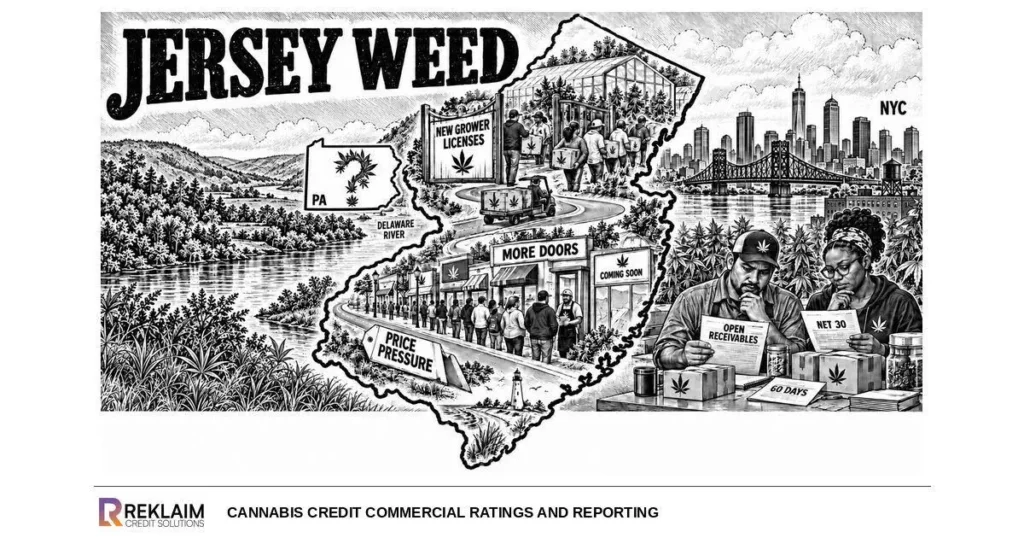
This article explores why the New Jersey cannabis market price held, what held it, and why 2026 is the year the paradox stops being one. Because it is stopping, on the state’s own numbers, and yes, the people who will feel it first are the ones shipping product on terms.
The Paradox, Part One – Why Did New Jersey Cannabis Demand Stay Strong Despite High Prices?
New Jersey has about 9.5 million residents in the densest state in the country, with New York City on one edge and Philadelphia on the other. Voters approved adult use in November 2020, the governor signed the law in February 2021, and sales began on April 21, 2022, seventeen months after the vote.
New York took 21 months from its law to its first store and let a gray market fill the gap. New Jersey filled the gap with its medical dispensaries, which in this state are called Alternative Treatment Centers, apparently a name chosen when the goal was to make a dispensary sound like a physical therapy practice.
Twelve only, belonging to seven companies, every one a multistate operator. On the first day they did nearly $1.9 million across 12,438 customers, about $158,000 a door. Twelve doors, seven owners, nine million people. That’s easy math, and I’d argue it set the price expectation for the next three years.
The customer never let up.
Lit Alerts, which estimates sales from menu inventory, put New Jersey’s 4/20 weekend in 2025 at about $14.8 million against New York’s $12.2 million, with a population less than half of New York’s.
Its note, as quoted by Heady NJ: “NJ has a fraction of the illicit market issues that NY does.”
Stockton University polled 660 New Jersey adults in April 2023, one year in, 213 of whom had used cannabis since legalization. 69% of the users had bought from a licensed dispensary. Among the 30% who had bought from a dealer, the main reason cited, in Stockton’s summary, was that no legal dispensary operated nearby; 18% said dispensary prices or taxes were too high.
The customer told a pollster that the bigger problem with the legal market was the drive, not the price. In a state this small, that’s a market begging for more doors.
It would get them…later.
The Paradox, Part Two – Why Are New Jersey Cannabis Taxes So Low?
New Jersey’s adult-use law did something no other state in this series did. It declined to invent a separate state cannabis tax at the register, the kind that in the other states we’ve covered kept the dealer in business and squeezed the supplier.
Adult-use cannabis pays the general sales tax, 6.625%, the lawn mower rate. Towns may add up to 2% on a retailer’s receipts, and Hoboken does, which takes the $100 bag to $108.63, or $108.76 if the sales tax is figured on top of the local tax; I couldn’t find written guidance from the Division of Taxation settling which.
Medical cannabis has paid no state sales tax since July 1, 2022. A patient pays $100.00 for the same $100 bag, or $102.00 in Hoboken, which taxes medical too.
Put the receipts next to the other seven states. Chicago stacks to about 41.5% on flower above 35% THC. Colorado charges 15% at the register plus local, with another 15% excise upstream. California is 15% plus sales tax plus whatever the city wants. Oregon runs 17% plus up to 3% local. Massachusetts, the cheapest eighth in the East on Headset’s table, runs up to 20%.
New York charges 13%. Missouri, which I called the lightest state tax in the series last time, comes to about 17.5% in Columbia, where local sales taxes and the city’s own cannabis levy sit at the state’s 6%.
New Jersey taxes weed like a lawn mower and sneakers like nothing at all.
The state’s one cannabis-specific levy is on the grower’s invoice, not the customer’s. The Social Equity Excise Fee is charged per ounce when a grower sells or transfers flower: $2.50 an ounce this year, about 31 cents on an eighth, held at $2.50 for two years running. Prior Governor Murphy’s last budget proposed $15. It didn’t happen. This fall, as it did last fall, the Commission moved to extend its own deadline for setting next year’s rate, which is how Trenton says “no” when it would rather not be seen saying it.
The state also decoupled from Section 280E for its own income tax beginning with the 2023 tax year.
A New Jersey licensee deducts rent and payroll on the state return even while the federal return disallows them on adult-use sales (April’s federal rescheduling took state-licensed medical sales out from under 280E; adult-use is still Schedule I), so the government with the lightest checkout is also the one that lets you deduct your expenses.
Well played, NJ.
The money it does collect is modest: about $67.5 million of sales tax on roughly $1.16 billion of combined adult-use and medical sales in 2025, and $15.4 million of SEEF collected from launch through the third quarter of 2025.
As of March 2025, nearly three years in, not a dollar of SEEF had been disbursed, because the law requires the legislature to appropriate it and the legislature hadn’t gotten around to it. By March 2026, the Commission reported $11.9 million finally out the door. Missouri can’t spend all that it collects. New Jersey needed three years to start.
So: a customer who shows up, a tax that barely does, and a $29.68 eighth, Headset’s October register average, that sells. Something was holding the price up, and it wasn’t Trenton.
What Kept New Jersey Cannabis Prices So High?
Headset’s September state pages, the ones I used for Missouri: New York $33.63, New Jersey $29.69, Illinois $25.99, Missouri $24.93, California $21.28, Massachusetts $17.68, Colorado $15.14, Michigan $14.32, Oregon $12.74. Headset’s own gloss: “State lines move cannabis prices more than any other variable.” It attributes the spread mainly to supply and licensing. New Jersey, with the lowest tax on the list and the second-highest eighth, is the exhibit.
The menus say the same thing, louder. Trees N Clouds, a tech-heavy data-rich service which tracks public dispensary menus across the country, pulled New Jersey menus for this article, with the latest snapshot dated November 10.
On listed prices, among states with at least 50 stores in a category, New Jersey ranked first of 29 for flower and vapes, second for concentrates and infused pre-rolls, third for pre-rolls. The listed eighth was $47.13 against $32.41 in the median state, $38.91 in New York, $30.37 in Pennsylvania’s medical program and about $22.50 in Colorado and Michigan. Pack size doesn’t explain it; that comparison is eighths against eighths. The one major category where New Jersey looks like everyone else is edibles, listed 8% above the median and tenth of 28. Whatever is holding the price up, it’s holding up what people smoke and vape, not what they eat.
Put the listed eighth next to the register eighth and you get, at minimum, a hypothesis about the customer.
The menu says $47.13. Headset’s register-based estimate says $29.68. The menu average weighs a $65 top-shelf listing the same as a $25 one, and stale listings stay on the menu; the register weighs them by what sells. A gap that wide suggests the New Jersey customer is buying from the cheaper end of the menu, which is also what the units-up, price-down pattern in Headset’s October numbers says. The discount tags don’t appear to close it.
Patrick Gorell of Trees N Clouds, in the research he sent over: “NJ dispensaries put sale tags on more of their menu than almost any other state, yet the average price paid is only 2 to 4% below list.” Paid, in his data, means the posted sale price where there is one.
About one in thirteen New Jersey flower listings carries a sale price, against one in two hundred in the median state, and the depth is ordinary, about 28% off. Lots of tags, small savings, and, if the register is right, the customer walks past most of them to the value shelf.
The original state structure set the price. The twelve launch-day doors belonged to the medical operators, and so did the growers that supplied them. A new entrant could apply for a retail license in 2022, but the licenses that let anyone other than a vertically integrated incumbent move product, Class 3 wholesale, Class 4 distribution and Class 6 delivery, didn’t open for applications until September 27, 2023, seventeen months after the first sale.
For a year and a half there was no licensed middle: a grower could sell to a store directly, but nobody could make a business of moving product between them. Among the incumbents the grower, the wholesaler and the store were usually the same company, and they still argued about terms.
Cultivation came in behind that. The Commission counted 46 cultivators licensed to operate in December 2025. On October 30 of this year it counted 105, with 110 manufacturers. The count of growers licensed to operate more than doubled in ten months, four and a half years into adult use.
For most of the program’s life a short list of growers, the medical incumbents and a handful of early entrants, supplied the whole state, and the price reflected it, which is what any supplier’s price would do in that position. We’ve seen in six other states what happens when more cultivation comes online.
The best illustration is from July 2023. With about 35 adult-use dispensaries open in a state of nine million, by Curaleaf’s count, the company cut 49 jobs at its Winslow cultivation site and said it had “ample supply” for the market as it stood. Its chief executive, Matt Darin, said 35 stores were “insufficient to meet the needs for a state this size.” NORML’s Chris Goldstein answered for the customer: “You don’t need an economics degree to understand that you’re not getting a good deal in New Jersey.” The Commission’s spokeswoman said the market was “growing substantially.”
Oddly, all three were right. Curaleaf had more flower than 35 doors needed, the customer was paying $13 a gram, and the market was growing. That’s a bottleneck, and the people on the supply side of a bottleneck set the price. The paradox wasn’t that New Jersey’s customers tolerated high prices. It was that for the first three years the license structure let very few others try to serve them.
The Paradox Resolved – How is the New Jersey Cannabis Market Performing in 2026?
The Commission’s certified sales, the ones that come from Treasury returns, say this. Adult-use sales were $329.5 million from the April 2022 launch through December, $681.2 million in 2023, $1.000 billion in 2024 and $1.118 billion in 2025. Growth went from 107%, off a partial first year, to 47% to 12%. The first half of 2026 came in at $540.2 million, 1.4% ahead of the first half of 2025. The second quarter was up 0.6%.
Round the growth rate to one decimal and it still rounds to standing still. Even I can do that math.
Medical is doing what medical did in Missouri, with a bigger tax reason to stay.
Medical sales were $226 million in 2022 and $46 million in 2025, and the first half of 2026 was down 66%. The patient count was nearly 130,000 in June 2022, 52,877 at the end of 2025 by the Commission’s year-end count, and 42,191 on October 15. Medical cannabis in New Jersey pays no state sales tax at all, and patients are still leaving; 6.625% is apparently less trouble than the doctor. Put the two programs together and total legal sales in the first half of 2026 were down 2.1% on the year before.
But hang on. The regulator also publishes a second set of numbers, monthly, pulled from Metrc, the state’s seed-to-sale tracking system, which in New Jersey has become an optimist.
Metrc shows adult-use sales in June 2026 up 22.8% from June 2025 and September up 23.1%, to $117.5 million. The certified quarterly figure covering June says up 0.6%. The Commission labels the monthly series uncertified and warns that it moves when late reports arrive. I’m going with the certified figures, and I’d note that the state’s dashboard and the state’s ledger disagree, by a lot, on whether the market is growing. Every licensed plant has a tag. The invoice doesn’t. Whichever series is right, the gap is information: the regulator publishes two answers, and a lot of people quote the one they prefer. I prefer to show you both.
What isn’t in dispute is traffic, which only Metrc counts.
Combined transactions were 3.47 million in June 2026, up 26% from 2.75 million a year earlier, and adult-use flower fell from $8.33 a gram to $6.51 over the same twelve months, down 21.8%. The Commission’s flower series starts in July 2023 at $13.06 a gram. Nearly three years later, June 2026, it’s $6.51. Half.
Headset’s register data sides with the ledger. October 2026 sales were $100.0 million, down 0.5% from October 2025, with units up 11.8% and the average item down 11%, from $32.03 to $28.50. Flower dollars fell 3.7%. Pre-rolls rose 11.8%. Headset’s one line: “Pricing pressure is offsetting stronger unit demand.” By Headset’s October dollars, flower is about 42% of sales, vapes 26%, pre-rolls 17%, edibles 10% and concentrates 3%, which is near where Missouri sits.
More units, less paid for each one. We’ve seen this movie before.
Now the doors, which is where the paradox is being resolved.
New Jersey had 12 dispensaries on launch day, 20 at the end of 2022 and 38 open, medical and adult-use combined, in May 2023, when the first two recreational-only stores joined the medical incumbents. The Commission counted 272 retailers licensed to operate on December 24, 2025, 346 on July 14 of this year and 393 on October 30. That’s 44% more retailers in ten months, against certified sales that grew 1.4% in the first half. A note on the term: “licensed to operate” is a Commission status, not a ribbon-cutting. A store can carry it for months before it sells anything, usually while the town extracts its pound of flesh.
Behind the 393: 970 conditional retail awards, 286 of which have converted to annual licenses, and 183 direct annual awards, by the Commission’s late-October table. Only 211 of the state’s 564 municipalities allow any cannabis business at all, which is the main brake on the pipeline and the reason the pollster’s customer still might have a drive.
The Commission doesn’t publish a store-by-month sales series, so no public series will tell you what the average New Jersey dispensary did last year, and I’m not going to divide a full year of sales by a December store count and pretend the number is accurate. The direction is enough. The pie is flat and the number of forks is up by nearly half. At 393 licensed stores for about 9.5 million people, New Jersey is at roughly 4.1 per 100,000, a little above Missouri’s 3.5 and nowhere near Colorado’s roughly 11 or Oregon’s roughly 18. The eighth says New Jersey prices like a limited-license state. The pipeline says that won’t last.
Wholesale is where that shows up next. Cannabis Benchmarks started a New Jersey spot index in April 2025 and had it at $2,598 a pound that May. By December 19 the index was 11% above its 2025 year-to-date average. By June 5 of this year it was 17% below its 2026 year-to-date average.
LeafLink’s 2026 New Jersey snapshot, built on 2025 transactions, still called the state’s wholesale prices “well above the national average” and said meaningful compression hadn’t arrived yet, with competition “building.” Headset’s average retail gram across the twelve markets it tabulates is $8.09. New Jersey’s is $14.57.
Take a look at the order of events.
Retail flower fell by half over nearly three years while wholesale, by the one public index, was still above its average last December and below it by June. Missouri’s growers absorbed the price rationalization and its stores held their price. New Jersey ran the film backwards: the stores took the first cut, because the stores were the part of the market the state let multiply like rabbits. If the pattern holds, and it has in six states, the growers’ turn is coming, with 105 of them licensed and the harvest, by the Commission’s wet-weight count, down about 2.5% June to June.
Who Controls New Jersey Cannabis Stores and Shelf Space?
Here is where New Jersey splits from every state before it, and it’s the part that matters for anyone shipping on terms.
Lit Alerts estimated that in 2024 the state’s retail revenue was split roughly even between the multistate operators and independents. By April 2026 it had independents at 68.8% of estimated retail revenue. The doors have gone local, fast. Many of the 121 retailers added to the licensed-to-operate list between last Christmas and Halloween are, I’d wager, somebody’s first dispensary.
The shelf did not go with them. Lit Alerts’ July report had the ten largest multistate house brands at an estimated 28.8% of all New Jersey cannabis sales, and its September 2025 report had the top ten brands at more than 30% of units, with two New Jersey brand names and two out-of-state specialists the only names breaking in.
So most of the state’s retail revenue now rings up at independents; all but a few dozen of them opened since mid-2023, and a good share of what they sell was grown and packaged by the five companies that also run a handful of the stores that they competes with. The brands have the growth. The independents have the leases. Each needs the other, but only one of them extends credit.
The reciprocity question that sits under the Missouri shelf sits under New Jersey’s too, and this year part of it moved into a courtroom. In February, Ohio’s attorney general filed a civil complaint against nine multistate operators over how they buy from and stock each other, and New Jersey appears on the complaint’s list of states.
Several of the companies dispute it; others declined to comment; nothing in the complaint describes a New Jersey transaction; and I’m not going to try the case here. The part that matters for a New Jersey supplier isn’t in dispute.
In a market where the same companies grow, package and sell, a vertically integrated store tends to stock its own product first. This is what the structure is for, and ordinary own-brand placement breaks no rule, nor should it. It took CVS a long time to figure this out. Cannabis learned from that lesson.
New Jersey’s rule on the subject is narrower than people assume: a management or financing agreement with a store can’t include unreasonable purchase promises or guarantee a brand more than half of its shelf. To be fair, half is a lot of shelf.
The independents know which side of this they’re on.
Jessie Marie Villars of Baked by the River told the Commission in February: “The only cultivators on our shelf are independent New Jersey businesses whose practices we vetted ourselves.” That’s one store’s choice. The sales data say independent shelves, taken together, carry a mix, which is what you’d expect when the deepest and most consistent supply in the state still comes from the companies that have been growing here since the medical era, and 59 of the 105 joined the licensed-to-operate list just this year.
And the independents’ doors are already finding buyers at prices that say a door is worth something.
TerrAscend took control of Union Chill in Hunterdon County at the turn of the year for $13 million of announced consideration, a store it said was doing more than $11 million in annualized revenue, and in September it did the same with Aunt Mary’s, also in Hunterdon County, for $9 million against more than $10 million.
Call it around one times revenue for a single door, before adjustments, in horse country, from a buyer with a roughly 140,000-square-foot cultivation and processing facility in Boonton and exclusive New Jersey manufacturing and supply deals for Wana and Cookies. Strong move by a smart operator.
Then there’s the satellite law, which deserves a plain-English explanation because it changes what a store count means here. Until this year, a New Jersey retail license meant one address; only the old medical operators had been allowed extra dispensaries, under a 2019 carve-out. A law that took effect April 20 lets any Class 5 retailer run up to two satellite locations under the license it already holds, with the Commission’s sign-off and the usual local approval and site control.
The Commission treats a satellite as an amendment to the existing license rather than a new application, which in practice means months instead of the better part of a year, and the first approvals came through in July. Three doors per license, no new license required.
A second law, effective May 29, lets a medical dispensary add adult-use sales at its existing premises without going back to the town for a separate vote. The state built a market of independent doors, and this spring it gave eligible retailers and medical dispensaries the tools to add more of them.
What Cannabis Products and Brands Are Selling in New Jersey?
Let’s start with what’s in the child-proof (and usually adult-proof) bag.
By Headset’s October count, flower is $42.5 million of the state’s $100 million month and down 3.7% on the year; vapor pens are $25.8 million and up about 1%; edibles $10.4 million and down 12.4%; concentrates $3.2 million and up 26.9% off a small base; beverages half a million and up 16.7%, which is the hemp-drink question in miniature.
Pre-rolls are the category moving against the market: $17.2 million, up 11.8% in dollars and 30% in units, with the average pre-roll item down from $17.94 to $15.44 and the infused segment up 39% to $5 million. I’ve said this before: younger consumers want the ease of a pre-roll.
Hoodie’s estimates have pre-rolls at close to 18% of sales and the fastest-growing major category, though Hoodie’s own page doesn’t reconcile with itself in places, so I’ll take the direction and not the decimal. The New Jersey customer is buying more joints, cheaper, and more of them infused. That’s the Massachusetts pattern and the Missouri pattern, and it arrived here on schedule.
The shelf has already leaned into it. On Trees N Clouds’ November 10 count, pre-rolls are 22.8% of New Jersey menu lines against 14.3% nationally, tied with vapes as the second-biggest category behind flower, and among the states in its 50-store cohort only Washington lists more pre-roll lines per store. As more legal consumers arrive on their 21st birthdays, this is likely to continue to grow.
Concentrates and infused pre-rolls get about half the menu share they get nationally. New Jersey built a flower-and-joints menu, and flower and joints are what the New Jersey customer buys. Edibles, the category priced closest to the rest of the country, are also the one where the national brands show up most in the rankings.
Now who makes it?
Lit Alerts’ July report had the ten largest multistate house brands at an estimated 28.8% of all sales: Ozone and Simply Herb from Ascend, Rythm and Good Green from GTI, Legend and Kind Tree from TerrAscend, Select and Find. from Curaleaf, Savvy and (the) Essence from Verano.
Those are the companies that have been on New Jersey shelves since the medical era, several of these brands with them, and the ranking data say the customer still reaches for them. Headset’s October list of the state’s top brands opens with Rythm, and Select and Find. are on it; Hoodie has Rythm at or near the top of flower, vapes and concentrates. Consistency is a product in a young market, and the companies that have been growing here the longest have the most of it.
The other 71%, which includes the multistate operators’ smaller brands too, is where the market is getting interesting, and it splits two ways.
The first is the national brands, most of them recent arrivals. Every one of them is made in New Jersey, because federal and state law leaves no other way, either in a facility the brand licensed or manages or one it built: Wyld and Camino in edibles, Rove in vapes, Fernway, which Lit Alerts last September called the only outside brand to crack the vape top ten, Grön in edibles, Miss Grass and Lowell in pre-rolls, 710 Labs with their yummy terps in concentrates, Wana and Cookies through TerrAscend.
Three of the six names on Headset’s October top-brand list, Wyld, Rove and Camino, come from Oregon and California and are recent arrivals; Camino’s New Jersey production started in April 2024. The brand is now doing the work the shelf used to do.
The second is New Jersey’s own.
Garden Greens, a New Jersey-owned cultivator in Vineland, was ranked second in New Jersey flower by Headset early last year and sits fourth in pre-rolls on Hoodie’s October list. Lit Alerts named it and Pete’s Farmstand, a sister brand from the same family, as the two New Jersey names challenging the multistate brands in flower and pre-rolls, and Pete’s still holds a top-ten pre-roll rank at an average item price around $8. Hamilton Farms in Millville, Brute’s Roots in Egg Harbor Township and the Glass Meadows brands, PreRoll King of Jersey and Rosin King of Jersey, are smaller New Jersey-owned names. Grown Rogue’s West Deptford flower is local in soil and mostly Oregon in ownership.
The pattern across all of them is the same. New Jersey’s independents compete in flower and pre-rolls, where freshness and a short drive from the grow count, and show up far less in the vape and edible rankings, where a national brand and a manufacturing line count more.
Two notes for the credit side. The independents’ ranks move a lot. Headset’s brand pages estimate both Garden Greens’ and Pete’s Farmstand’s dollar sales well below a year ago as the national brands and the new grows arrive. That says nothing about the product and a lot about the shelf. And a national brand sold in New Jersey is made and sold here by somebody. Before you ship to or buy from one, find out which entity is on the invoice; the logo on the package and the name on the contract are often not the same company.
Why is it so Expensive to Open a New Jersey Dispensary?
The state license is cheap. A standard retailer pays $10,000 a year to the Commission; a microbusiness $1,000. The conditional license, New Jersey’s main on-ramp, can be awarded before the applicant controls a site or has a town’s approval. It’s a hunting license, but it doesn’t come with a deer.
That’s where the money tends to go. Only 211 of 564 municipalities allowed any cannabis business at the end of 2025. The ones that do set their own fees: Ocean Township’s (Ocean County) listed charges come to $12,500 for a retailer in the first year, Trenton’s to $20,000, and the escrow, planning board, host agreement and legal bills sit on top.
The Commission’s own estimate for its review is 12 to 26 weeks for an annual or conversion application. That clock doesn’t include the town, the landlord or the contractor, and in Hudson County it doesn’t include the town’s attorney costs either.
Hashstoria, on Broad Street in Newark, signed a lease at $23,333 a month and, according to court filings reported by Jersey Digs, stopped paying it in April 2023. By the time the store opened, it was 19 months behind. The eviction notice went up in June 2025, the arrears were put at nearly $500,000, the store closed in July, and two contractors have since claimed another $598,000 for the buildout. The operator didn’t respond to Jersey Digs or Heady NJ; it told TMZ it disputed the rent arrangement and planned to sue. A store that was, by the landlord’s account, 19 months behind before it rang its first sale. The contractors’ claims were unpaid when reported, and I wouldn’t hold my breath.
Dr. Alyza Brevard-Rodriguez of The Other Side in Jersey City told a public hearing she held her site for 30 months and paid $211,000 in rent waiting for approvals. She announced the store’s closing in January, blaming municipal inaction and what she counted as 60 dispensaries in a city of 300,000.
In March, she told a city hearing that a state grant had once brought the store back; by May, local reporting still had it closed. Those are her numbers, from the public record.
Haytham Elgawly of Xena, also Jersey City, said at the same hearing that he spent about $1.2 million to open, $750,000 of it his own, between local approval in September 2022 and the first sale in April 2025. The Medicine Woman, on Tonnelle Avenue, held its grand opening in April 2025 and was closed by January; the landlord alleged $63,597 in unpaid bills, the suit also alleged a $51,392 mechanic’s lien, and a court-supervised sale of the store’s assets was listed and marked sold.
The state’s answer to this is sized for the license, not for the lease. NJEDA announced $12 million for 48 equity awardees, $250,000 each, in 2023. Its current grant reimburses $75,000 of expenses already paid, which helps if you have the expenses and not the problem. Its $15 million NJ LEAF loan pilot is for cultivators, manufacturers and labs with a year of operations and fixed assets to pledge.
Retailers aren’t eligible.
Taken together: New Jersey made the license cheap but the local municipalities made the opening expensive, and the operators who made it through are independents, many of them thinly capitalized, who by Lit Alerts’ estimate, ring up about two-thirds of the state’s retail revenue. That’s the counterparty base. It’s the one Missouri doesn’t have and Colorado had too much of.
Where Is Financial Pressure Building in the New Jersey Cannabis Market?
The grows are where the balance sheets have been breaking, and the names are the ones everyone assumed were safe.
Ayr Wellness, which owned three New Jersey stores and a cultivation site, entered a restructuring agreement with its noteholders in July 2025. The noteholders won the company’s core assets, New Jersey included, with a credit bid at a public foreclosure sale in November. The Commission approved the ownership transfer on March 31, and on June 2 Ayr announced its New Jersey operations had moved to entities called Arboretum. In May, the Commission approved Ayr’s request to cut its cultivation authorization from Tier VI, which allows up to 150,000 square feet of flowering canopy, to Tier I, which allows 10,000. The minutes don’t say how much was ever planted. Up to 140,000 square feet of permission went away in one vote.
The Cannabist Company, the old Columbia Care, filed under the CCAA on March 24, Canada’s rough equivalent of Chapter 11 (with better manners, as long as you’re not at a hockey game). Its New Jersey business did $43.5 million in 2025, about 16% of the company. In July, Vireo Growth agreed to buy Cannabist assets in five states for up to $35 million, and the monitor’s reports put the New Jersey piece at $7,538,214, of which $4.0 million is cash and $3.5 million is a loan, for three stores in Vineland, Deptford and Mays Landing. That’s about 17 cents per dollar of 2025 New Jersey revenue. It’s a different kind of transaction from TerrAscend’s roughly one-times-revenue for a single Hunterdon County store, and the contrast tells you what a distressed seller gets.
Cannabist said it would close its two Vineland cultivation sites; the state’s layoff notice lists 86 jobs effective October 11, the extraction and packaging equipment went to auction in August, and the property securing about $15.9 million of loan balance went back to East West Bank by deed in lieu on September 21. A deed in lieu is what you sign when the bank would rather have the building than the conversation. As of the monitor’s September report, the New Jersey management agreement was still waiting on the Commission.
Vireo now appears in the fourth straight state of this series: Colorado out of a lender auction, Missouri at a negotiated multiple, New Jersey out of a Canadian insolvency. The same caution I gave in Colorado and Missouri applies here, with one addition. A buyer that acquires through an insolvency takes the stores and whichever liabilities the deal says it takes. Read the schedule before assuming your invoice came along. Hate the game, not the player.
Justice Grown, which runs the BLOC stores in Ewing, Waretown and Somerset and a grow in Ewing, saw its credit facility with Advanced Flower Capital mature in May without repayment. The lender’s second-quarter 10-Q, filed in August, carried $78.8 million of principal across the borrower group at a fair value of $42.0 million and said it was pursuing remedies; in August its management told investors foreclosure had begun. In July, the Commission renewed BLOC’s manufacturing license through 2027. Both things are true at once, which is the point. A license renewal is not a credit opinion.
Harmony Foundation, one of the original medical operators, had its adult-use cultivation and manufacturing awards vacated in June 2023 over about $700,000 in unpaid state fees, went through a court-appointed receiver and was sold to Illicit, the same Missouri company we met last time. Curaleaf’s 2023 cuts I’ve covered. Set against all of that: Grown Rogue, the Oregon craft grower, raised its stake in its New Jersey subsidiary to 70% in October, said it was “very pleased with how New Jersey is performing,” and is building toward about 16,000 square feet of flowering canopy, with construction expected to be done by year-end. TerrAscend is buying. The companies adding capacity are the ones that already own doors or genetics.
The ones leaving were carrying debt sized for a market that no longer exists, and the market didn’t send a notice.
How Serious Is the Cannabis Receivables Problem in New Jersey?
New Jersey has no cannabis-specific rule about payment between licensees that I could find: no cash-on-delivery requirement, no credit-term limit, no delinquent list. Your contract and the commercial code govern, which is to say you’re on your own. New York built a COD regime, Massachusetts enacted one in April that takes effect in 2028, and Illinois made a pattern of non-payment a potential license problem.
New Jersey has the model sitting in its own code: a liquor retailer who doesn’t pay a wholesaler within 30 days of delivery gets reported and, once the notices run, goes on cash with every wholesaler in the state until the bill is cleared, under N.J.A.C. 13:2-24.4. Miss a beer distributor’s invoice in this state and your taps go to cash within weeks of the deadline. Miss a cannabis grower’s and the conversation turns to product in trade in two. Net 30 in New Jersey cannabis is a term in your contract and nowhere else.
The industry asked for the liquor rule. At the Commission’s May 14 meeting, Max Jackson, vice chair of the New Jersey Cannabusiness Association’s cultivation committee, described one cultivator and manufacturer with “74 out of 115 accounts overdue” carrying “between $600,000 and $1.2 million in unpaid receivables,” a second licensee that “has been forced to go COD-only” and was losing accounts to competitors offering 60 and 90 days, and a third that “won a court judgment against non paying dispensaries and still couldn’t collect,” with legal fees that ran past the debt. He asked the Commission to “initiate rule making to establish a trade credit enforcement framework for cannabis licensees.” The minutes record the request, which is what minutes are for. No rule has followed it yet. I’m told, off the record and by people in a position to know, that the Commission is working on it. In New Jersey that counts as momentum.
The named accounts since then point the same way. Josh Krane, who runs New Jersey operations for Grown Rogue, told Heady NJ in October that his receivables run about a month of sales and that “there’s 30 to 40 we won’t sell to [because] they won’t pay.” On terms: “Some you give them net 30, and you’re chasing the money after 60 days.” Some buyers, he said, offer product in trade after 60 or 90 days. He charges late fees and is willing to waive them to get the principal. His summary is the one every supplier in this industry has made: “It’s my cash they’re making their profit with.”
Nate Green, co-founder of Sun Extractions in Hamilton, put the manufacturer’s version on LinkedIn in September: “Healthy revenue means very little if businesses throughout the supply chain cannot reliably collect it.” Order-to-cash in New Jersey is following the pattern we’ve seen across state lines. Receivables might look good on the balance sheet, but not so good on the bank statements.
And one suit, which I include for its size. Jerzey Grown, a licensed cultivator, sued a three-store dispensary chain, a related retailer and the chain’s out-of-state management company in Superior Court this year over an order delivered in January and due February 28. The amount is $2,081.76. Heady NJ, which reported the suit in April, quotes the complaint as saying the defendants “admitted the debt but refused payment citing historical liabilities.” The chain is one whose lender had disclosed, in public filings, a loan that matured unpaid in May.
Think about it. A $2,000 invoice went to court over a debt the lender’s filings would describe, for free, a few months later. Nobody files a $2,081 lawsuit for the money. You file it to make a point.
Ayr and Cannabist, two of the biggest names of the state’s medical era, spent 2026 in creditor processes: Ayr’s New Jersey operations changed hands in June, and Cannabist’s are waiting on the Commission. Cannabist’s monitor estimated about $38 million owed to vendors across the whole group before the filing, with no New Jersey breakdown. If you shipped to a Deptford store on terms in March, your invoice’s fate is being decided in a Canadian courtroom. The multistate name on the door was never the credit. The filings were.
Now set that against the other two-thirds of the market: independent stores, all but a few dozen of them opened since mid-2023, that paid rent for a year or two before the first sale and are about to watch their flower price keep falling as 105 grows come online. None of this makes either group a bad customer. It makes both groups customers whose circumstances changed faster than their terms did.
The label, multistate or independent, tells you where to look. It doesn’t tell you what you’ll find.
What Could Change the New Jersey Cannabis Market Next?
The hemp fence is nearly finished. The 2024 law lost its out-of-state provision to a federal judge in October 2024, and the Commission said it couldn’t enforce most of the rest. The replacement, signed January 12 and effective the next day, redefined hemp from April 13: any finished hemp product over 0.4 milligrams of total THC per container is cannabis; synthetic cannabinoids are out, online sales are out, and the civil penalties run at least $100, $1,000 and $10,000 for a first, second and third violation, with each day counting as a new one.
Liquor stores were originally given until November 13, 2026, to sell intoxicating hemp beverages. On November 12, Governor Sherrill signed legislation aligning New Jersey’s deadline with federal law. The state now defines the federal compliance date as December 11, 2026, or any later date on which the corresponding federal hemp restrictions take effect. For now, the gate stays propped open until at least December 11.
Once that compliance date arrives, a beverage over the limit is cannabis, made by Class 2 manufacturers and sold by Class 5 retailers, which is to say inside the state regulatory fence. The Department of Health told local health officers in August that THC food and drink in a grocery store is adulterated food, and reminded them of their embargo and confiscation powers. Jersey City closed smoke shops in March 2025. East Orange shut eight this year.
Which means, once the gate closes, a potential customer won’t be able to try a legal THC drink at a bar, a restaurant or a club at all. The only lawful place to buy one will be a dispensary.
How much walks through the dispensary door I’d again guess small. By the accounts I’ve seen, Lit Alerts’ among them, New Jersey’s illegal market was already a fraction of New York’s.
The border, as far as anyone can tell, runs mostly one way, in.
New York’s eighth is $4 dearer, though New York lets adults grow at home, which New Jersey does not, for patients or anyone else. Delaware opened adult-use stores on August 1, 2025. Pennsylvania still runs a medical only program, but on November 3 its voters elected a Democratic state Senate majority, 26 to 24, that takes office in January, giving the party that passed a legalization bill through the House in 2025 the governor’s office and both chambers for the first time since 1993. Cannabis Business Times is already calling Pennsylvania the 25th adult-use state in 2027. The Democrats’ own incoming Senate leadership has been quoted saying it isn’t at the top of the list.
But legal in 2027 is not stores in 2027. New Jersey needed 17 months from the vote to the first sale with twelve medical doors ready to go, and Pennsylvania’s medical operators will want the same head start. If the optimists are right, call it 2028 or 2029 before the Pennsylvania plates thin out in South Jersey lots, and call it now for operators on both sides to start pricing that in. The South Jersey stores facing Philadelphia, Bellmawr and Deptford among them, have the most to think about.
The politics are quiet. Governor Sherrill took office in January and, by Heady NJ’s count this week, has not spoken publicly about the cannabis market or home grow. The Commission’s 2027 excise decision is deferred. The satellite and co-location laws passed quietly. The hemp timing bill got signed the day before the old deadline. A state that spent 2022 to 2025 arguing about towns and taxes has gone quiet at exactly the moment its wholesale market is about to find out how much canopy 105 licenses hold.
Will More New Jersey Cannabis Cultivators Push Wholesale Prices Lower?
Supply is definitely something to watch.
The Commission counted 46 growers licensed to operate last Christmas and 105 at Halloween, with 110 manufacturers behind them. Its wet-harvest count was down about 2.5% June to June. Nobody publishes how much of the canopy those licenses allow is planted, and the Cannabis Benchmarks index turned down in June.
The menus haven’t noticed: Trees N Clouds’ snapshots from October 31 to November 10 show New Jersey list prices up about 3% across most categories, in step with the national drift, which it reads as holding, not easing. The price rationalization is in the wholesale index and at the register. It hasn’t reached the price tag, at least not in those ten days. Colorado, Oregon and California each saw wholesale fall by more than half as supply caught up with demand. New Jersey’s supply, by license count, is just starting to.
Which Parts of the New Jersey Cannabis Market Are Likely to Hold?
The register take is law, not constitution, but it’s the general sales tax rate, and a legislature that wants more from cannabis has to invent a new tax, raise the rate on lawn mowers, or lean on the one lever it already has, the excise fee on growers, which the last governor tried to take from $2.50 to $15 and got nowhere. I’d call the light tax load-bearing for now.
The eighth isn’t. It’s what the bottleneck produced, and the bottleneck is coming apart at both ends: 393 licensed doors and 105 licensed grows, with 970 conditional retail awards and a wholesale index that turned down in June.
The customer holds.
That’s the one thing the paradox proved for certain. More than nine million people, no home grow, no self-serve gas, and a pollster’s finding that the first complaint was the drive.
The independents’ two-thirds share holds until the satellite law and the acquirers’ appetite say otherwise. Two deals in nine months at around one times revenue is the kind of price that gets an independent to pick up the phone.
And the border holds until Harrisburg moves. On November 3 Pennsylvania’s voters moved it, or at least elected the people who might. Stores are years out, but the clock on the South Jersey border is running.
What Can New Jersey Cannabis Operators Control Now?
A New Jersey receivable is governed by your contract, the commercial code and a courthouse. Claims up to $5,000 go to Small Claims, up to $20,000 to the Special Civil Part, larger ones to the Civil Division, and the Judiciary’s own guidance tells you that a judgment is not a payment, which Max Jackson can confirm.
The name on the door is not the credit. Ayr, Cannabist and Justice Grown were all multistate operators with public filings, and the filings were public well before the stores changed hands. Ayr’s restructuring agreement was public in July 2025. Cannabist’s filing was March 24. AFC disclosed the Justice Grown maturity in a 10-Q. If a customer has a lender that reports to the SEC, read what the lender says. It’s free, and it’s more candid than the sales rep.
For the independents, ask three questions you wouldn’t ask in Missouri. How long has the store been open. Who owns the building. How many months of rent went out before the first sale. Hashstoria’s answers to all three surfaced in a landlord’s court filing after it was too late to matter.
Count doors by owner. A satellite sits on the same license as the main store, so ask whether it also sits on the same balance sheet. TerrAscend’s fifth door reports up to TerrAscend. Vireo’s three will be Vireo once the Commission says so, and whether your Cannabist invoice came along is written in the purchase agreement, not on the sign.
A price demand is a credit event here as in Missouri. A buyer asking for 60 or 90 days because somebody else offers 60 or 90 days is telling you about the market’s cash, not just his own.
AR aging still catches the slowdown before the headline does, and in New Jersey the state publishes two headlines.
Again, this is one of the reasons we built Reklaim Credit Solutions. No supplier, on its own, can see how a customer is paying everyone else, and few have the time to check whether it has liens, judgments or tax filings against it, or a compliance problem with the state. By combining de-identified AR aging data from across the industry and supplementing it with public records, we can see how that customer is paying the suppliers across the network, and every operator that contributes helps itself by widening the picture.
That allows us to provide independent commercial credit scores, suggested credit limits, credit reports and, equally important, continuous portfolio risk monitoring based on what is happening across the market, not just what one customer is doing with one supplier.
In a state where two-thirds of retail revenue rings up at independents, most of them new, and the biggest names just went through creditor processes, the network is where the fullest picture exists.
Is there a viable path?
New Jersey has the pieces. Nine million people, the lightest checkout in this series, a regulator that opened the gates, an illegal market smaller than New York’s by the accounts available, and a customer who, by a 2023 Stockton poll, mostly buys from the licensed store.
It also has a billion-dollar adult-use market whose growth has slowed to about 1%, a medical program that lost two-thirds of its patients, a flower price that halved in three years, a retail tier that added 44% more licensed doors in ten months, and a cultivation tier that just doubled its license count and hasn’t shown up in the harvest yet.
Oh, and Harrisburg flipped.
The paradox was never about the customer. It was about who was allowed to sell to him.
New Jersey’s grows stayed in a few hands for three years while the doors multiplied, and the state is now releasing new growers into a market whose stores have already given up half their flower price.
The price rationalization that took Massachusetts years is very likely going to run through New Jersey’s wholesale tier on a shorter clock, and the companies carrying the receivables when it does are the ones who shipped to 121 new doors on Net 30 or Net 60.
In New Jersey the state takes less of the $100 than anywhere we’ve looked, and the customer still pays more. For now, most of the difference appears to go to whoever owns the grow.
The grower count just doubled. Watch where the difference goes next.
Sources
New Jersey Cannabis Regulatory Commission (NJ-CRC): Cannabis Sales Totals through Q2 2026 (certified quarterly medical and adult-use sales, 2022 to 2026); Data Benchmark, December 24, 2025 (397 businesses licensed to operate: 46 cultivators, 62 manufacturers, 4 wholesalers, 2 distributors, 272 retailers, 3 delivery, 8 laboratories); public meeting slides, July 16, 2026 (Metrc June 2026 flower price per gram, transactions, product mix, 346 adult-use retailers licensed to operate July 14, wet harvest) and October 29, 2026 (September 2026 Metrc adult-use sales; 644 entities licensed to operate as of October 30, including 393 retailers, 105 cultivators and 110 manufacturers; license pipeline as of October 21; 42,191 registered patients as of October 15; SEEF deadline extension); Reports and statistics page, license table as of October 29, 2026 (970 retail conditional awards, 286 conversions, 183 annual awards); public meeting minutes, May 14, 2026 (Max Jackson public comment; Ayr Wellness canopy reduction from Tier VI to Tier I) and February 12, 2026 (Jessie Marie Villars); July 18, 2024 and August 7, 2025 slides (flower price history from July 2023); “2025 in Review,” posted February 5, 2026 (211 municipalities, 52,877 patients, sales tax and SEEF collections); news releases of April 27, 2022 (launch day sales), May 19, 2023 (38 dispensaries open) and September 7, 2023 (wholesale, distribution and delivery applications opening September 27, 2023); Resolution 2025-12-17-02 (2026 SEEF held at $2.50) and Resolution 2024-298 (2025 SEEF); 2026 Recommendations to the Legislature for Social Equity Investment, April 23, 2026 ($11.924 million disbursed as of March 2026); satellite retail approvals of July 16, 2026 (NJ Leaf, Jamesburg) and N.J.S.A. 24:6I-42h; Month to Month Patient Numbers (51,776 on December 15, 2025); Report on Adult-Use Cannabis 2022-2023; 2024 Annual Report; N.J.A.C. 17:30 (shelf-space limits in management and financial-source agreements at 17:30-6.9 and 6.10; enforcement framework at 17:30-20); fee schedule effective November 20, 2024 (documents/businesses)
New Jersey Division of Taxation: New Jersey Sales Tax Guide (S&U-4), exempt clothing and footwear list; ANJ-30, Cannabis and Intoxicating Hemp Products Sales (6.625% rate on adult-use cannabis; medical exemption from July 1, 2022; local transfer tax; SEEF); Social Equity Excise Fee page (annual rates 2022 to 2026); P.L. 2021, c.16 (CREAMM Act); P.L. 2021, c.118 (medical cannabis tax); N.J.S.A. 40:48I-1 (optional local cannabis transfer tax); City of Hoboken Code, cannabis transfer tax (2% retailer, 2% medical, 1% wholesaler); P.L. 2023, c.50 (state decoupling from Section 280E); Governor Murphy FY2026 budget proposal as reported by Cannabis Business Times, March 5, 2025; Drug Enforcement Administration final rule, 91 Fed. Reg. 22714, April 28, 2026 (state-licensed medical cannabis placed in Schedule III); Missouri Department of Revenue rate tables for Columbia, 2026
Headset: New Jersey market page, October 2026 data (eighth $29.68, gram $14.57, sales, units, average item price, category sales and year-over-year changes, pre-roll and infused pre-roll detail, top brands list) and September 2026 data (eighth $29.69) as retrieved for the Missouri article; state market pages for New York, Illinois, Missouri, California, Massachusetts, Colorado, Michigan and Oregon, September 2026; “Cannabis Prices in 2026: Average Prices by Category and State,” October 2026; “The NJ Cannabis Paradox,” February 17, 2026; 420 analysis, April 2025; sampling and methodology notes; Headset brand pages for Garden Greens (March 2025 and October 2026 snapshots) and Pete’s Farmstand (March 2025 and September 2026 snapshots)
Lit Alerts (Rick Bashkoff): “Independent Retailers Continue to Shape New Jersey’s Cannabis Market,” May 27, 2026 (68.8% independent share of estimated April 2026 retail revenue; roughly even split in 2024); “MSO Brands Continue Their Dominance in NJ,” July 8, 2026 (top ten MSO brands at 28.8% of sales: Ozone, Rythm, Legend, Select, Savvy, Kind Tree, Simply Herb, Find!, Good Green, (the) Essence); “MSO brands continue to hold strong in NJ,” September 15, 2025 (top ten brands above 30% of units; Garden Greens, Pete’s Farmstand, Fernway, Grön); 4/20 weekend 2025 estimates as reported by Heady NJ, April 23, 2025
Trees N Clouds (Patrick Gorell), New Jersey research pack: prices and product mix, prepared November 14, 2026, from Trees.Cloud public dispensary menu listings, snapshots of October 31, November 5, 7 and 10, 2026 (listed prices by category versus the median state and neighbors; eighth list price by state; sale-tag share, discount depth and list-to-paid gap; product mix by menu line; ten-day price trend). Menu listings, not transactions; “median state” is the median of states plus DC with 50 or more stores in the category. Cannabis Benchmarks, U.S. Cannabis Spot Index, May 2, 2025, December 19, 2025 and June 5, 2026 (New Jersey wholesale index); LeafLink, New Jersey Pricing Snapshot 2026 (2025 transactions) and 2026 Wholesale Cannabis Pricing Guide
Stockton University Hughes Center for Public Policy, cannabis poll, fieldwork April 1 to 14, 2023, released April 25, 2023 (660 adults, 213 cannabis users since legalization; 69% licensed dispensary purchase, 30% unlicensed sellers, 27% online or out of state; reasons for not buying from a licensed dispensary, per the release and the full-results questionnaire)
New Jersey Monitor, “Cannabis company cites ‘ample supply’ of weed in N.J., but critics wonder where it is,” July 24, 2023 (Curaleaf Winslow layoffs, Matt Darin, Chris Goldstein, Commission spokeswoman); MJBizDaily and Cannabis Business Times, Curaleaf layoffs and Bellmawr phase-out, March and July 2023; MJBizDaily, “New Jersey revokes marijuana licenses over unpaid fees,” June 5, 2023 (Harmony Foundation); NJ-CRC memorandum recommending approval of the Harmony ownership transfer to Illicit Cannabis New Jersey LLC, February 15, 2024 (subsidiary of Illicit Gardens, Missouri operations); Secaucus Investors v. Harmony Foundation (App. Div. 2024) and Lowenstein Sandler v. Harmony Foundation (App. Div. 2026)
Ganjapreneur, “Medical Cannabis Patient Counts Down Significantly in New Jersey,” December 29, 2025, citing NJ-CRC data reported by the New Jersey Monitor (nearly 130,000 patients in June 2022; 51,776 in mid-December 2025)
State of Ohio v. Ascend Wellness Holdings, Inc. et al., complaint filed February 5, 2026 (paragraphs 55 to 62, including the “Trade Balances” allegation at paragraph 58, the state list at paragraph 59, the GTI and Ascend 25% Ohio allocation at paragraph 61, and the Ayr “balance-of-trade” email at paragraph 112), via the Ohio Attorney General and the National Association of Attorneys General; MJBizDaily, February 6, 2026 (company responses); Heady NJ, March 2, 2026
TerrAscend Corp., Union Chill option closing announcement, December 30, 2025 (Form 8-K exhibit; acquisition and consolidation dated January 2, 2026 in the Form 10-Q for the quarter ended September 30, 2026, which reports total consideration of $13.290 million and $11.967 million for the two transactions) and closing of Aunt Mary’s transaction, September 16, 2026 (press release; $9 million consideration, more than $10 million annualized revenue, fifth New Jersey location); TerrAscend 2024 Form 10-K (Boonton facility, Wana and Cookies); Ascend Wellness Holdings 2025 Form 10-K (Franklin facility, Morristown headquarters); P.L. 2025, c.325 (satellite locations, effective April 20, 2026); P.L. 2026, c.13 (co-located medical and adult-use; hemp beverage transition originally to November 13, 2026); P.L. 2025, c.86 (medical dispensary satellites); S4635/A5604, signed November 12, 2026 as P.L. 2026, c.103 (hemp deadlines tied to the federal compliance date, no earlier than December 11, 2026)
Jersey Digs, “Wu-Tang Clan Rapper’s Dispensary Hashstoria Evicted in Newark,” July 16, 2025, and “More Trouble for Hashstoria: Contractors Claim Over $600K in Unpaid Work,” September 19, 2025; Heady NJ, Hashstoria closure, July 7, 2025; Cannabis Equipment News, The Other Side closure statement, January 29, 2026; Cannabis Cashier public hearing report (Brevard-Rodriguez and Elgawly), March 25, 2026; NJBIZ, “Cannabis dispensary co-owned by Ice-T closes in Jersey City,” January 8, 2026; Jersey Digs, The Medicine Woman lawsuit and closure, January 2026; AuctionAdvisors court-supervised sale listing; NJEDA, Cannabis Equity Grant awards ($12 million to 48 awardees, 2023), Cannabis Business Development Grant, and NJ LEAF product specifications, September 2025; NJ-CRC Garden Greens LLC Class 1 license record (Vineland); JointCommerce and Hoodie brand listings (Garden Greens, Pete’s Farmstand); Business Wire, Hamilton Farms releases, December 2023 and April 2024; Brute’s Roots and Hamilton Farms company pages and NJ-CRC permit records; Garden Society (Kiva manufacturing partner), New Jersey launch, April 2024
AYR Wellness: restructuring support agreement, July 30, 2025; Article 9 public auction result, November 11, 2025; closing of New Jersey operations transfer to Arboretum, June 2, 2026; NJ-CRC Resolution 2026-03-31-04 (ownership transfer approval); monitor’s report, July 8, 2026. The Cannabist Company: CCAA application record, March 24, 2026 ($43.5 million 2025 New Jersey revenue); Vireo Growth release, July 20, 2026; FTI Consulting, Fifth and Sixth Reports of the Monitor (New Jersey consideration of $7,538,214; East West Bank deed in lieu, September 21, 2026; management agreement pending through September 13); New Jersey 2026 WARN notice archive (86 Vineland workers, effective October 11, 2026); Cannabis Business Times, July 23, 2026; MJBizDaily, July 22, 2026; TMZ, July 18, 2025 (Hashstoria operator statement); Heritage Global Partners auction listing, August 2026. Advanced Flower Capital, Form 10-Q for the quarter ended June 30, 2026 (Justice Cannabis facility maturity; $78.8 million principal; $42.0 million fair value); Hayden Gateway LLC and Bloc Dispensary LLC v. Advanced Flower Capital Inc. (D.N.J. 2025); NJ-CRC, Bloc Dispensary LLC renewal, July 2026
Heady NJ (Dan Ulloa): “Overdue NJ Cannabis Invoices Hurting Many Legal Operators,” October 9, 2026 (Josh Krane, Grown Rogue; Todd Johnson); “Grown Rogue in West Deptford Cultivating Quality Cannabis Flower,” September 10, 2026; “Jerzey Grown Suing MSO Bloc Dispensary of Somerset, Others for Non-Payment,” April 30, 2026; “New Lt. Governor of New Jersey to Oversee Critical Cannabis Program,” November 9, 2026. Nate Green, Sun Extractions, LinkedIn post, September 4, 2026, and New Jersey Cannabis Chamber of Commerce post of the same date. Grown Rogue International, “Grown Rogue Increases Ownership Stake to 70% in New Jersey Subsidiary, ABCO Garden State,” October 20, 2026. New Jersey Division of Alcoholic Beverage Control, N.J.A.C. 13:2-24.4 (regulation of wholesaler credit), and New Jersey Credit Compliance Corporation retailer guidance. New Jersey Courts, Special Civil Part and collecting a judgment guidance
P.L. 2025, c.215 (intoxicating hemp, signed January 12, 2026; product definitions operative April 13, 2026); P.L. 2024, c.73 and Loki Brands LLC v. Platkin (D.N.J., October 10, 2024); NJ-CRC intoxicating hemp FAQ; New Jersey Department of Health guidance to local health departments, August 2026; City of Jersey City release, March 2025; City of East Orange release, August 2026; New York Office of Cannabis Management, home cultivation overview; State of Delaware, adult-use sales launch release, August 1, 2025; Vicente LLP, New Jersey 2026 regulatory summary; Pennsylvania November 3, 2026 election coverage: WHYY, PhillyVoice, Philadelphia Inquirer, Pennsylvania Capital-Star (Shapiro re-elected; Democrats win a 26-24 state Senate majority taking office in January 2027); abc27, November 14, 2026 (incoming Senate leadership on legalization priority), Cannabis Business Times, “Pennsylvania Flips Senate, Secures Cannabis Legalization Trifecta,” and Marijuana Moment, November 2026
Prior articles in this series for comparison figures: Missouri (Headset eighth $24.93; 222 dispensaries; checkout tax stack), Illinois (Chicago tax stack), Colorado, Massachusetts (gram price history; Chapter 65 of the Acts of 2026, credit and delinquent-list provisions effective January 1, 2028), New York, California and Oregon